Their families moved to Chennai from Hubei province and set-up dental clinics in the Evening Bazaar in the 1930s.

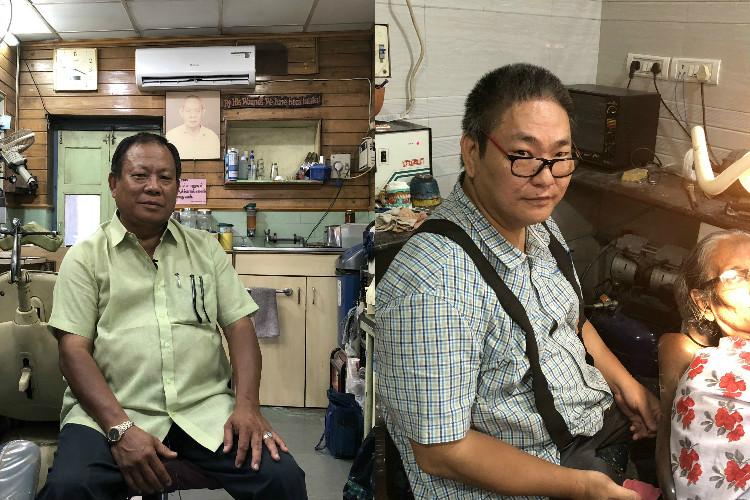
The glass doors of the tiny dental clinic swing open to green tiles, wooden panels, lots of dental instruments and neatly stacked bottles and medicine packs. Dr Shieh Hung Sen is inside, dressed in a green linen shirt, attending to a patient with practised deftness, while directing his assistant Nila in flawless Chennai Tamil.
Dr Shieh, who is better known by his Christian name Albert Shieh, is a second-generation Chennaite of Chinese origin. He runs Dr Shieh’s Bright Smile, a 75-year-old clinic, the oldest among the 8 such compact Chinese dental studios dotting the sides of Evening Bazaar Road, Park Town.
“My parents moved from Hubei province in China to Madas some time before the World War II. The Chinese communists were forcibly recruiting people to the army. It was either abscond or die. So my parents along with 8 other families left in the cover of the night to Burma, from where they came to Chennai in boats,” says Albert.
His father, Saw Ma Seng, among others who fled the country, were traditional Chinese dentists who established their business in Park Town in the 1930s. Now, their children and grandchildren are running the operations.
“Dental colleges started in the city only around the 1950s. Yet, our fathers had set up thriving businesses way back in the ’30s and we sons took over when they passed on,” says Albert, who went on to a acquire degree in dentistry from Annamalai University, after finishing his schooling in Bishop Corrie School, Parrys.
Growing up in Chennai
As he reminisces of the Chennai of his youth, Albert, who specialises in denture making, prods open his patient’s mouth and fixes a perfect set of lower front dentures on his gums.
“The best days of my life in Chennai were my school days. We used to play cricket in the Park Town grounds until late evenings. I spoke English and Tamil with my friends group and at home we spoke Mandarin (Hubei dialect),” smiles Albert, who can also read and write Tamil. Albert also understands Malayalam, Telugu and Hindi, and even attempts speaking them occasionally.
“Today is Tamil New Year. You must be celebrating Vishu since you are a Malayali, right?” he asks this reporter with a smile.
Now married with two children, a son and a daughter, Albert reveals that his family speaks Tamil, Chinese and English at home.
“I got married to my wife, Hu Yu Kwan, who is from one of the families in the community itself. However, now the community is not as close-knit as we were, with the older generation passing on,” he says.
In his childhood, the families would get together every Chinese New Year and feast.
“The Chinese New Year’s Eve is a special day for us and the entire community gathers for a feast, which is a grand affair with Wuhan (Hubei cuisine) delicacies of Changyu fish and Sou Chin (stir fry) Chicken. It’s nothing like what you get in the Chinese restaurants in the city,” says Albert, who shares an equal and impartial love for south Indian cuisine too.
“Ïdly, dosa, sambhar and all other dishes I relish. My wife makes the best rasam and kaara kolambu, I feel. In fact, my son’s friends used to ask him if his mum was Tamilian or Chinese after tasting the lunches she used to pack for his school,” he adds with a shy smile.
Albert’s son, Joshua, is a practicing dentist in Canada and, interestingly, is married to a Tamil woman.
“When I was a kid, my mother used to threaten me that if I married outside of the community she would disown me. When I got married, I had a traditional two-day Chinese wedding and a church wedding. Now, times have changed; my daughter-in-law is Tamil and we had a register marriage along with a reception here in Chennai,” says Albert.
The family members are practicing Seventh Day Adventists who had earlier adopted Roman Catholicism. Over the years, many from the community have diverged to different denominations within Christianity.
In the next clinic, David Ma, also known as You Chang Ma, Albert’s nephew, is a Jehovah’s Witness and runs Venfa, a clinic started by his father. Unlike Albert, David belongs to the third generation of the Chinese diaspora settled in the city.
“I don’t have many ties to Hubei. All my life I have known this city. My favourite food is the karuvattu kolambu or the dried fish that you get here. I’m married to an Indian girl, who is from Sikkim. In fact, I had an arranged marriage and went all the way to Sikkim to find my wife, since they look similar to us,” David says with a chuckle.
From Kung fu to Kollywood
Emphasising that they don’t watch Chinese films but for the occasional Jackie Chan Kung fu movie that is released in Chennai, Albert and David reveal that they enjoy Tamil cinema, especially the songs.
“I love old Tamil songs. There are some beautiful songs from Mudhal Mariyathai,” says David as he hums ‘Poongatre’ from the Sivaji Ganesan-starrer.
While David had no qualms about breaking into song, his uncle is more of a closet musician.
“He is usually singing all the time. He loves SPB and sings very well,” his assistant Nila tells TNM.
Albert is a fan of Suriya too and says he is excited about Kamal Haasan’s entry into politics. Apart from this, the dentist also boasts of a few famous friends from the industry.
“Prabhu, Sarathkumar and drummer Sivamani are all my close friends. I became close Prabhu and Sarathkumar as an athlete in school when we met at an inter-school sports competition. We meet once in a while when I am in town,” says Albert, who migrated to Canada with his wife a few months ago and shuttles between Chennai and Ontario.
The future
The Chinese clinics like Albert’s and David’s cater to the local population in Park Town.
“We have a thriving business and clients who have been consulting us and our fathers before us. They trust us and we have sort of established a brand here in Chennai,” says David.
Although many of their relatives have migrated to the US, Canada and other parts of the world, David and Albert remain rooted to the city.
“Although I keep going to Canada, I can’t let go of my business here and most of the year I’m in Chennai,” says Albert.
And despite this mass migration to several parts of the world, none of the Chinese in Chennai have returned to their home province of Hubei.
“I once visited China on a packaged tour with my wife. We couldn’t visit our native place as we couldn’t break away from the others.I have a few cousins there and I hope to visit them once in my lifetime,” says Albert.
However, Chennai remains in their hearts even as they search for better prospects elsewhere.
“I have never felt like an outsider. Chennai has and will always remain one of the most welcoming cities here. My sentiments for this city, in IPL language would be Namma Chennai-ku oru whistle podu,” David concludes with a grin.
Source…… https://www.thenewsminute.com
Natarajan





 Take off with Natarajan