The Hindi-Speaking Aussie who loves India …

Charles ‘Biharilal’ Thomson, is an Australian who speaks fluent Hindi learnt on the streets, trains and buses of India’s hinterland.
Biharilal tells Rediff.com‘s Archana Masih how India has bewitched him.


Photograph: Kind courtesy Charles Thomson/Facebook

Biharilal Thomson is a white Australian who speaks Hindi better than many Indians.

The first time he saw a non-white person was as a 10 year old. His mother had invited an Indian yogi from Bihar into their home in Australia and asked her son to share his room with the sadhu for a few weeks.

“I had only seen white Australians till then, not even native Aboriginals — and here was an Indian in a langoti in my room!” he exclaims in good humour, sitting in a film producer’s home in suburban Mumbai, wearing a kurta-pajama and a yellow stole.

In the two hour conversation, he only speaks Hindi, a language he learnt in the streets, trains and buses of Bihar where he had arrived at age 13 in December 1974.

He loved his new home on the banks of the Ganga so much that he did not return to Australia for the next 11 years. Accounts of his experiences in India’s rural underbelly in the 1970s-1980s, include encounters with dacoits on horseback on at least two railway journeys.

“I saw real sadhus, I saw real dacoits — and I thought I had reached an amazing place,” says Biharilal with a grin. His life experiences, he says are so unbelievable that he sometimes thinks it is like a film.

It also reveals an India of another time — one that was simpler, wilder, unfamiliar and distant from what it is today.

“India was friendly with the Soviet Union, and I came across Indians who were desperate to emigrate to the USA, Canada or UK — not to the USSR.”

“The other thing that was common was cycles. Only the DM (district magistrate) and SP (superintendent of police) had cars — and in the trains people sometimes travelled with their own cooks!”

After going back to Australia in 1985, he returned to formally work in India in 2011.

India has seen a giant leap ahead since, and he has spent nearly 16 years here, but one question posed to him that hasn’t changed over the years is — “Why did you come to India?”

“This is what I am routinely asked, especially by the youth. They ask ‘Why have you come here when we want to settle abroad?’,” says Biharilal, who applied for Indian citizenship in 2014 and hopes to hold an Indian passport soon.

“The other thing I am amazed with is this craze for English. Even if I speak to those who know Hindi in Hindi, they reply in English!”

“Why?”

His fluency in Hindi has fetched him invites to Hindi events by the Indian high commission in Australia, to symposia at Savitribai Phule Pune university and Delhi’s Hansraj College. He has anchored a few film festivals and done some acting roles.

It has also brought him an FM radio show that he hopes to receive a confirmation for by April.

“In independent India it will be the first time that an angrez will do a radio show in Hindi,” he says enthusiastically.

Not wanting to be boxed into roles of the typical gora speaking tooti-phooti Hindi, he refers to the accomplished actor Tom Alter.

“He is an asli Hindustani, I’m nakli, but because earlier directors made him speak broken Hindi like an angrez, people thought he was English.”

“People didn’t know he was Indian, a Padma Shri, who spoke fluent Hindi and Urdu.”

Biharilal works at Josh Talks, a media company that invites guests to share inspirational stories. His focus is on all regional languages and tier-2 cities.

He has also done a few acting roles in Hindi and Marathi television serials, and recently appeared in an airline commercial for Scoot, a budget airline owned by Singapore Airlines.

There are quirky benefits to a white man speaking Hindi too — like the number of wedding invitations he receives. Many wedding organisers in the Delhi area send him invitations only to have a foreigner on display!

“I get so many invitations for chief guest. In the marriage season, I’ll be booked,” he laughs.

“People want a gora who speaks Hindi to show at their weddings.”

The move from Australia to India may have been a continental shift, but for Charles ‘Biharilal’ Thompson, it was like coming home.

It was a life introduced to him by his mother, a ballerina and an early convert to yoga, who came to learn at the Bihar School of Yoga in Munger in 1972.

“At that time only 1% of the world travelled by aeroplane,” says Biharilal, who is often recognised as ‘Biharilal Autowale Babu’ after a show on Zee TV where he covered the 2017 Delhi municipal election in a colourful autorickshaw.

He also covered the UP assembly election last year for WION, Zee’s English news channel.

“We used to fly to the Gold Coast to visit my grandparents every year. I made my father promise that he would send me to India instead, if I stood 1st or 2nd in school.”

He stood 2nd and travelled to Calcutta, he says, taking a train to Jamalpur and then a bus to Munger.

“I was shocked to see the poverty in Calcutta, but hearing ‘garam chai‘ by tea vendors in the train was like music,” he remembers.

Eight weeks later, his father returned to take him home.

“I told him I wanted to stay for one more year,” he says over a cup of tea.

“But I stayed for 11.”

blob:https://ishare.rediff.com/d8239350-f845-46f6-86e1-762bd67d53b5

He has now spent 16 years in India — first at the Bihar School of Yoga in Munger, then working in a financial tech start up Eko India, and currently in the entertainment industry.

At the famed yoga school in Munger, he says he learnt yoga and managed the library. He helped in the institute’s office work which would take him to Patna and Delhi.

It was on one these travels that he found himself in the middle of a dacoity.

He had bought a third class ticket and boarded a train from Jamalpur to Patna in Bihar. The TT saw his ticket and upgraded him to first class. Along the way, dacoits came riding alongside the train, detached the first class compartment and started looting passengers.

When they reached his coupe, he held out his hands, and said, “Ruko, ruko! (stop, stop!)”

The dacoits stopped.

“I was a young boy and did not know very good Hindi at that time, so I just managed to ask a dacoit if he had any videshifriend?”

The dacoit said ‘No’ and Biharilal told him that he would be his friend.

“He smiled and did not take anything from me.”

Caught in another dacoity on a railway platform — this time on a dark railway platform surrounded by crop fields — his saffron clothes came to his rescue.

“When they came to me, I just sprang up and started chanting Bum, Bum Bole-Bum, Bum Bole and they said, ‘Yeh toh Ganga jal wala aadmi hai‘ and let me go,” he chuckles.

India was very different then, he says. Yoga institutes were very austere and drew only the most committed.

He remembers the first function he organised which had a generator as backup for electricity failure. When the lights went off and the generator was switched on — the crowd left the sammelan and rushed to get a first glimpse of a generator at the back.

At fifty-seven, Biharilal has seen the arc of India’s history from Indira Gandhi’s Emergency to her assassination to the post liberalisation. He has travelled widely, even taken his mother to the Kumbh Mela.

In between, he returned to Australia and ran a Thai vegetarian restaurant but kept coming back to India.

“I started coming back in the late 80s, but visas were very difficult. Till the Modi Sarkar came, getting a visa to India was not easy. Sushma Swaraj is doing a good job,” he says.

In 2009, a startup started by Biharis, Eko India, offered him a job and he moved to India.

But it was a chance encounter with an Indian student at a Sydney swimming pool that opened the door to acting.

Shashank Ketkar, now a popular television actor, had got talking to him by the pool hearing his Hindi and came to eat at his Thai restaurant.

Few years later, Biharilal would visit him on the sets of his show whenever he was in Mumbai. His kurta-pajama style of dressing and fluency in Hindi caught the eyes of the director and led to small roles. He also got to play an angrez in a Marathi film Shashank Ketkar was acting in.

“I went to Kohlapur and shot a scene where I was seated on a horse in 40 degrees heat. I loved it. I thought I had become Shah Rukh Khan!”

He has also acted in a Hindi suspense thriller that will release this year.

Every day, he receives a large number of messages on Facebook and makes it a point to at least say ‘Ram, Ram’ or ‘Namaste’ to them.

“I feel the whole of Hindustan is made for me. Yeh kamal ka desh hai, yaha aapko sab kuch mil jayega (this is a great country, there is nothing you can’t find here),” he says, adjusting the famous Australian Akubra hat he is wearing and steps into the hot Mumbai sun.

Archana Masih / Rediff.com

Source…..www.rediff.com

Natarajan

A Tribute to a Genius – Stephen Hawking…

Stephen Hawking, the world-renowned theoretical physicist and cosmologist, has passed away at the age of 76, leaving a scientific legacy behind him that will undoubtedly be remembered for many centuries to come.

Stephen Hawking

Hawking was born on January 8th, 1942 in Oxford, the United Kingdom to two Oxford University graduates, Frank and Isobel. He had two younger sisters, Philippa and Mary, as well as an adopted brother named Edward.

The family moved to St. Alban’s, Hertfordshire, where they were considered to be both highly intelligent and somewhat eccentric by the locals. They lived frugally in a large, messy house and got around in a converted London taxi cab.

Following his primary and secondary school education, Hawking began his university education as an undergraduate at University College, Oxford in 1959. He was just 17 years old. Although the world only pictures him as a man confined to a wheelchair due to debilitating motor neuron disease that he was diagnosed with aged just 22, Hawking actually gained a reputation as being something of a daredevil during his university years.

He was the coxswain of a rowing crew at the University College Boat Club, and became notorious for steering his crew on risky courses, inevitably leading to a string of damaged rowing boats. He left University College with a Bachelor of Arts in natural science in 1962 prior to starting to work on his doctorate.

Stephen Hawking

His diagnosis with a rare form of motor neuron disease occurred at that time, and it led to him becoming deeply depressed. Nevertheless, he was encouraged to continue his studies by his supervisor, Dennis William Sciama, and was eventually able to demonstrate that Einstein’s general theory of relativity implies space and time would have a beginning in the Big Bang and end in black holes.

During his graduate years at Cambridge, Hawking fell in love with his first wife, Jane Wilde, with whom he had three children. The marriage would end some 30 years later after the marriage succumbed to the pressures of Hawking’s fame, ideological differences and the difficulties surrounding caring for him in light of his disability.

Despite beginning to use crutches in the early 1960s, he long fought off having to use a wheelchair, but when he finally couldn’t do so any longer, he gained notoriety for wild driving on the streets of Cambridge. He also used to run over students’ toes intentionally and would even spin himself on the dancefloor at college parties.

Together with Roger Penrose, Hawking had his first major breakthrough in 1970. They were able to use mathematics to show that a singularity, a region of infinite curvature in space-time, was the point from which the big bang emanated.

Stephen Hawking

After he realized that he was wrong in his argument about black holes being able to radiate, Hawking was in a Cambridge pub with his students when he suddenly turned up his voice synthesizer to full volume and bellowed that he was conceding defeat. Anyone who studied under his tuition or knew him personally knew him for his wicked sense of humor.

Hawking was elected to the Royal Society in 1974 aged just 32 after the series of radical discoveries he made during his early career, and would become the Lucasian professor of mathematics at Cambridge. The latter is often thought as the UK’s most distinguished academic chair and was once held by Isaac Newton.

His 1988 book, A Brief History of Time, catapulted Hawking to international stardom. It sold over 10 million copies and was translated into no less than 40 different languages. It was around that time that his marriage would begin to break down, but he would go on to remarry in the mid-1990s.

During his lifetime, he won the Albert Einstein Award, the Wolf Prize, the Copley Medal and the Fundamental Physics Prize, however, the Nobel Prize for Physics eluded him. He also returned to the White House (he had also visited during the Clinton administration) to receive the Presidential Medal of Freedom from Barack Obama.

Stephen Hawking

His life has also been immortalized on screen, not least thanks to the multiple award-winning movie, the Theory of Everything. He also lent his voice and know-how to various documentaries over the years.

Perhaps it’s not surprising to know that Hawking was not a religious man, and dismissed the comforts of religious belief. With that being said, he had once told an interviewee that he wasn’t afraid of death, but he added that he wasn’t in any hurry to die due to how much work he had left to do. The great cosmologist is survived by his three children from his first marriage, together with his three grandchildren.

Watch Stephen Hawking being interviewed by Charlie Rose:

https://youtu.be/2f3WcIvTLYk

Source……..www.ba-ba mail.com

natarajan

Her Small Act Of Kindness Went Viral. Now, She Has A College Scholarship…!

Her Small Act Of Kindness Went Viral. Now, She Has A College Scholarship

A young restaurant worker in Texas who spent the past year saving up for college is now one step closer to her dream – all thanks to a small act of kindness she performed. Evoni Williams, 18, went viral earlier this month for helping an elderly customer at the Waffle House Texas eat his food. A picture of Evoni, an employee of the Waffle House, cutting up food for a customer who was unable to do so himself, was clicked by another customer and shared on Facebook. The picture went viral with thousands of shares and even earned Evoni a scholarship to the Texas Southern University.

The incident took place on March 3 at La Marque in Texas, USA, when Adrian Charpentier came into the restaurant. He had recently undergone surgery, which made it difficult for him to cut his food, reports the Daily Mail. Evoni cut up his food for him, and her small act of kindness was captured on camera:

I don’t know her name but I heard this elderly man tell her his hands don’t work too good. He was also on oxygen and struggling to breathe. 😔 Without hesitation, she took his plate and began cutting up his ham. This may seem small but to him, I’m sure it was huge. I’m thankful to have seen this act of kindness and caring at the start of my day while everything in this world seems so negative. If we could all be like this waitress & take time to offer a helping hand….🤝 #wafflehouse#kindness #givingback #offerlove #bekind #goodnews 

As the post gained attention, praise started pouring in for the teenager. “She’s an angel,” wrote one person. “That was very kind and sweet,” said another.

It eventually caught the eye of Texas Southern University, and they decided to present Evoni with a $16,000 scholarship. “Her act of kindness went viral on social media, and today Texas Southern University returned that act of kindness by surprising Evoni Williams with a scholarship,” they said.

Not only this, she was also honoured by the mayor of La Marque, Bobby Hocking.

It just came from the heart,” Evoni said to ABC 7 about her now-famous act.

Source….www.ndtv.com

Natarajan

Australians Rescued A Giant Spider. The Rest Of The World Wonders Why….?

AUSTRALIA:  For the past day, people around the world at least the ones who can get past a certain spider video without screaming “kill it with fire!” have been engaged in a rigorous debate about whether Andrea Gofton is one of the most compassionate Australians on her continent, or simply insane.

This month, her community has endured its worst flooding in almost a decade nearly 20 inches since March 1

Australians Rescued A Giant Spider. The Rest Of The World Wonders Why.

Homes and roads are flooded; students on a field trip to Echo Creek Adventure Park got more creek and more adventure than they were expecting; and towns have been declared a “disaster area.” Still, all things considered, the waterlogged population has escaped mostly unscathed.

At least the humans. It is a tough time to be an air-breathing animal in northeast Australia. Dens and burrows are flooded. Food sources are underwater and water-adept predators, particularly crocodiles, sharks and snakes, are riding newly-created waterways in search of unsuspecting prey.

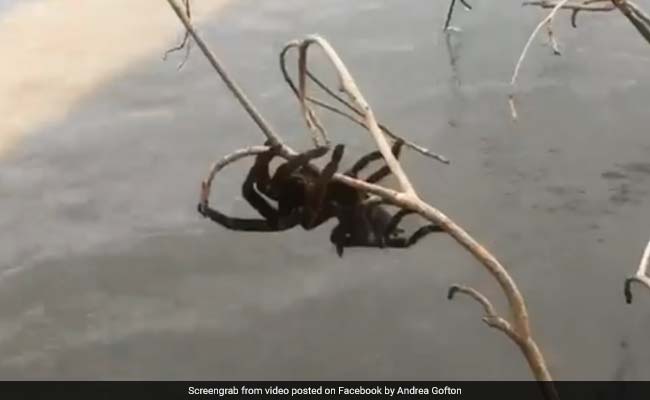
But Gofton’s ethical dilemma came in the form of a not-so-tiny spider found clinging precariously to a tree branch: A giant Australian tarantula called the bird-eating spider.

It is, of course, almost instinctual for humans to want to save animals, even when they don’t do a particularly good job of it.

But there are some things about the spider that Gofton encountered that people need to know before deciding to reject the offer from #TeamKillItWithFire.

It is huge: The spider can grow to be the size of a man’s hand, a two-inch body with six-inch legs. That is bigger than some chihuahuas.

It has giant, venomous fangs. The tarantula’s fangs are nearly half an inch long, about a sixth the size of its body. The Queensland Museum says the tarantulas “can be quite aggressive if mishandled” and that the bite is “quickly fatal to dogs and cats,” but rarely causes serious illness in humans.

It has a deadly, if inaccurate nickname.Scientists have pointed out that the name “bird-eating” spider is, technically, a misnomer. The giant Australian tarantula only occasionally eats birds. Instead, it feasts on lizards, frogs and other spiders, a correction that is not at all reassuring.

It is standing right behind you. Okay. That one is technically a lie, but not as much as you think.

It hisses. Although some have said it’s more of a bark. Either way, the sound is nature’s way of saying “Don’t save me from this raging river, Andrea.”

But some people don’t listen.

Gofton and her friend Andrew Giliberto encountered the arachnid outside a SPAR Supermarket in the town of Halifax. The creature’s legs were intertwined over a flimsy branch, which was the only thing stopping it from being swept away by the water below, according to 9News Australia.

One of the Aussies filmed, while another put a hand close to the spider, apparently to see if it would latch on. It didn’t. So they snapped the branch that it was on and carried it to a nearby avocado tree, where they set it free.

They’ve spent the subsequent 24 hours going back and forth with ardent supporters of spider-cide, arguing that their actions were heartwarming, not horrendous.

Clearly, critics argued, Gofton had not gotten the message that giant spiders are notour friends.

“Nope nope, just nope,” one woman wrote on a post about the spider-save on a community Facebook group about the floods. “The tree has gotta be burnt, with a flame thrower.”

A short time later, Gofton replied: “I’m glad there are decent people out there, the negativity about an animal is beyond ridiculous.”

Of course the spider is the one who’s having the last laugh (hiss? bark?). It’s now safely weathering out what remains of the storm in the avocado tree outside the neighborhood supermarket.

That means some unsuspecting shopper may be in for a surprise, especially if the rescued spider is female.

Another fun fact about the giant Australian tarantula: Females can lay 50 eggs at a time.

Source…….www.ndtv.com

Natarajan


The little girl from Mahabalipuram who is taking Indian skateboarding scene by storm…

Eight-year-old Kamali Moorthy, a child prodigy, is the only girl skateboarder and surfer in her hamlet in Tamil Nadu.


It was 3pm on a Friday. The air was hot and salty, and Fisherman Colony, a seaside village near Mahabalipuram in Tamil Nadu, was baking in the afternoon sun. Seemingly oblivious to the heat, a few children are skateboarding on a quirky new skating ramp set up in the street. Among them was an arresting sight – a small girl effortlessly navigating the concrete slopes of the ramp, setting herself apart from the rest.

With her short hair tied up and two front teeth still taking shape, 8-year-old Kamali Moorthy grins as she drops into the ramp from the granite coping and rolls down the slopes, as if she was born to do so. And this is indeed the common belief among many people, from tourists to the fisher folk, who adore Kamali, the only girl skateboarder and surfer in the hamlet.

“Was she born with a skateboard?” asks Steffano Beccari, an Italian sculptor as he watches Kamali on the ramp.

“Right? she makes it look so easy,” responds Aine Edwards, Kamali’s mentor and an Irish entrepreneur residing in Mahabalipuram.

For the skateboarding community in India, Kamali is a child prodigy. She is not a professional skateboarder yet, but she is already a part of the circuit and goes on tours with other skateboarders. How did this young girl from a fishing hamlet in coastal TN become the next big thing in Indian skateboarding?

Destined to meet

“Kamali was only 3 years old when she started skating on a slope built by Holystoked collective, which builds skating ramps free of cost across India,” Aine says, “Mahabs has always been a surfer’s town, and skateboarding is concrete surfing, so it goes hand-in-hand here.”

Velu, a well-known surfer and Kamali’s uncle’s friend taught her and her little brother, Harish, how to balance themselves on a skate board, she says. “He even gifted them two boards. Ever since those baby steps, Kamali has been on a roll, quite literally, teaching herself new tricks every day and skating to her heart’s content.”

However, it was when world-renowned skater Jamie Thomas visited Mahabs as part of a brand promotion event few years ago, that Kamali got her first big break.

“I was down the end of the street and one of my friends mentioned that there was a pro skate-boarder in town. Just then, Kamali came out in a white dress with a skate board in her hand and Jamie Thomas was by the beach. I went and asked him if I can introduce him to a little girl. The rest is history,” says Aine, adding that they were destined to meet.

For Aine, it was just surreal to watch Jamie and Kamali skateboard together.

“What was merely a chance encounter lasted 3 to 4 hours. Jamie changed all his plans and taught her new tricks,” Aine says, “And just like that, he took Kamali’s skills up by a few notches. It was magic.”

“I learned a lot of new tricks from Jamie which I have been practicing. He taught me to drop in from the big one (taller part of the ramp) and to skate through steeper slopes. Then he taught me this cool trick called rock to fakie which I’m not sure how to explain” Kamali chips in with excitement. A talkative child, who is not shy to speak up, Kamali has more than just the sporting talent, she has confidence.

Jamie even sent Kamali a skateboard, on which she has been practicing ever since. Every day, she takes her board and goes to the ramp opposite to her house to hone her skills. However, Kamali’s potential, Aine explains, is not limited to the ramps in her village.

“Last year, we took a bunch of kids, including Kamali, to Mangaluru where Holystoked set up a skate park. She skated non-stop. She dropped in from the top of the ramp which is twice as tall as the ramp she was used to back home. After she got back, she was dejected as she had to go back to the smaller ramp. It was like giving a kid a big candy and taking it back,” laughs Aine.

Skateboarder in the surfers’ family

Aine and Kamali were introduced to each other through a surfer friend who stayed in a homestay atop Kamali’s house. Kamali’s chirpy presence instantly drew everyone to her, and Aine too was charmed the moment they met.

“She was quite a character even then. A lot of fun to hang out with. We soon started going to the ocean to surf and she gradually picked up the art of riding the waves,” Aine recollects.

Unlike the other girls in the town, Kamali was born into a family of surfers and hence it came naturally to her, Aine explains.

“Surfing is in her blood. Kamali only started skating regularly during her school summer holidays, as there was no one to take her surfing. Now she can catch green waves and go sideways on her own, which is quite impressive,” says Aine.

“She has two skateboards and there’s a skating park conveniently located opposite to our house. She has been skateboarding almost every day since she was three. I sometimes think she uses her board more than her feet,” Kamali’s mother Suganthi says.


With the surf season beginning in March, Aine says that Kamali is excited to hit the waves again.

Skateboarding into the future

Living with her single mum, Suganthi, and grandparents, Kamali and her four-year-old brother Harish are the first-generation English medium school goers. So, they have to strike a balance between their formal education and sport. But with growing popularity, a lot of the residents around Mahabs want to send their kids to skate. And many of them even ask if Kamali can teach their children, explains Aine.

“The teachers in her school are very encouraging. Some of them wanted to get Kamali to teach skating to her classmates as part of the school’s extra-curricular activity,” says Aine.

“All said, this is still a conventional fishing village and the girls are brought up pretty traditionally. Many in this village don’t understand this culture of skating and surfing. For them it is something that has infiltrated from the West and they wonder what all the fuss is about?” says Aine.

Despite these challenges, Kamali, Harish and several other skater kids aim to shatter stereotypes and become mainstream skateboarders.

Aine and other surfing enthusiasts in Mahabs want to promote the sport in and around the village by setting up more and better ramps in the future. However, when asked about promoting skating through competitions, she remains sceptical, “She is too young to compete professionally. But besides this, skating much like surfing, is a soul sport. Although there are quite a few surfing contests, you do it not as a competition but for the love of the sport.”

Source ::::: Sreedevi Jayarajan in http://www.thenewsminute.com

natarajan


After Coimbatore’s Water Table Collapsed, This Simple Initiative Revived It…Thanks to ” Siruthuli “

As cities across India are facing a severe shortage of water, Coimbatore has been trying to preserve and recharge its groundwater levels. At the forefront of this change is Siruthuli, an NGO that is dedicated to cleaning Coimbatore, and infusing green methods throughout the city!

Coimbatore, which was once a place of abundant rainfall, was shaken to reality following a drought in 2003.

As part of its initiative to recharge groundwater levels in the city, Siruthuli has implemented rainwater harvesting structures (RWH).                                               

“In 2003, Coimbatore received 65% less rainfall than in previous years. This made us release the need to save water, and harvest it when there was adequate rainfall,” says Shruthi Suresh, a representative of the organisation.

The organisation conducted a series of geo-hydrological studies in 2005, to better analyse how to approach the conservation of groundwater in the region. In association with the Corporation of Coimbatore, Siruthuli began conducting rainwater harvesting structures in various locations across the city.

However, one of the significant challenges of the construction was the fact that Coimbatore was primarily a hard rock structure, and thus percolation of water was difficult. The organisation persevered and came up with the idea of drilling bore wells for groundwater.

“We came up with this technique to recharge the groundwater. We recommended two types of structures using this technique. The first simply recharges the aquifers, while the other not only recharges but also pumps the harvested waters so that it can be used,” she explains.

According to Shruthi, the structures are installed in both open spaces, as well as on roadsides.

Today, thanks to the efforts of this organisation, Coimbatore has more than 600 rainwater harvesting structures in different locations across the city.

However, on average it has been observed that the open spaces have seen a much higher level of maintenance than the ones on the roadside ones. There have been instances where some of the roadside RWH structures have been shut down for new roads and construction.

However, the organisation is optimistic and has seen significant growth in groundwater tables, from the time the wells have been implemented. This can be seen in the table below:

The water that is harvested from the ground is what is used extensively for not only daily use but as drinking water. It, therefore, becomes imperative for the citizens of the city, to maintain and use the water judiciously.

Today, even with a shortage of water, Coimbatore maintains stable and sustainable groundwater tables.

This initiative goes along with one of the organisation’s chief objectives, titled, “Water Watch,” under which, they aim to not only recharge groundwater, but also rejuvenate water bodies, and restore the River Noyyal. The river, which once had 34 streams, is now reduced to just four.

In the future, Siruthuli plans to conduct a comprehensive study of the entire region. This will be done to better understand natural drains, vegetation, groundwater levels, land use, and livelihoods. The study will form the basis for developing watershed concepts, RWH structures, and more. These will be applied across Coimbatore, after a series of awareness campaigns.

Siruthuli has also been involved in spreading the message of going green and educating the next generation for the same.

You can read about their initiatives here!

Source…..Anakha Arikara  in http://www.the better india .com

Natarajan


Seen the photos of Deer eating garbage in Chennai ? …Here is the story behind it …


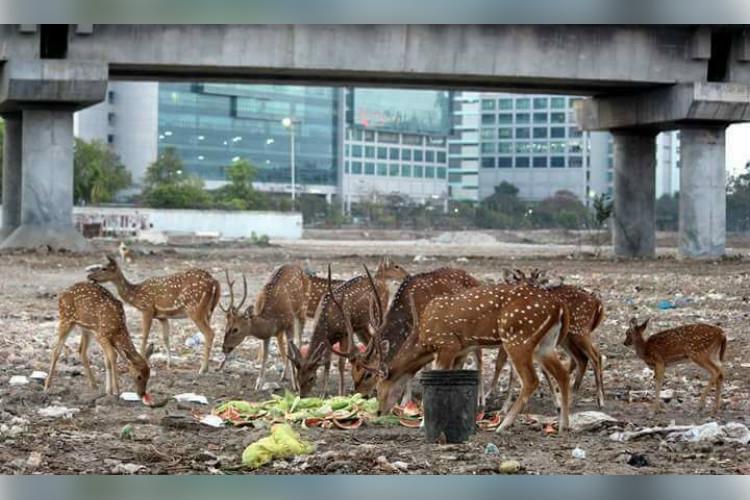
Over the past month, upsetting photos of spotted deer feeding on plastic and other waste in and around the Taramani area in Chennai have surfaced on social media. The deer had reportedly strayed from the IIT Madras campus or nearby areas. The loss of the forest ecosystem forces these herbivores to munch on plastic which in turn results in their death due to stomach bloating.

The pictures, which many are sharing on social media, were perhaps first postedby Facebook user Aarthi Gopalan.

Unfortunately, this is not new to a city that has witnessed several deer deaths over the years.

In fact, an RTI by animal activist Antony Rubin revealed that 220 deer and 8 blackbucks died between 2013 and 2016 on the IIT Madras campus. The campus, a thickly forested area, has increasingly come under the scanner for disrupting the ecosystem in the area with toxic waste and with garbage during its annual student fest, Sarang. After the January 2014 edition of Sarang, The Fifth Estate, a website run by IIT Madras students, reported that 21 deer had died and three were injured during the event.

Speaking to TNM, Antony Rubin says, “There is too much construction, debris and waste on campus. This has been happening for quite some time now. DLF bought a property in the area which was occupied by deer. They cleared out the entire building, so the deer came out and they are feeding on the garbage over there.”

Antony warns that trying to ‘trap them’ could prove fatal for these creatures. “Deer are very sensitive. If they are caught by force, they literally die within a few minutes because they go into shock. The death rate during translocation is about 20 to 30%. The ideal way is to slowly guide them towards Guindy National Park or IIT. There should be no traffic and it should be calm, so that the deer are not stressed.”

Animal rights activist Shravan Krishnan wrote on Facebook, “We have in fact spotted deers as far as Gandhinagar, Indra Nagar and past Kotturpuram. The main reason for these deers to stray out is because of loss habitat especially in IIT.  These deers stray out for food and water during the summers. You only see deers coming out, but we have spotted a whole lot of animals such as pangolins, jackals, civet cats, jungle cats and monitor lizards also venturing out due to habitat destruction. This problem will get worse in the coming years.

The only way to stop deers venturing out is to improve their habitat and to stop construction inside IIT and other buffer areas. (sic)”

In November last year, in response to Antony Rubin’s petition before the National Green Tribunal (NGT), the Forest Department had admitted that “due to the presence of the solid waste stray dogs are entering into the campus and they are attacking the deer and blackbucks and causing fatal injuries and in such circumstances necessary directions are to be issued to remove all the solid waste and to see that campus is free of stray dogs and protect the wildlife (sic).”

In December 2017, the southern bench of the NGT had directed IIT Madras to ensure that no further damage or injury is caused to the animals, including endangered species on campus.

IIT Madras, on the other hand, had claimed that they have an efficient process for solid waste management in place and blamed the increasing number of stray dogs on the campus for the death of the animals.

Meanwhile, the southern bench of the NGT has virtually become non-existent as its last member retired and no new appointment is forthcoming. Pending non-compliance appeals before the court are now left in the lurch.

With no way of filing appeals here, activists end up incurring significant expenditure moving the cases elsewhere. “The case keeps getting rescheduled here. So we are trying to move it to Delhi. What else can we do?” Antony asks.

Source….Manasa Rao in http://www./www.thenewsminute.com/

Natarajan

வாரம் ஒரு கவிதை …” கொஞ்சி விளையாடும் கோபம் “


கொஞ்சி விளையாடும் கோபம்
—————————-
நேற்று இருந்தவர் இன்று இல்லை …இது
தெரிகிறது எனக்கு !…இன்று இருப்பவர்
எல்லாம் நாளை விடியல் பார்ப்பாரா இல்லையா ?
விடை இல்லையே என்னிடம் இந்த கேள்விக்கு !
நெருநெல் உளனொருவன் இன்றில்லை என்னும்
பெருமை படைத்து இவ்வுலகு …சொன்னான்
அன்றே வள்ளுவன் ! குறளை  பாடமாக படித்த
நேரம் புரியவில்லை அவன் சொல்வது என்ன என்று !
வாழ்க்கைப் பாடம் தினம் படித்து வள்ளுவன் சொன்னது
என்ன என்று புரியும் இந்த நேரம் கோபம் கொஞ்சமும்
வேண்டாம் எனக்கு என்று நினைக்கிறேன் நான் இன்று !
வேண்டாம் நீ என்று நான் சொன்னாலும் விட மாட்டேன் நான்
உன்னை என்று என்னுடன் கொஞ்சி விளையாட வரும்
கோபமே …கெஞ்சிக் கேட்கிறேன் உன்னை , விட்டு விடு
என்னை இன்று ஒருநாள் !
நாளை விடியலை நான் பார்த்தால் மீண்டும் கெஞ்சுவேன்
உன்னிடம்  கோபமே, “கொஞ்சி விளையாட வர வேண்டாம்
நீ என்னிடம்  இன்னும் ஒரு நாள் ” என்று !
K.Natarajan
in http://www.dinamani.com dated 4th March 2018

” Despite everything …this too will pass …”

One day, King Solomon, the wisest man in the world, wanted to test the integrity and wisdom of his faithful servant. The King summoned his servant and asked him to carry out a task, knowing that it could not be completed. King Solomon said: “The Feast of Tabernacles is in 6 months, and I would like to wear a magic ring for the holiday. Any person who is sad and looks at the ring will become happy and any happy person who looks at the ring will become sad.”

The faithful servant immediately went on the journey in the search of the mysterious ring. A month passed, two months passed, and the servant, who visited every jeweler and peddler in the kingdom, remained without the ring. Two more months passed, and the servant reached the limits of the kingdom, but he had yet to find anyone who had heard of such a magical ring.

Over time, the faithful servant became frustrated. With all his might he wanted to fulfill his master’s wish, but no matter how hard he tried, he could not find the mysterious ring. He was depressed and almost gave up, until one day before the Feast of Tabernacles, he arrived at the small workshop of a poor jeweler in a small village.

The servant, who had nothing to lose, asked the old silversmith: “Tell me, sir, have you ever heard of a magical ring that causes the sad to become happy and the happy to become sad?” The old silversmith thought for a second, took out a small copper ring from one of the drawers, scratched it and handed it to the servant. The servant, who for the past few months had lost all hope, gave one glance at the inscription on the ring, and his eyes lit up. He thanked the silversmith, paid him a bag of gold coins, and hurried to the king’s palace.

When the servant finally arrived at the King’s Palace, Solomon was very happy and rejoiced. He did not believe that his servant would really come back to him with a ring. The servant handed the ring to his master, the wise king gave it one look and the smile immediately disappeared from his face. All the courtiers were curious to see what was written on the magical ring, and finally, when they looked at it, they saw the following simple sentence:
“Despite everything, this too will pass” 
This simple sentence contains a truth that we must cherish in our hearts – even if it feels like everything is going great and were on top of the world, we must remember that all this might disappear one day. On the other hand, and this is the happy side of the rule, all the suffering, all the frustration, all the difficult times we sometimes experience, these too will pass and be forgotten.
Source….www.ba-bamail.com
Natarajan

‘Literally’ Tops List for Most Hated Phrases…” Top 10 Most irritating Phrases !!!

How often do you notice yourself saying the word ‘literally’? Well according to the Daily Telegraph readers, this word literally tops the list of phrases and sayings that cause annoyance among readers.

In fact, according to a response of 700 Daily Telegraph readers in an online poll, the words ‘basically’, ‘a safe pair of hands’ and ‘I’m gutted’ were preferred over the word ‘literally’. Of course, overused words like ‘basically’ and ‘upcoming’ made the list, as did the grammatically incorrect use of ‘shouldn’t of’ instead of ‘shouldn’t have’.

The readers were asked to respond to a top 10 of irritating expressions which have been compiled by researchers at Oxford University. Expressions which topped the University list included ‘at the end of the day’, which was followed in second place by the phrase ‘fairly unique’.

The statement, ‘I personally’ made third place. Phrases which made the list are highlighted in a new book which looks into jargon, poor grammar and meaningless expressions which are often found in modern speech. The book is known as ‘Damp Squid: The English Language Laid Bare’.

The list was compiled by researchers using the Oxford University Corpus database, which alerts them to new words and phrases by monitoring books, papers, magazines, television, and the internet. The database tells which words are being misused and it also identified expressions which are disappearing.

The author of the book Jeremy Butterfield, also a lexicographer, said that many over-used expressions are considered to be annoying. They actually started off as office lingo – such as 24/7 and synergy. He also said: ‘we grow tired of anything that is repeated too often – an anecdote, a joke, a mannerism – and the same seems to happen with some language.’ During the survey, Daily Telegraph readers responded in the hundreds to express which words annoyed them.

Below is the Oxford University’s top ten most irritating phrases:  

1. At the end of the day

Usually used before we say what we believe to be an important fact of a situation we are describing. In conclusion and when all is said and done have the same meaning.

2. Fairly unique

Here’s a classic example of an oxymoron – two words which seem to have an opposite meaning. Grammatically, this is incorrect. An object can either be unique, or not, but it cannot be fairly unique.

3. I personally

I and personally have the same meaning, after all, I is personal so there is no need to use the two together.

4. At this moment in time

Simply put, this expression means now or at the moment. This expression is used too much and is overblown.

5. With all due respect

This expression is used before something impolite is said, or before we disagree. Most people seem to dislike this phase because it makes it OK to be rude to someone when we use this expression first.

6. Absolutely

This adverb means very or completely. But most people tend to find it absolutely annoying when it is used to mean yes or I agree.

7. It’s a nightmare

This idiom means a very bad experience. But it is felt that people use this expression too much in spoken English.

8. Shouldn’t of

This expression is used to express regret about something we have, or haven’t done. It is also used to criticize the action of others. However, in the way that it is used here it is not good English. The correct expression is shouldn’t have.

9. 24/7

This expression is used to refer to something that never stops. It is considered to be annoying because it is office jargon, not always true and the word always is deemed to be a better replacement for 24/7.

10. It’s not rocket science

This expression meaning it’s not difficult is disliked because it’s a cliché.

Source….www.ba-ba mail.com

Natarajan