Source….www.thehindu.com
Natarajan
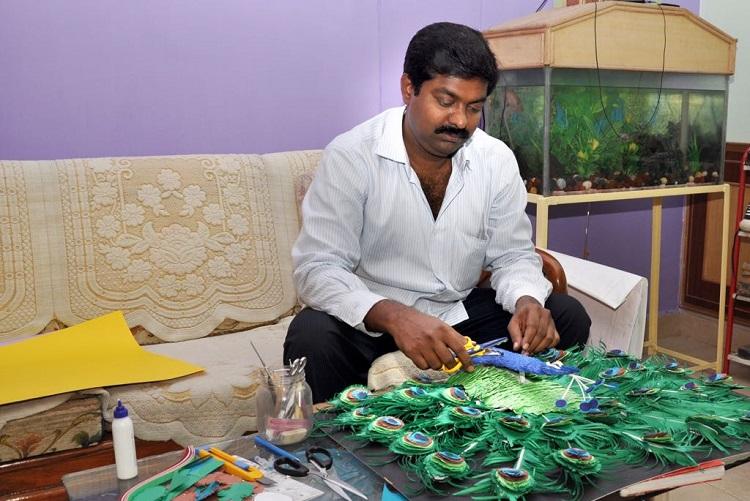
The word sculptor usually brings to mind a man busy chiselling away on metal or plaster, but Moka Satish Kumar, a Visakhapatnam-based artist, plans to change that perception.
Completely self-taught, Satish began with small subjects like birds and insects before gradually moving on to exotic sculptures.
A paper sculptor, Satish is gaining recognition for intricate sculptures carved by him using nothing but paper.
Born, raised and educated in Visakhapatnam, Satish has been sculpting these three-dimensional sculptures for close to 12 years now.
“I come from a commerce background and have no formal training in the arts field. It all started when I began observing paper collages. I was drawn to the subtle way in which light and dark colour paper are assembled to create an image,” says Satish, who used to work in the private sector.
“However, with sculptures, it’s far more realistic as the effect of a shadow is created by the subject itself,” he adds.
Since Satish is completely self-taught, he began with small subjects like birds and insects before gradually moving on to some exotic sculptures. Here are a few examples.


The outline of the art is first drawn on the paper before Satish cuts them out and gets to work. The sculptures are made using a combination of cutting, folding and embossing techniques.
“Embossing is nothing but adding an extra layer on top of a paper to give it a certain finish and 3D effect. For example, the finish you find on wedding cards is from preset designs, which are pressed onto the card,” Satish explains.
“However, I do it manually to ensure that the final product is smooth. The paper should also be handled with care as it is generally a delicate thing,” he adds.
Meticulous effort
Making a sculpture is not easy work, as even a basic 2×2 feet portrait can take up to 250 hours, says Satish.
“The sculptures are also expensive for the same reason. Only those who put in the hard work will understand. No corrections can be made to the art work… even a minor mistake means that the sculptor has to start over again,” Satish says.
While paper sculpting is relatively more common in western countries, very few Indians indulge in the art form. Therefore, Satish has also opened an institute and is presently teaching three students in his workshop.
“I also need labour. I can’t mass produce these sculptures, so I’m working on teaching it to more people. I also plan to approach the Andhra Pradesh government with my work,” he says.
Source…Nitin.B. in http://www.the news minute.com
Natarajan

The sun is the hottest when the clock strikes one in the small town of Seringapatam, not far from the city of Mysore, in present day Karnataka, a state in India. Colonel Arthur Wellesley, who was leading two army units of the British East India Company, knew that the defenders of the fortress of Seringapatam would be taking a break for refreshment at this hour. That’s when he planned to strike.
The date was May 4, 1799—the final day of the final confrontation between the British East India Company and the Kingdom of Mysore led by the strong and assertive Tipu Sultan. At the scheduled hour, seventy-six men dashed across the four-feet-deep river Cauvery and in only sixteen minutes had scaled the ramparts and stormed into the fort. The defenders, taken by surprise, were quickly subdued and in two hours the fort had fallen completely. Later, in a choked tunnel-like passage in the interior of the fort, the
bullet riddled body of Tipu Sultan, “the Tiger of Mysore” was found.

Photo credit: Victoria and Albert Museum
The victorious troops then proceeded to raid the royal treasury and over the next few weeks systematically emptied it, sharing the loot among the British army. Some time later, a curious object was discovered in the music room of the palace. It was a large wooden musical automata depicting a tiger mauling a man in European clothing. The man, which is nearly life-size, lies on his back while the tiger sinks its teeth into his neck. There is a crank protruding from the side of the tiger. When it’s turned, a hidden mechanism causes the man’s arm to go up and down, while a set of bellows inside causes the animal to growl and the man to emit distressing cries of agony. A flap on the tiger’s body can be opened to reveal a small organ and a keyboard capable of playing 18 notes.
Tipu Sultan’s mechanical tiger—known as Tipu’s Tiger— was a clear representation of his hostility towards the British—a feeling that he shared with his father, Hyder Ali, since his childhood. Hyder Ali regarded the British as their sworn enemy as they prevented Hyder from expanding his kingdom, and Tipu grew up with violently anti-British feelings. In 1792, when Tipu Sultan was forced to concede half of Mysore’s territories along with a large financial tribute to the British after the defeat at the Third Anglo-Mysore War, he had this machine built.
Tipu Sultan’s personal emblem was the tiger. The tiger motif was visible throughout his palace—on his throne, on his weapons and armor; the tiger stripe motif was painted on walls and used in uniforms; he even kept live tigers in his palace. Even his nickname that he adopted for himself was “the Tiger of Mysore”. Tipu’s Tiger, hence, was a symbolic representation of his desire to triumph over the British. It’s believed that the Sultan had frequently amused himself by playing with the instrument’s crank and hearing the distressing cries of the victim.
Understandably, the British were not amused. When they discovered the “contrived machine”, the Governor General of the East India Company wrote a memorandum calling it a “memorial of the arrogance and barbarous cruelty of Tipu Sultan” and “another proof of the deep hate, and extreme loathing” the Sultan had towards the English.
For a while, Tipu’s Tiger was displayed in the reading-room of the East India Company Museum and Library in London where it became very popular, especially since anybody could walk up to the machine and hand-crank it to hear the wailing and the grunting. The handle couldn’t take the abuse for long and it broke a few years later, to the great relief of the students using the reading-room in which the tiger was displayed.
In 1880, the tiger was acquired by the Victoria and Albert Museum in London. Since then, it has been one of the most popular exhibits in the museum and a “must-see”, although it’s too fragile now and cannot be operated. During the Second World War, the roof above the museum came crashing down and broke the tiger into several hundred pieces. After the war, the tiger was carefully pieced together, but it no longer works.
In recent times, Tipu’s Tiger has formed an essential part of museum exhibitions exploring the subject of Indian resistance to British rule, as well as British prejudice and imperial aggression. Tipu’s Tiger appears in various forms of memorabilia in the museum shops as postcards, model kits and stuffed toys.
Source ….Kaushik in http://www.amusingplanet.com
Natarajan


 Take off with Natarajan