The making of the Tiranga….

Year after year, Indians hoist the Tricolour with great fervour on Republic Day and Independence Day.

But have you ever wondered where, and how, the flag is made?

On the occasion of India’s Republic Day, Rediff.com visits Khadi Dyers and Printers, a tiny unit in Borivli, north west Mumbai, where the Tricolour takes shape.
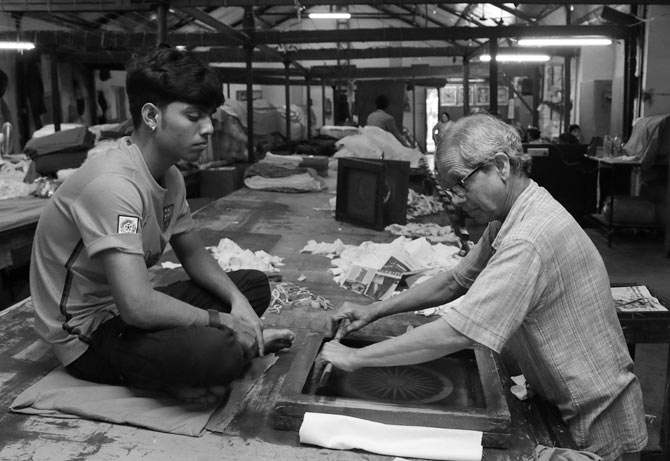


IMAGE: The blue dye is spread evenly on a cast with the Ashoka Chakra.
It takes the better part of the entire day to get the Ashoka Chakra printed onto a piece of white cloth.

The national flag you see fluttering on government buildings across Maharashtra take shape in a tiny unit in suburban Mumbai.

Here workers stencil and stamp the Ashoka Chakra onto white khadi cloth — the central motif is printed in blue ink using a screen printing technique.

Printing happens only by hand at this unit, where flags are manufactured according to the Indian standard specifications for the national flag.   

IMAGE: The white cloth is quickly spread out so that the ink can dry and does not bleed.
At this unit, no cloth is just a piece of fabric. It’s something special.

“When you buy khadi flags, you’re actually supporting poor farmers living in villages,” says D N Bhatt, manager, Khadi Dyers and Printers.

“Education has not touched some of these villages, where poor farmers make khadi for a living,” he adds.

The process of flag-making is strenuous and the flags are made in segments.

Khadi manufactured in the villages reaches Bhatt’s unit. It is then segregated into three parts: One to be bleached white and two to be dyed green and saffron.

When the bleached cloth returns to the unit, the Ashoka Chakra is printed on it.

Once the green and saffron dyed cloth return to the unit, a stitching team cuts out the required sizes and sews the flag panels to put together the Indian flag.

Lastly the flag is ironed, neatly folded and packed.

The finished bags are then ready to be shipped to government offices and also supplied to khadi stores from where the public can buy these flags.

Bhatt’s unit has limited production capacity, so it produces flags throughout the year.

“Our main work is printing the Ashoka Chakra and stitching the flags according to BIS norms,” says Bhatt. “We also sew accessories like ropes, toggles and threads into the flag.”

“The flags here are made of khadi only and they strictly adhere to the specifications laid down by the BIS,” he adds.

“The flags come in nine sizes from 4″ x 6″ to 14″ x 21”.

“As and when a Khadi Bhandar gets an order, they approach us and we immediately supply flags to them. For that, we need to keep flags in all sizes ready.”

Bhatt’s unit also manufactures table and car flags for VIPs. “We cater to all government departments and embassies in India and abroad.”

The flags made at this unit are more expensive than the ones made of regular cloth, paper and metal. That’s the price you pay for the effort that goes into making the flag.

“Please buy khadi flags,” Bhatt urges readers. “By doing so, you are helping poor people.”

Source….www.rediff.com

Natarajan


Meet Narasamma…97 years…Padma Awardee from Karnataka ….Who help delivering babies for 70 years ….

When Narasamma helped deliver the very first child in 1940, the mother told her that her hands were ‘special’.

It was the year 1940. Narasamma was only 20 years old when she helped bring the first baby into the world. This child was her aunt’s. And even as an overwhelmed Narasamma took on the role of a midwife for the very first time, little did she know that what she would one day win a national honour for it.

‘Sulagatti’ Narasamma has been delivering babies for 70 years in backward areas of Tumkur district in Karnataka. And her life-long services to women whose children she helped deliver without taking a penny were finally recognised – she was honoured with a Padma Shri on Thursday.

Narasamma, now 97, is currently admitted at a nursing home for treatment.

TNM spoke to Sriram Pavagada, one of Narasamma’s 12 children. He says that Narasamma would always observe her grandmother Margamma deliver babies, when she was a child.

“Margamma herself was locally famous in Tumkur for delivering babies around 70 years ago. When she delivered her aunt’s child – her first – her aunt remarked ‘Narsu, your hands are special’. That was the start,” Sriram narrates.

Encouraged by her grandmother and aunt, Narasamma began delivering babies and soon became the go-to person in Pavagada for pregnant women.

Narsamma delivered babies free of cost at a time hospitals and roads were unheard of in Pavagada. It earned the moniker ‘Sulagatti’ Narasamma – sulagatti in Kannada means ‘delivery work’.

“Even now, though there are hospitals, many people don’t like to go there. Instead, they prefer Narsamma since they know her,” says Sriram.

People’s immense faith in Narasamma and her ways has seen her deliver over 1,500 babies in the last 77 years. And until a few years ago, she did this apart from agricultural work. “If you ask her, she will say I don’t have a count since she has been doing it all her life,” Sriram says with fondness.

Midwives were an integral part of rural life in Tumkur until technological innovations in medicine reached there. The introduction of hospitals contributed to the gradual fall in the prominence of women who help during childbirth.

The Padma Shri award has brought Narasamma’s work into limelight once again, and her son hopes that there is a greater interest in taking her work forward.

Narasamma’s work is now being continued by close to 180 pupils who learnt the traditional way of delivering babies from her. This includes her youngest daughter Jayamma who is now an experienced midwife.

Though he doesn’t remember when, Sriram says that his mother has also been conferred an honorary doctorate by Tumkur University.

Source…Prajwal Bhat in www. the news  minute .com

Natarajan


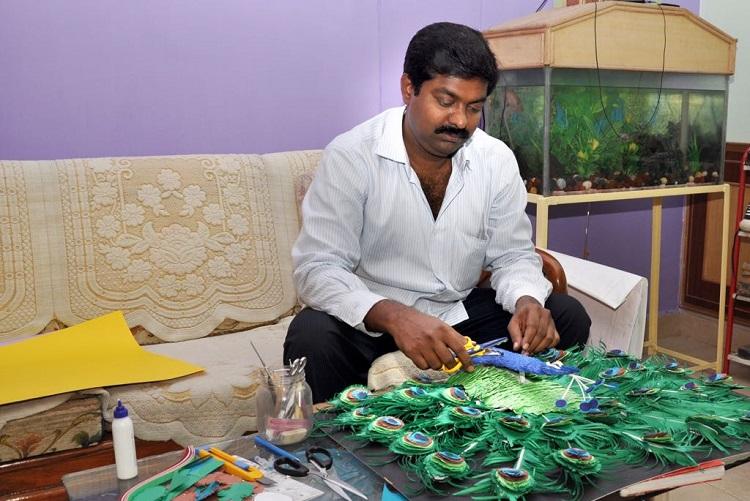
For the love of art: Meet the Vizag man who makes beautiful sculptures using paper…

The word sculptor usually brings to mind a man busy chiselling away on metal or plaster, but Moka Satish Kumar, a Visakhapatnam-based artist, plans to change that perception.

Completely self-taught, Satish began with small subjects like birds and insects before gradually moving on to exotic sculptures.

A paper sculptor, Satish is gaining recognition for intricate sculptures carved by him using nothing but paper.

Born, raised and educated in Visakhapatnam, Satish has been sculpting these three-dimensional sculptures for close to 12 years now.

“I come from a commerce background and have no formal training in the arts field. It all started when I began observing paper collages. I was drawn to the subtle way in which light and dark colour paper are assembled to create an image,” says Satish, who used to work in the private sector.

“However, with sculptures, it’s far more realistic as the effect of a shadow is created by the subject itself,” he adds.

Since Satish is completely self-taught, he began with small subjects like birds and insects before gradually moving on to some exotic sculptures. Here are a few examples.


The outline of the art is first drawn on the paper before Satish cuts them out and gets to work. The sculptures are made using a combination of cutting, folding and embossing techniques.

“Embossing is nothing but adding an extra layer on top of a paper to give it a certain finish and 3D effect. For example, the finish you find on wedding cards is from preset designs, which are pressed onto the card,” Satish explains.

“However, I do it manually to ensure that the final product is smooth. The paper should also be handled with care as it is generally a delicate thing,” he adds.

Meticulous effort

Making a sculpture is not easy work, as even a basic 2×2 feet portrait can take up to 250 hours, says Satish.

“The sculptures are also expensive for the same reason. Only those who put in the hard work will understand. No corrections can be made to the art work… even a minor mistake means that the sculptor has to start over again,” Satish says.

While paper sculpting is relatively more common in western countries, very few Indians indulge in the art form. Therefore, Satish has also opened an institute and is presently teaching three students in his workshop.

“I also need labour. I can’t mass produce these sculptures, so I’m working on teaching it to more people. I also plan to approach the Andhra Pradesh government with my work,” he says.

Source…Nitin.B. in http://www.the news  minute.com

Natarajan


Weight Loss Strategies to Avoid…

Fighting off the bulge can range from following a sensible and healthy diet to making ill-guided efforts that can have serious consequences for your health. Below you’ll find seven dangerous strategies that you should avoid at all costs when trying to lose weight:

1. Starvation, Fasting, or Very Low-Calorie Diets

This may lead to weight loss, but the lost weight includes precious muscle and lowers metabolism. Drastic calorie restriction also causes a shift towards a higher percentage of body fat, which increases the risk for metabolic syndrome and type 2 diabetes.

Unless medically supervised, don’t consume fewer than 1,200 calories per day. Otherwise, you’ll struggle to get enough nutrients to fuel your daily activities and satisfy your hunger. Keep in mind that when you lose weight quickly, you might be at risk of packing it back on – with more fat and less muscle – especially if you’re older than 50.

2. Taking Supplements That Make Grand Promises

If it sounds too good to be true, then it probably is. Unlike makers of prescription drugs, companies that make supplements don’t have to prove that their products are safe or effective before selling them on the market. Even products that claim to be natural aren’t necessarily safe or good for you.

Therefore, if you’re thinking about taking any weight loss products, ask a doctor first. It’s better to focus on what’s proven to work for weight loss, including your diet.

3. Using Cleansing or Detox Plans

At best, cleanses cause weight loss from water and stool weight, but they can be dangerous. They carry the risk of electrolyte imbalance and dehydration. Your body is fine-tuned to detoxify and excrete toxins, so cleanses aren’t necessary and can lead to serious complications by messing with your body’s system.

Therefore, instead of detoxifying, be more mindful of what you’re eating. If you want to cleanse or detoxify your body, drink plenty ofwater and eat high-fiber foods.

4. All Forms of Purging

Purging includes making yourself vomit, chewing food and spitting it out, and abusing laxatives. These habits pose serious health issues, and are the first step towards the development of eating disorders.

Acid in the stomach is extremely strong, and it’s meant to stay in the stomach, not be regurgitated into the throat and mouth. Extremely acidic vomit can cause erosion in the esophagus, mouth and tooth enamel. This can increase the risk of certain cancers and tooth decay.

Regular purging by vomiting or abusing laxatives can cause excess fluid loss that can cause serious dehydration and electrolyte imbalance.

Purging in all its forms is no way to decrease your waistline. Eating and drinking healthfully is a much safer option.

5. Extreme Exercising

This can cause serious problems such as severe wear and tear,dehydration, increased injury risk, and electrolyte imbalance.

The American College of Sports Medicine and American Heart Association recommend getting at least 30 minutes of moderately intense cardio exercise five days a week, or 20 minutes of intense cardio exercise three days a week, and strength-training exercises that work all the major muscle groups 2-3 times a week.

Some people think that more is better and go beyond what is healthy. This kind of obsessive approach can take control of their lives in an unhealthy way. If you take a moderate approach to exercise, you’ll be able to stick with it for the long haul.

6. Legal or Illegal Drugs

Using drugs other than prescription weight loss drugs intended for weight loss is a mistake that can come with dangerous consequences.

The risks associated with abusing drugs such as cocaine, speed, and medication intended for attention deficit disorder or diabetes to lose weight far outweigh any health benefits you may get from the weight loss. The risks include anxiety, severe headaches, addiction, financial and relationship problems, strokes, and heart, lung, and kidney issues.

Using illegal drugs for any purpose is strongly discouraged, and using legal ones for their unintended purpose without medical supervision is dangerous.

7. Smoking

We are all aware that smoking has countless health risks. Yet, some people, especially young adults, use smoking as a diet strategy.

Nicotine has been shown to be an appetite suppressant, but the risks of smoking vastly outweigh any benefits. Smoking damages nearly every organ in the body; causes cancer as well as respiratory and cardiovascular diseases.

Beyond the numerous health risks, weight gain is often a side effect when smokers try to kick the addictive habit.

Best Weight Loss Practices

Choose a diet that works well for your lifestyle. The best diet is one that you can stick to long-term. Use common sense, listen to your body, be mindful of what you eat, and ignore expensive, risky, and worthless weight loss strategies or products that are unproven.

Seek advice from your doctor or a registered dietitian if you are concerned that your weight loss methods may border on extreme or unhealthy.

Source….www.ba-ba mail.com

Natarajan

World’s busiest air route is right here in India!…

In 2017 only the Jeju-Seoul Gimpo route (with over 64,991 flights) and Melbourne-Sydney (54,519 departures and arrivals) were busier than Mumbai-Delhi.

It is the third-busiest air route in the world, with as many as 47,500 departures and landings last year.

Yet despite reaching this position, the Mumbai-Delhi route could face serious challenges in sustaining or improving it this year.

The reason? Hardly any additional capacity is now available at Mumbai airport to deploy more flights on this route.

But with the demand growing by 10-12 per cent annually, and with no possibility of adding more flights, flyers will soon face a hike in air fares this year.

According to OAG, an air travel intelligence firm based in the UK, the Mumbai-Delhi air route was the third-busiest in the world last year, with an average of 130 flights between the two cities every day.

In 2016, India was number six in the pecking order of the busiest routes, and this calculation was based on the capacity deployed on the route one way.

In 2017 only the Jeju-Seoul Gimpo route (with over 64,991 flights) and Melbourne-Sydney (54,519 departures and arrivals) were busier than Mumbai-Delhi.

Airlines say the route makes up about 10 per cent of their capacity and revenues, making it by far the biggest market.

And, at an average passenger load factor on this route of 80-90 per cent, this is a lucrative route, on which the demand is growing.

It also reflects the skew that these two markets have in the aviation business in the country as it constitutes more than 35 per cent of the domestic traffic.

Over 10,000 passengers depart every day from Mumbai for Delhi and vice versa and 70 per cent of them are corporate travellers, and this makes the situation even worse as they travel only during the peak hours (6am-8am and 5pm to 7pm).

That is why IndiGo and Jet Airways, each of which has 17 departures from Mumbai, top the list, followed by Air India (11), Vistara (10), GoAir (7), and SpiceJet (4). Yet the writing is on the wall. While most airlines are pushing for more capacity on the route, none is available.

Says a senior executive of a leading airline: “If slots are available, we can achieve a growth rate of 10-12 per cent on this route every year.

“But as slots are not available, the only possibility is to deploy bigger planes. But everyone does not have that flexibility, especially the LCCs. What you will see is fare increases”.

Last year, for instance, only Vistara and IndiGo were given additional slots on the route.

According to estimates of the Centre for Asia Pacific Aviation, the airport, which has a maximum capacity of 50-52 million per annum, is handling 46-50 departures an hour, which pretty close to the global best of around 55.

Currently the airport handles over 45 million passengers a year.

The agency says that the airport would reach its full capacity either by FY18 and surely by 2019, which makes the development of the new airport in Navi Mumbai so important.

Source…www.rediff.com

Natarajan