Joke of the Day…” Welcome to Heaven”… !!!

A Tough Decision

While walking down the street one day, a high ranking politician is tragically hit by a truck and dies. His soul arrives in heaven and is met by St. Peter at the entrance.
“Welcome to Heaven,” says St. Peter. “Before you settle in, it seems there is a problem. We seldom see a high official around these parts, you see, so we’re not sure what to do with you.”
“No problem, just let me in.” says the politician .
“Well, I’d like to but I have orders from higher up. What we’ll do is have you spend one day in Hell and one in Heaven. Then you can choose where to spend eternity.”
Really, I’ve made up my mind. I want to be in Heaven,” says the politician.
“I’m sorry but we have our rules.” And with that, St. Peter escorts the politician  to the elevator and he goes down, down, down to Hell. The doors open and he finds himself in the middle of a green golf course. In the distance is a club and standing in front of it are all his friends and other politicians who had worked with him, everyone is very happy and in evening dress.
They run to greet him, hug him, and reminisce about the good times they had while getting rich at expense of the people. They play a friendly game of golf and then dine on lobster and caviar. Also present is the Devil, who really is a very friendly guy who has a good time dancing and telling jokes.
They are having such a good time that, before he realizes it, it is time to go. Everyone gives him a big hug and waves while the elevator rises. The elevator goes up, up, up and the door reopens on Heaven where St. Peter is waiting for him.
“Now it’s time to visit Heaven.” So 24 hours pass with the politician  head of state joining a group of contented souls moving from cloud to cloud, playing the harp and singing. They have a good time and, before he realizes it, the 24 hours have gone by and St. Peter returns.
“Well then, you’ve spent a day in Hell and another in Heaven. Now choose your eternity.”
He reflects for a minute, then the head of state answers: “Well, I would never have thought it, I mean Heaven has been delightful, but I think I would be better off in Hell.”
So Saint Peter escorts him to the elevator and he goes down, down, down to Hell. Now the doors of the elevator open and he is in the middle of a barren land covered with waste and garbage. He sees all his friends, dressed in rags, picking up the trash and putting it in black bags. The Devil comes over to the politician and lays an arm on his neck.
“I don’t understand,” stammers the politician. “Yesterday I was here and there was a golf course and club and we ate lobster and caviar and danced and had a great time. Now all there is a wasteland full of garbage and my friends look miserable.”
The Devil looks at him, smiles and says, “Of course!Yesterday we were campaigning.  Today you voted for us!
Source…www.ba-bamail.com
Natarajan

For this IIT grad, even a newspaper was a luxury….

Super 30 is a free coaching centre in Bihar that selects 30 meritorious, economically-backward students every year and prepares them for the prestigious Indian Institutes of Technology.

Founded in 2002 by Anand Kumar, Super 30 has managed to send about 300 students from extremely impoverished backgrounds to the coveted IITs in the last 12 years.

But what happens to these youngsters after they complete their graduation?

In the first of a series, Divya Nair/Rediff.com talks to Shubham Kumar Gautam (pictured below), son of a farmer and a Super 30 student, who feels that if you have the passion and determination to pursue what you want, the sky is the limit.

Shubham Kumar Gautam

Who would have thought that a son of a farmer who grew up without reading a newspaper would study at an Indian Institute of Technology one day and set an inspiring example to several hundred youngsters in his little known hamlet?

Twenty-two-year-old Shubham Kumar Gautam says had it not been for mentors like Anand Kumar of Super 30, he wouldn’t have been able to give his family a better life today.

Here, the young engineer recounts how, in a journey laced with perseverance, grit and determination, he achieved what seemed impossible.

‘I grew up without reading a newspaper’

Shubham Kumar was born and bought up in Kulti, a small village in Nalanda, Bihar.

His father worked as a supervisor with Anaupcharik Shiksha Karmachari Sangha (Bihar State Non-Formal Education Employees Association). His mother is a homemaker.

As part of Govt. reforms, the Anaupcharik Sangha programme was called off and many people, including Shubham’s father, lost their jobs.

“My grandfather had taken a huge loan for my aunt’s (my father’s sister) wedding; he had to sell our ancestral property and the responsibility of paying off the debt fell on my father,” says Shubham, who has a younger sibling.

They were left with a small piece of land and, since his father wasn’t able to find a job, he decided to take up farming.

“Most of the households in our village are poor and resources are limited. We grew up without reading a newspaper, so you can imagine…” his voice trails off.

Fortunately, Shubham, then aged 13, was a good student, a fact that encouraged his uncle Uday Singh to take him under his wings.

His uncle, also a farmer, promised to take care of Shubham’s education and living costs and, in 2005, enrolled him at the Sri Sankar Government High School in his village, Pillich, on the condition that Shubham would continue to excel in his studies.

“Situated 20 kilometres from Kulti, it was a relatively better village and the school was just two kilometres away from my uncle’s place. I would mostly walk to school but if I was late, I would take a lift in a bail gaadi (bullock cart) or cycle,” he recalls.

The school had four classrooms, of which only two were functional. Most kids would bunk school. Even the teachers took little interest. But I really wanted to continue studying, so I formed a group of like-minded students who were keen on completing their education and willing to work hard for it,” says Shubham, about the school from where he completed his Class X.

‘I had no clue about engineering or the IITs’

Shubham Kumar Gautam in his first year

Shubham’s elders and neighbours would often advise him to prepare for the UPSC and bank exams like the other bright students in the village who managed to complete their graduation.

But Shubham wasn’t keen on these options.

“During my Class X, I would visit a store in Pillich to buy second hand books for revision. There, I found books on technology and computers and became interested. Slowly, I started to seek more information about the courses available.”

In Pillich, Shubham also had access to a newspaper where he had read about “Anand Sir and Super 30 and his special programme in Patna”.

“Until then I had no clue about engineering or the IITs,” he confesses.

The more he read about Super 30, he says, the more he was convinced engineering could be the “doorway” to his future.

But he had his fears. “If I did not qualify for the Super 30, I would have to spend extra for private coaching and accommodation, which we could not afford.”

He would worry about the cost of staying in Patna and wonder whether his father could afford it. “But I was clear that I wanted to do something different. I wanted to pursue a career that would bring dignity to my family and make my parents proud,” he says.

In July 2007, after completing his Class X, Shubham’s uncle took him to Patna and enrolled him at the Nalanda College, Biharsharif.

“When I first came to Patna in 2007, I stayed in a lodge and the bed charges were Rs 400 per day, which I shared with another student. I could not sleep that night; I kept thinking how long I could survive in this city.”

His first step was to move to another lodge, where he paid Rs 450 a month to share a room with two other boys.

It took him two months to trace the Ramanujam School of Mathematics, the coaching centre run by Anand Kumar, but getting admission wasn’t easy.

“I was new to Patna and very few people knew the exact address. After a lot of difficulty, I reached the place only to realise that about 1,000 students apply at the Ramanujam School of Mathematics every year. But Anand Sir doesn’t take more than a few hundred students.

“He carefully scrutinises the profile and academic performance of all the applicants and prefers to enrol those with weaker economic backgrounds. Those who are financially well off, he says, can always enrol in a better coaching centre.

“I was told that I could enrol for the Foundation course which would teach me the basics in Physics, Chemistry and Mathematics. I had to write an entrance test to qualify for the Foundation course too.”

Shubham cleared the entrance test and, in August 2007, joined the two-year programme (even as he continued with his Class XI and XII) to study Mathematics and Physics, the fees for which were waived by Anand Kumar.

I was good at Chemistry, so I did not take any coaching for it,” Shubham says.

After his Class XII board examination, he appeared for the JEE — the IIT entrance exam — in 2009 but failed to qualify by five marks.

“The cut off for the IITs was 178 and I had scored 173. I could have taken admission in lesser known engineering colleges, but my aim was to get into one of the IITs” he says.

Post the results, Shubham had already lost a year, but he wasn’t willing to give up.

He worked harder and appeared for the Super 30 entrance test.

“I didn’t want to go back home empty-handed. I somehow convinced my parents and uncle to give me one more year to prepare and promised that I would pay off all their debts as soon as I completed my engineering.”

‘Joining Super 30 changed my life’

Shubham Kumar, right, with Anand Kumar

In July 2009, Shubham topped the Super 30 entrance exam.

Qualifying for the 10-month programme ensured that his living and tuition costs would be taken care of, which he says was both a “huge relief” and a “life changing moment” for him and his family.

More than the academic mentoring, it was the positive atmosphere and the presence of Anand Kumar that mattered to students like Shubham.

“Anand Sir ensured that we focussed on the exam instead of worrying about our families and finances.”

Shubham cleared the JEE in 2010 and joined IIT-Bhu (Banaras Hindu University) in Varanasi where he pursued electronics engineering.

First encounter@IIT

Back home, Shubham’s parents had mixed reactions about sending him to a new city for four years.

“Although my parents were happy, my mother began to cry thinking that I would be living so far away from them. She packed me a lot of ready-to-eat food just like they do in the movies,” he smiles.

His greatest challenge, he says, was to not give in to peer pressure and hold his dignity.

There were lessons to be learnt and not necessarily at the IIT. It began on his first day at campus.

“My father had come to drop me to the college hostel. It was a few kilometres away and he decided we would walk instead of spending money on a rickshaw. We were walking with my heavy luggage and, as we reached the gate of the college, it started raining heavily.

They took shelter nearby and some other students from the IIT joined them. Because of the wind, mangoes fell from a nearby tree and Shubham’s father immediately nudged him to go and pick some.

“For us, it was nothing new. Even I felt like picking up those mangoes and eating them. But I saw some of the students smiling and looking at us. I did not know how to react and gave up on the idea.”

As soon as they entered the hostel, one of the boys asked Shubham’s father to collect his luggage.

“My father immediately followed his orders and got the luggage inside. I was very angry and scolded my father. I then introduced him to the boy — who later turned out to be a batchmate and a good friend — and he immediately apologised. That was just the beginning of struggles I faced.”

New batchmates and new life

It took Shubham, who came from a small town and had been educated in the Hindi medium, a while to get used to life in the city and to his new batchmates.

“Some of the kids who came from good financial backgrounds would hesitate to start a conversation,” he says.

There were others who had heard about his success at Super 30 and appreciated his hard work.

“I made some good friends,” he smiles.

Expenses mount

“After the results were announced, Anand Sir would take us students to various events where we were felicitated. He would appeal to the audience to donate whatever they could and distribute the money among us for our further education.

“Even chief minister Nitish Kumarji promised Super 30 students a scholarship of Rs 50,000 each. We never got the full amount. We got about Rs 15,000, all of which took care of our first semester fees,” he recalls.

In 2010, Shubham’s father was reinstated as a clerk on a temporary basis in the Jan Kalyan scheme.

Their financial condition improved and Shubham could focus on his studies without worrying excessively his tuition costs.

Help started pouring from other quarters too.

“After seeing my success, my uncles and aunts also helped me financially without expecting anything in return,” he says.

And life takes a U-Turn

At IIT-Bhu, Shubham learnt about taking initiative, team management and improving his networking skills.

I would participate in and also be part of various event organising committees, which helped me improve my communication skills,” Shubham says.

“In those four years, I never went to a movie theatre; in fact, I haven’t been to one till date.”

He would spend his time networking with seniors and juniors and writing poems and short stories in Urdu and Hindi.

After completing his engineering, Shubham was placed as a senior technical manager at HCL Technologies, Noida.

“Today, I have an Android phone and I write programmes for Android,” he says proudly.

“When people ask me, if my dreams have come true, I tell them that, so far, only my necessities have been met. For people like us, who come from poor backgrounds, education is a necessity — the window that enables us to dream.”

A lesson in humility

“There was a time,” says Shubham, “when I was so overcome by my own success that I had begun to bask in my self worth. I believed I was the best in the batch.”

Anand Kumar shattered Shubham’s myth. “He reminded me that everyone was equal and it is important to stay grounded. He taught me not to judge a person by his financial background but by his/her character and values.”

He was, he says, fortunate to have a mentor like Kumar who trained them to prioritise and focus on improving their academic performance day after day.

Shubham tries to visit Kumar every year. He interacts with the Super 30 students, “I share my experiences with them. I hope it inspires them to study hard and work towards a better future.”

SHUBHAM’S LIFE LESSONS

  • Find a passion that you believe in.
  • Never let your constraints come in the way of fulfilling your passion.
  • Prioritise your goals and remind yourself each day that, come what may, you have to get up and chase them.

Photographs: Courtesy Shubham Kumar Gautam

Divya Nair / Rediff.com….Source…www.rediff.com

Natarajan

Why this 50-yr-old makes India proud….?

Read on to learn how Raju Dabhade created history…

Raju Dhabade

Do you know this man?

No? Even I didn’t, till I met him.

Now that I have, I will never forget him.

He is a man who makes India proud.

No, he is not a celebrity or a sportsperson who has won medals for the country.

Fifty-year-old Raju Dabhade is the creator of the game of roll ball that will see its third World Championship in December, 2015, in Pune.

The first Roll Ball World Championship, held in 2011 in Pune, was won by Denmark; India was the first runner up.

The second World Cup, which India won, took place in Kenya in 2013.

“Roll ball is so named because it is a fast-paced game where the players use skates and the ball is always rolling, says Dabhade, who is also the general secretary of the International Roll Ball Federation.

Roll ball is a combination of basketball, handball, throwball and skating that requires balance, speed, accuracy and teamwork.

It is played between two teams; the objective is to score the maximum number of goals within a stipulated time.

So how did someone who, as young a boy, made ends meet doing odd jobs like working in a tea stall and delivering newspapers door-to-door end up inventing an international sport?

We asked Dabhade himself:

Raju Dabhade

How did roll ball begin?

As a Physical Training teacher in Pune’s MES Bal Shiksha English Medium School, I used to train and take players from different games for interschool competitions.

During the matches, I was always curious about the origin of these sports.

So I researched about them in detail — I used books from our school library and the internet.

I found out how different types of sports such as basketball, judo, hockey, football, etc, started, their history, playing techniques and strategies, different types of balls, etc.

Then, I began to wonder if it was possible to create a new game and started working on it.

Once in 2002, while teaching skating to students, a ball from the basketball court came bouncing over and I saw a student on skates bouncing the ball back to the players.

That’s how the idea of roll ball began.

It took one year to finally create the game with proper rules and techniques.

Raju Dabhade at the International Roll Ball Federation in Japan

How did roll ball get international recognition?

I took the idea of roll ball to the school’s then principal, Dr Sunitha Bhagwat.

She was very encouraging and talked to the students’ parents about it. I also contacted people I knew.

In February 2003, the official demonstration of the game was organised before the Sports Authority of India.

They liked it a lot and guided us on how to get the game recognised by the government.

We started working on the procedure and I personally went many times to New Delhi for this purpose.

After roll ball was recognised by the Indian government, we obtained a copyright certificate from the USA in March 2003.

Thereafter, first we contacted people in India and held matches here.

Once roll ball got national recognition, we started contacting the neighbouring countries and so on.

Dr Bhagwat adds: “PT teachers usually fall into a routine and are least motivated about getting involved in activities that are not within that routine or interacting with students. But Raju was different. He was an honest person who was good with people and went out of his way to help others.

“Initially, parents of his students funded expenses like transportation that were required for the game’s development.

“He had no financial or social support and lacked communication skills. Yet still, he never came to me with a problem.

“He would say that this is what he had found and needed to see how it works. Hence, I allowed him to use the school grounds for roll ball practices.

“All the support that he has is due to sheer goodwill.”

Raju Dabhade training students for Roll Ball

Can you tell us about your early days?

We were a financially poor family.

I was 15 when I lost my father. So I started earning early through odd jobs like working in a tea stall and door to door newspaper delivery.

I completed my education through night school and finally found a job as a PT teacher at BSEM school.

It has been 15 years since I stared working here and I am indebted to its people for having believed in me at the first go.

I am grateful to that newspaper delivery job which helped me feed my struggling family.

I now have a newspaper agency where I provide employment to poor boys.

You won the national level skating championship at school. How did that happen?

I wanted to learn skating but did not have enough money as my income went towards supporting my family.

Somehow, I managed to save some money and bought the basic skates with iron wheels.

I polished them well and covered them with rubber.

I learned skating on my own.

Later, a friend gave me a pair of good quality skates and I put my soul in practising with them.

I competed at the national level between 1980 and 1985. Then I got a job and couldn’t continue.

It will be the third world cup for roll ball. The game’s reach is surpassing the resources available to manage it. How has this been handled now and initially?

I am lucky. Behind the immense moral and financial support of the school management, friends and parents of students is perhaps the reputation I have earned over the years.

I was a punctual, fair and dedicated teacher, who was a mentor-cum-friend to students.

Fortunately, I have a very supportive wife.

My family never questions me about my whereabouts.

That is their faith in me, perhaps because I’ve never indulged in any wrong doing.

People like local businessmen and associations have also helped after seeing the matches.

Recently, we put up a sports stall in Russia.

As we couldn’t afford LCDs, I took the television set from my home and attached a pen drive to it.

We continuously played match videos and had many people stop by our stall.

What are your success mantras and advice to young Indians?

Work hard and don’t give up till you succeed.

Keep calm and be positive.

Pursue your passion and own your work.

Do something different and innovative.

Everyone gets the opportunity to succeed. Don’t miss it.

Make your nation proud.

Photographs: Kind courtesy Raju Dabhade

Payal Khare Bhatnagar    source….www.rediff.com

Natarajan

Believe it or Not…No Casualties in these Air crashes….

When one thinks of airplane disasters, one relates them to tragedy, loss and devastation.

However, German photographer Dietmar Eckell finds ‘miracles in aviation history’ at the abandoned sites of wrecks that have resulted in no casualties.

Happy End’ is a photo-project of 15 airplanes that had forced landings but all on board survived and were rescued from the remote locations. The planes remain abandoned in nowhere for the last 10-70 years.

He writes, “It’s part of  my long term project ‘restwert’ (German for residual value) to document abandoned objects with fascinating backgrounds like cold war relicts, Olympic sites, flooded churches, railroad tracks, never finished nuclear reactors, overgrown adventure parks etc.”

Douglas Skytrain C-47, Yukon, Canada

In February 1950, a Douglas Skytrain C-47 plane accidentally crashed into the ridge and 10 passengers on board miraculously survived in the cold weather. Photograph: Dietmar Eckell

The pilot made it down to a nearby highway to get help rescuing the other nine survivors.Photograph: Dietmar Eckell

The photographer spent two hours at the crash site taking various shots of the wreckage. Speaking of his experience, Eckell says, “I still cannot imagine how they survived in February 1950 with temperatures in the -40s up there.” Photograph: Dietmar Eckell

Carvair, Alaska

In June 1997, Carvair took off from Venetie, United States of America. The aircraft was climbing when the engine on the left wing began to run rough. Soon, a fire broke out, causing the engine to fall off the wing. The captain was forced to carry out an emergency landing on a sand and gravel bar in the ChandalarRiver. Photograph: Dietmar Eckell

Fairchild C-82, Alaska

A twin-engine Fairchild C-82, carrying cargo, experienced troubled and had to crash-land in January 1965 in the Tundra forest, cutting down many trees. The three crewmembers survived by building a huge fire from the surrounding pines, which proved their salvation when a spotter plane saw its glow 3 days later. Photograph: Dietmar Eckell

Cessna T-50, Alaska

This Cessna T-50, also known as the “Bamboo Bomber,” crash-landed in Alaska after it ran out of fuel in the 1960s. Photograph: Dietmar Eckell


Cessna 310, Australia

A Cessna 310 in repose in Western Australia after it crashed in 1993. Eckell captured this image after a 1,500 kilometre drive. Photograph: Dietmar Eckell

B-24 Liberator, Papua New Guinea

This massive B-24 bomber crash-landed in Papua New Guinea swamp in October 1943 after running low on fuel after a bombing mission. The crew successfully parachuted to the ground, and the two pilots were unhurt in the crash landing.

Douglas C-53, Australia

The Douglas Skytrooper was forced to land in February 1942 after the pilot missed the airport and ran out of fuel. This cluttered transport wreck is the last shoot — to date — of the Happy End project. Photograph: Dietmar Eckell

Grumman hu-16 Albatross, Mexico

This Grumman Albatross crashed on a beach about 70 km south of Puerto Escondido, Mexico. The locals told Eckell that the plane was used by drug traffickers. Eckell discovered the wreck in 2010, six years after the crash. The imminent storm gave him precisely the backdrop he wanted. Photograph: Dietmar Eckell


Avro Shackleton, Western Sahara

Two engines of this plane suddenly failed, sending it down to the desert sand in 1994. Surviving this crash in such an inhospitable environment was an astonishing feat for the 19 passengers and crew. He remembers his attempt to reach the plane as dangerous. “After a 30-hour car ride from Morocco to Mauritania and a 26-hour ride on an ore train, I got to a mining town and there had to convince the local Polisario leader to take me over the border to the Western Sahara. I had the plane’s GPS location and we drove cross country to avoid getting caught by the Mauritanian military. Photograph: Dietmar Eckell

Curtiss C-46 Commando, Manitoba, Canada

This Curtiss Commando made a heroic emergency landing in the hills of Manitoba, Canada. All 3 people aboard survived. The Commando was often used as transport aircraft in World War II; command crews nicknamed the C-46 the ‘flying coffin’. Eckell explains that although this wreck is relatively easy to hike to, it involves an extra threat: It’s in polar bear country. Photograph: Dietmar Eckell

Douglas C-47 R4D-8, Iceland

In November 1973, this US Navy transport plane crashed after encountering severe weather conditions and icing near Vik, Iceland. All 7 passengers and crew members made it to safety.Photograph: Dietmar Eckell

Vought F4U Corsair, Hawaii

A Vought F4U Corsair ended up in Hawaii waters a few years after World War II.  cal diving school operators helped Eckell to find the small fighter plane and told him the pilot escaped.Photograph: Dietmar Eckell


Bristol 170, Canada

This Bristol Type 170 broke through the frozen lake on landing, fracturing the wing, and has been there ever since 1956. Eckell tracked it down with the GPS coordinates and persuaded a local Cessna pilot to fly him out to it. Photograph: Dietmar Eckell

Check out Dietmar Eckell’s Facebook page

Source….www.rediff.com

Natarajan

Message for the Day…” 4 Questions that Every Person Should Ask Himself…”

Sathya Sai Baba

There are four key questions that every person must show interest in: “Who am I? Where did I come from? Where am I going? How long will I be here?” All spiritual inquiry begins with these questions. The four Vedas give you the answers! Will you drop a letter into the post box without writing the address of the sender and receiver? If you do, then, the letter will go nowhere and the effort in thinking and writing the letter would be wasted! So too, it would be a phenomenal waste of opportunity to have come into this world, without knowing where we have come from and where we are going. Just as the no-address letter will go to the dead-letters office, the clueless individual soul will be caught in the cycle of birth and death for eternity! To avoid this phenomenon, enquiry about the Self with spiritual discipline is essential and must be prioritized. The answers will automatically come to you, as practical experiences.


Two Indians Make it to the FORBES List of Top 20 Billionaires of 2015….

Indians are making their country proud everywhere. While 5 Bollywood actors made it to 35 highest-paid actors list released by Forbes yesterday, 2 Indians have made it to the list of Tech Billionaires of 2015.

Here’s the entire list:

20. Klaus Tschira – Rs. 54,844 Crores

  •     Net worth- $ 8.6 billion
  •     Co-founder of SAP

19. Hiroshi Mikitani – Rs. 55,482 Crores

  •     Net worth – $ 8.7 billion
  •     Chairman & CEO of Japan’s biggest E-retailer, Rakuten


18. Eric Schmidt – Rs. 58,026 Crores

  •    Net worth – $ 9.1 billion
  •    Executive chairman Google


17. Hasso Plattner – Rs. 58,026 Crores

  •    Net worth – $9.1 billion
  •    Co-founded SAP (Systems, Applications, Products)


16. Lei Jun – Rs. 84,179 Crores

  •    Net worth – $13. 2 billion
  •    Founder of Xiaomi


15. Shiv Nadar – Rs. 94,372 Crores

  •    Net worth – $14. 8 billion
  •    Co-founder of HCL

shiv-nadar-1

14. Robin Li – Rs. 97,571 Crores

  •    Net worth – $15.3 billion
  •    CEO of China’s largest online search company Baidu


13. Ma Huateng a.k.a. Pony Ma – Rs. 102,661 Crores

  • Net worth – $16.1 billion
  • Chinese Internet firm – Tencent


12. Paul Allen – Rs. 111,571 Crores

  •    Net worth – $17. 5 billion
  •    Co-founder of Microsoft Corporation

11. Azim Premji – Rs. 121,788 Crores

  • Net worth – $19.1 billion
  • Founder of Wipro

Azim-Premji-1


10. Michael Dell – Rs. 122,443 Crores

  • Net worth – $19.2 billion
  • Founder of Dell


9. Lauren Powell Jobs – Rs. 124,356 Crores

  • Net worth – $19.5  billion
  • Founder of Emerson Collective


8. Steve Ballmer – Rs. 137,126 Crores

  • Net worth – $21.5
  • Owner of Los Angeles Clippers, an American basketball team

7. Jack Ma – Rs. 144,763 Crores

  • Net worth – $22.7 billion
  • Founder of Alibaba Group


6. Sergey Brin – Rs. 186,215 Crores

  • Net worth – $29.2 billion
  • Co-founder of Google and runs Google X


5. Larry Page – Rs. 189,404 Crores

  • Net worth – $29.7 billion
  • CEO of Google

4. Mark Zuckerberg – Rs. 212,969 Crores

  • Net worth – $33.4 billion
  • Founder & CEO of Facebook


3. Jeff Bezos – Rs. 221,896 Crores

  • Net worth – $34. 8 billion
  • CEO of Amazon


2. Larry Ellison – Rs. 346,235 Crores

  • Net worth – $54.3 billion
  • Ex-CEO of Oracle Corporation


1. Bill Gates – Rs. 459,161 Crores

  • Net worth – $72 billion
  • Founder of Microsoft Corporation he has been on the top of the list for 16 times out of last 21

They are the richest in the tech field in the world. Now please don’t look at your bank balance and cry.


Source….www.storypick.com  and  www.forbes.com

Natarajan


India”s Pride….Indians come home with 173 medals at Special Olympics….

Ishant Tudeja, a 13-year old boy with intellectual disabilities bagged a gold and silver medal in roller skating at the Special Olympics World Games. (Parveen Kumar/HT Photo)

The 275-member strong Indian contingent made the country proud by pocketing 173 medals at the Special Olympic World Summer Games 2015 in Los Angeles.

The athletes, who competed under the banner of Special Olympics Bharat, bagged 47 gold medals, 54 silver and 72 bronze pieces 14 disciplines during the nine-day event that ended August 2.

The country was most successful in athletics where Indians collected a total of 47 medals which included three gold medals in various categories of the 100-metre race. They also clinched the soft ball gold on debut.

Prime Minister Narendra Modi congratulated the Indian contingent for its great outing in the American city.

“Achievements of Indian contingent at @LA2015 @SpecialOlympics are truly gladdening. They are India’s pride,” Modi wrote on his Twitter page.

“The @LA2015 @SpecialOlympics were a triumph of determination, hardwork & sportsman spirit. Congratulations to all athletes who participated,” he tweeted.

Mukta Narain Thind, Special Olympics Bharat’s national director (organisation development), said it was an improvement from last year.

“They shine every time, and they have shone this year too. We are pleased with the performance, the medal tally has improved. They have bagged 173 from 150 something last time around, so we are extremely proud of what they have achieved,” Mukta told IANS.

“Next is the winter Olympics in Austria in 2017 which will be our main focus. The athletes will start training from October this year,” she said.

India had won 156 medals – 56 gold, 48 silver and 52 bronze – in the last edition of the games held in Athens, Greece.


Facts about Special Olympics:

  • Special Olympics is the World’s largest multi-sport event which is held for athletes with disabilities
  • Special Olympics was founded in 1968 by Eunice Kennedy Shriver
  • In 1988, International Olympics Committee recognised Special Olympics
  • The 2015 Special Olympics event in Los Angeles had the largest gathering in the World after 1984
  • This year, the Games were held from July 25, 2015 to August 2, 2015
  • The 2015 Special Olympics World Summer Games were officially opened by Michelle Obama. Stevie Wonder was also featured in the opening

Source….www.hindustantimes.com and http://www.indiatoday.intoday.in

Natarajan

World-class airports offering perks so good you’ll actually want a flight delay….!!!

Singapore’s Changi airport has a swimming pool to float away the time. Picture: Alamy

Singapore’s Changi airport has a swimming pool to float away the time. Picture: Alamy Source: Alamy

BELIEVE it or not, flight delays can actually be a blessing in disguise, especially if you’re stuck at one of these airports.

From golf courses to wave pools and a game of croquet, these airports are truly destinations in themselves. These are six of the world’s best airport terminals.

Incheon International Airport, South Korea

Earlier this year, this airport was hailed the world’s cleanest by Skytrax, a UK-based consultancy that reviews airports.

When you’re not taking advantage of the free showers in the hotel-style bathrooms, you can also enjoy a museum, golf course, casino and ice-skating rink. No one would notice if they scraped the “airport” off the sign and changed it to “resort.”

Changi International Airport, Singapore

It almost seems silly to fly out of this airport — because how many destinations can hold a candle to its awesome attractions?

The hands-down coolest thing? A Hobbit Hole inside the Naturally New Zealand exhibit — holla! It’s a hobbit village as depicted in “The Lord of the Rings,” built by some of the same film crew. (OK, the installation ended in April, but something equally cool is bound to replace it.)

Not to be outdone, the Social Tree claims some bragging rights. It’s surrounded by eight interactive booths made from 32-inch televisions with touch screens. You can take photos to send to yourself, to store in the system, or to display on its massive wall.

Fancy a dip before your flight? No problem — pre- and post-flight swims are available at Changi’s rooftop pool. For some serenity, check out the koi ponds and 500,000 plants throughout five indoor gardens, which require maintenance from 11 fulltime horticulturists.

Munich International Airport

Sometimes you need to take the edge off before a flight — and this airport has you covered in the hippest way possible: It has its own microbrewery. There’s also an in-house art gallery.

And if you get sick of waiting for your flight, there’s always the Audi car showroom above Terminal 1, in case your destination is within driving distance.

But Munich’s sweetest amenity has to be the newly opened wave pool, where surfers can enjoy stationary shredding.

London Heathrow Airport

Often considered the crossroads of the world, there’s very little Heathrow doesn’t have — including a Harrods outpost.

When retail therapy doesn’t cut it, there’s always the Molton Brown Travel Spa in British Airways Terminals 1 and 4, where you can grab a quickie hydrotherapy shower. The therapeutic technique increases your circulation, thanks to all that (water) jet action.

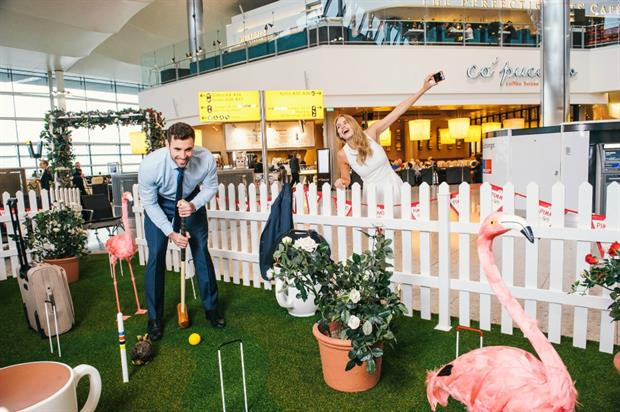
And don’t forget to enjoy croquet on a mini court.

Embedded image permalink

Amsterdam Schiphol Airport

If you’re still on a high from all that Amsterdam has to offer, and forgot to pick up souvenirs for your loved ones, don’t despair: This airport has Dutch diamond purveyor Gassan, offering cut and polished bling with all the proper certifications. Freaked out by the price on your receipt? Then check out the meditation centre.


Queen Alia International Airport, Zizya, Jordan

Sure, it’s been known to heat up in Jordan in summertime, but the airport — whose terminals are shaped like desert palm leaves — has taken care of that. In an eco-friendly move, it uses actual rainwater for the indoor garden, cooling everything down in the process.

Embedded image permalink

Source…..www.news.com.au

Natarajan

Message for the Day…” Keep the Mind Free from Dirt and dust of Evil thoughts…”

Sathya Sai Baba

The greatest disease (or absence of ease) is the absence of Shanti; when the mind gets peace, the body also will have health. So everyone who craves for good health must pay attention to the emotions, feelings and motives that animate you. Just as you wash clothes regularly, you must wash the mind free from dust and dross again and again! Otherwise, if dirt accumulates and you form a ‘habit’, it is difficult to get rid of the ‘stains’, besides it is harmful for the clothes. So washing should be a daily process; you should see that no mud settles upon the mind! That is to say, you have to move about in such company that dirt is avoided. Falsehood, injustice, indiscipline, cruelty, hate – these form the dirt; Sathya, Dharma, Shanti, Prema (Truth, Righteousness, Peace, Love) – these are the cleansers. If you inhale the pure air of virtues, your mind will be free from evil viruses and you will be mentally sturdy and physically strong.