do not understand his work, but just know he has grown to spend a lot of time with computers now.

do not understand his work, but just know he has grown to spend a lot of time with computers now.
t is the foremost duty of students to transform every activity of life into one of strength and beauty. But unfortunately, the education system of today fails to nourish the qualities of wholesomeness, unity and love, which are the hallmarks of true education. Students must realise that their lifespan is fast melting away like ice, whether they care to improve or not. Students of today are blind to the goal of life; many do not even feel the pain of not knowing the purpose of life. Only one in a million strives to realise the essence of life. This striving is the steppingstone for the realisation of the purpose of life. Many people feel that the acquisition of food, clothing, shelter, wealth, conveniences, and comforts constitute the very purpose of life. Life remains a tragedy as long as people toil under this kind of delusion. The day you realise the purpose of life, you undergo a total transformation, from agony (vedhana) to freedom from pain(nirvedhana)


Museum is not exactly the word that comes to mind when you step into this little square of open land near the Kumbharwada (Potters’s Colony) signal in Dharavi, Mumbai’s much coveted real estate that sprawls over nearly 600 acres, houses families cheek-by-jowl in tiny one-room homes that lean into each other, accessed by everything from roads to very, very, very narrow lanes bisected by vein-like gutters though which flows sludge-like, smelly dark liquid… the amalgamated refuse of the thousands of people who inhabit this patch of land once infamously known as Asia’s largest slum and then made famous by Danny Boyle’s Slumdog Millionaire.
In front of you is a bright white 8 feet by 4 feet cart, a little like the one you see pushed vegetable vendors all over Mumbai. Only, it is larger, made of metal, brightly lit, with brick-coloured panels that open welcomingly to 24 feet, can bear the weight of almost 1,000 kgs and looks quite out-of-place.
It is this dichotomy that, hope Amsterdam-based artists Jorge Mañes Rubio and Amanda Pinatih, will draw the people of Mumbai in. And inspire the people of Dharavi, many of whom stand around stoically, wondering what was happening.
“Museum,” say best friends Akansha, Ayesha and Riya, bright eyed 10-year-old Class 6 students who stay nearby. They explain that museums normally “carry things about the past” but this one is different. This one, they proudly say, showcases “Dharavi ki kala (the creativity of Dharavi).”
That, says 31-year-old Rubio, is the museum’s very purpose. Both Rubio and Pinaith admire the way the denizens of Dharavi have found ways to earn a living. “You can bring a purse here,” says Rubio, “or a jacket, or hand over a design for shoes, and they will replicate it for you.”
What they hope this museum will do is help the citizens of Dharavi tap into their creativity.
Looking around him, says Rubio, is motivation enough, as he recalls his first visit to Dharavi four years ago. Crammed into tiny spaces, where you would believe a nuclear family could live, hundreds of cottage industries flourish, making everything from earthen lamps to designer rip-off to food products to even soaps.
With a dash of creativity, they hope these entrepreneurs — from those who maintain their generations old family trade to those who are using the latest technology to set up new business — will be able to expand the scope of what they do, reach wider audiences and make more money.
To break the communication barrier, and earn the trust of the residents of Dharavi, they turned to URBZ, an experimental urban research and action collective. It was here that they met Shyam Kanle, who lives in Dharavi and has been working to improve the condition of its residents. Kanle, who belongs to a family of basket weavers and broom makers, stepped in as facilitator.
On February 18, the museum launched in Kumbharwada with exhibits made by the potters, given a design and colour spin by Rubio and his team, whose effort is being supported by the Creative Industries Fund NL and The Art of Impact.
The museum, says Rubio, who has bundled up his hair in a bun to beat the heat, is interactive and will include workshops and, like a few days ago, even a cricket match. Each of the items in the museum, emphasises Rubio, is made by local talent.

Yes, those are bats and you are supposed to play with them. To add some more change, Design Museum Dharavi offers modified gloves and stumps too.
Photograph: Kind courtesy Design Museum Dharavi

Twenty-seven hand-crafted bats, made from recycled wood in different shapes, sizes and designs, are tested by four teams from across Dharavi. Each has a brightly coloured grip. The leather gloves, too, are handcrafted and features different styles. Each team had its own uniquely designed tee shirt.
Photograph: Kind courtesy Design Museum Dharavi

Now that the bats and gloves had been designed, it was time for some intense concentration and a game of cricket. Even the pink stumps did not distract the players.
While some of the bats worked, others shattered in a matter of minutes.
Photograph: Kind courtesy Design Museum Dharavi

But the teams had a good time, and slipper-clad team Purple won the Golden Stumps 🙂
Photograph: Kind courtesy Design Museum Dharavi

The launch exhibit celebrated matkas (pots used to store water and keep it cool), brooms and tea cups.
Pots, that were generally stacked one top the other to save space, were given an exotic design spin.
Photograph: Uttam Ghosh/Rediff.com

Why should a cup look like a cup? “Why indeed?” asks Rubio as he spotlights the exotic shapes of the cups, with handles shaped like the human ear, triangles or even rectangles, all inspired, he solemnly assures, from the varied ways in which he has watched the Dharavi residents pick up a hot cup of chai.
Photograph: Uttam Ghosh/Rediff.com

Resting on a pristine white block placed on a brightly coloured reed mat are still more exotic tea cups even more exotic handles. A couple look like diyas and we wonder how useful they would be while sipping a hot beverage.
Photograph: Uttam Ghosh/Rediff.com

Experiment is everything, seems to be the motto. So there are more cup; some with saucers. “Sharing a cup of tea or sipping it from a saucer,” says Rubio is something he has noticed as he watched endless cups of chai make their way down thirsty throats.
Photograph: Uttam Ghosh/Rediff.com

Rubio and Pinatih share a moment with Shyam Kanle, who has helped them with the project, as they celebrate the launch of what has been called the first ever moving slum museum in the world.
Photograph: Uttam Ghosh/Rediff.com

Best friends Akansha, Ayesha and Riya, who stay nearby, pose in front of the three-sided broom (in the corner) which they have made themselves and of which they are very, very proud.

You might thing that broom is good for dusting…
Photograph: Uttam Ghosh/Rediff.com

…But Rubio has other ideas. “Why not look at it as hand-held fan,” he asks with a smile.
Photograph: Uttam Ghosh/Rediff.com

These exhibits grabbed a lot of attention. Not only were they bright and colourful, nobody seemed to know what they actually were.
“Diaries?” somebody ventured. Touching them put paid to that idea.
“Tiles?”
“Door-stoppers?”
“Coasters?”
“Design samples,” says Rubio, “that the potters can offer as options to their clients.”
Photograph: Uttam Ghosh/Rediff.com

And these, ladies and gentlemen, were the most excited visitors to the museum.
Photograph: Uttam Ghosh/Rediff.com
Savera R Someshwar / Rediff.com
Source…….www.rediff.com
Natarajan
The dollar is one of the most common currencies in the world used by the US, Australia, Canada, Fiji, New Zealand, and Singapore to name a few. The origin of the dollar, also the Slovenian tolar, is from a coin called the Joachimsthaler, shortened to Thaler (or daler in early Flemish or Low German), named after the valley in which the silver it was made from was mined, the Joachimsthal, literally ‘Joachim’s valley’. The term began to be used in other languages, especially Dutch, and was later applied to the most widely used coin in the American colonies. In 1792, it was adopted as the name of the US monetary unit.
Many countries use the dinar, which comes from the Latin denarius, an ancient Roman silver coin: Jordanian dinar, Algerian dinar, Serbian dinar, and Kuwaiti dinar among others. The Indian and Pakistani rupee derives from the Sanskrit rupya meaning ‘wrought silver’,which is also the origin of the Indonesian rupiah.
The South African rand is named after the Witwatersrand, the area around Johannesburg known for its gold deposits, while Poland uses the zloty which means ‘golden’ in Polish. The Hungarian forint comes from the Italian fiorino, originally the name of a gold coin from Florence, Italy with a flower (Italian fiore) stamped on it. The British coin the florin (used until 1971) has the same origin.
Serrated edges on coins became popular when coins were made of precious metals like gold and silver because the ridges made it harder for people to scrape off metal and devalue the coins. The Malaysian ringgit is from the Malay for ‘jagged’ and refers to the serrated edges of the Spanish silver dollars used as currency in Malaysia before the ringgit was introduced.
Chinese yuan 元, Japanese yen 円, and Korean won 원, all originate from the Chinese character 圓 meaning ‘round’ or ‘round coin’. Although in English, we speak about the Hong Kong dollar or the New Taiwan dollar, in Chinese these are referred to as yuán 圓. Likewise, in Chinese, ‘dollar’ is translated as ‘yuan’, so the US dollar or měiyuán 美元 is literally ‘American yuan’ in Chinese.
Many Scandinavian countries use currency whose name is ultimately derived from the Latincorona meaning ‘crown’: Swedish krona, Norwegian krone, Danish krone, Icelandic krónaas well as the Estonian kroon (now replaced by the Euro) and the Czech koruna. The Spanish real, a former currency of Spain derived from the Latin regalis meaning ‘royal’ which is the origin of a number of Middle Eastern currencies such as the Omani and Iranianrial, and the Qatari, Saudi, and Yemeni riyal.
Although the Germans and the Finns use the Euro now, their former currencies the Germanmark and the Finnish markka, both have their origin in units of weight. While the Spanishpeso meaning ‘weight’ in Spanish, is also no longer used in Spain, it lives on as the currency of Mexico, Argentina, the Philippines, Chile, Uruguay, the Dominican Republic, Cuba, and Colombia. The Russian ruble or рубль, also used in Belarus, was originally a measure of weight used for silver. The British pound (or pound sterling) comes from the Latin pondus ‘weight’ (sterling probably originally from Middle English meaning ‘little star’ because there was a star on early Norman coins). The Italian and Turkish lira also have their origins in units of weight from the Latin libra meaning ‘pound’.
Source…..www.blog.oxforddictionaries.com
Natarajan
How does Bhutan, the world’s most eco-friendly and carbon-negative country, celebrate the recent birth of its new prince? By planting trees of course. Lots and lots of trees.
108,000 saplings were planted in the tiny mountain Kingdom to commemorate the first Royal Child of His Majesty King Jigme Khesar Namgyel Wangchuck and Her Majesty Queen Jetsun Pema.
The Bhutanese constitution stipulates that at least 60 percent of land remains forested at all times, but this green-fingered celebration wasn’t just inspired by the country’s commitment to ecological preservation.
“In Buddhism, a tree is the provider and nourisher of all life forms,’ said Tenzin Lekphell, who coordinated the initiative. ‘It symbolizes longevity, health, beauty and even compassion.”
This isn’t the first time that Bhutan has made headlines for its epic tree-planting sessions. In 2015, the country set a Guinness World Record by planting almost 50,000 trees in just one hour. Which is proof, if ever you needed it, that while Bhutan might be small in size, it’s definitely big when it comes to awesomeness.
(h/t: treehugger)


Source…….www.boredpanda.com
Natarajan
Oxford University professor Sir Andrew Wiles has been awarded the prestigious Abel Prize for his “stunning proof” of Fermat’s Last Theorem.
Wiles life has been dedicated to the three-century-old theorem which has been his “passion from an early age” after he read “The Last Problem” by ET Bell.
His proof was first published in 1994 while working at Princeton University in New Jersey — he will collect the award 22 years later at a ceremony in Oslo in May.
The theorem, created in 1637 by French mathematician Pierre de Fermant, says that there are no solutions in integers — or whole numbers — to the equation xn + yn = zn when n is greater than 2.
Wiles’ work isn’t merely a solution to the theory, his findings have shaped mathematics and the entire approach to the field, and were originally submitted as a 200-page file.
The Abel Prize is awarded by the Norwegian Academy of Sciences and Letters and is widely regarded as the most prestigious award in its field. As well as a trophy, winners of the award also take home six million Norwegian Krone (£500,000, $700,000).
When asked what it feels like to solve a puzzle that has mystified mathematicians for centuries, he said: “It’s thrilling. It’s the experience we live for, this insight, that suddenly you see everything clearly before you that’s been so obscure and so frustrating for so long.”

The Norwegian academy lauded the professor’s groundbreaking work, saying: “Wiles’ proof was not only the high point of his career — and an epochal moment for mathematics — but also the culmination of a remarkable personal journey that began three decades earlier.”
This isn’t the first time Wiles has been recognised for his contributions to mathematics. He was knighted in 2000, and also won the US National Academy of Science’s Award in Mathematics, the Wolf Prize, and the Royal Medal of the Royal Society.
The Abel Prize was created in honour of Niels Henrik Abel, a Norwegian mathematician who died in 1829. It was created in 2001 and first awarded a year later. Previous winners include economist John F Nash Jr, who was the subject of the film “A Beautiful Mind,” and Sir Michael Atiyah for his work on the Atiyah-Singer theorem.
Source…… Charles Clark in http://www.businessinsider.com
Natarajan
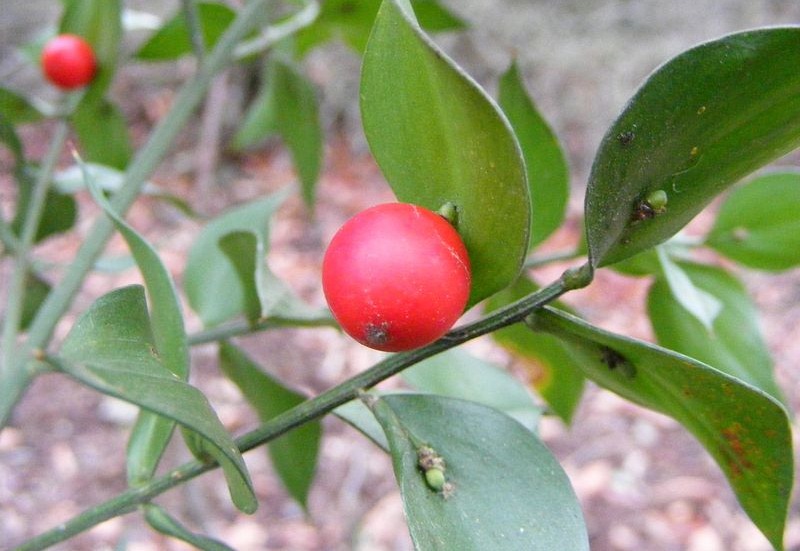
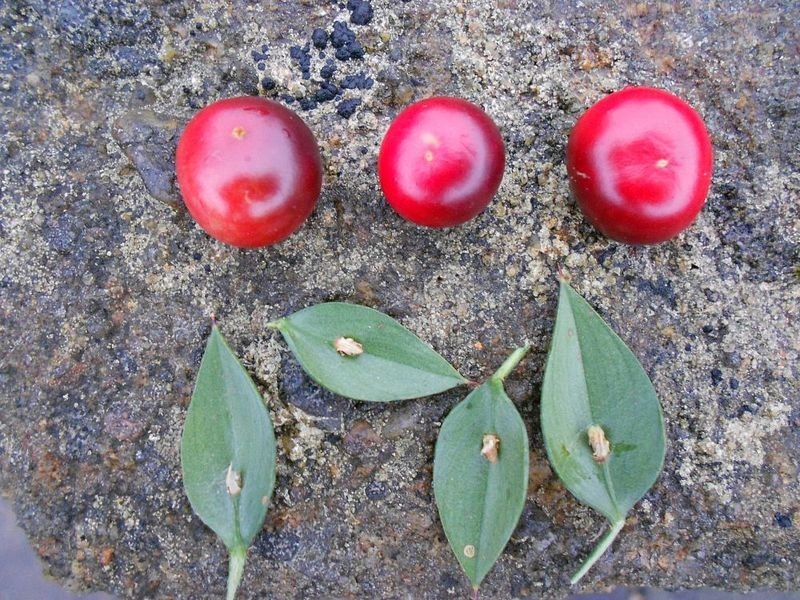
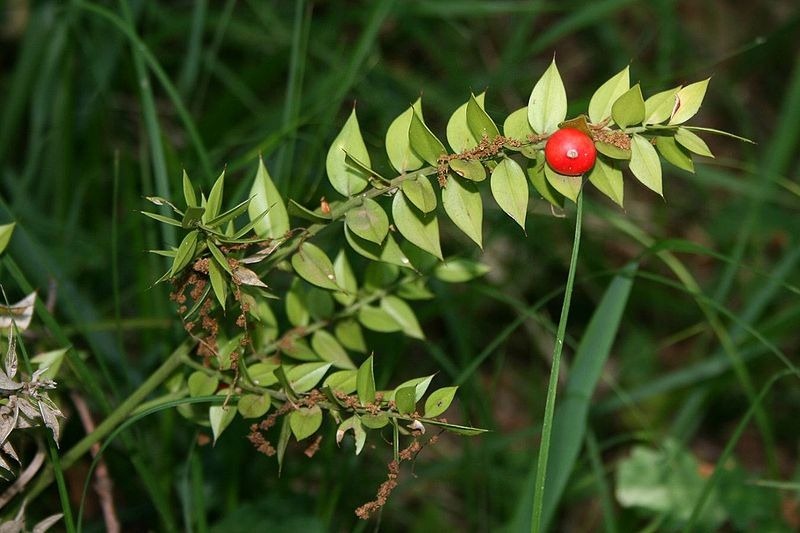
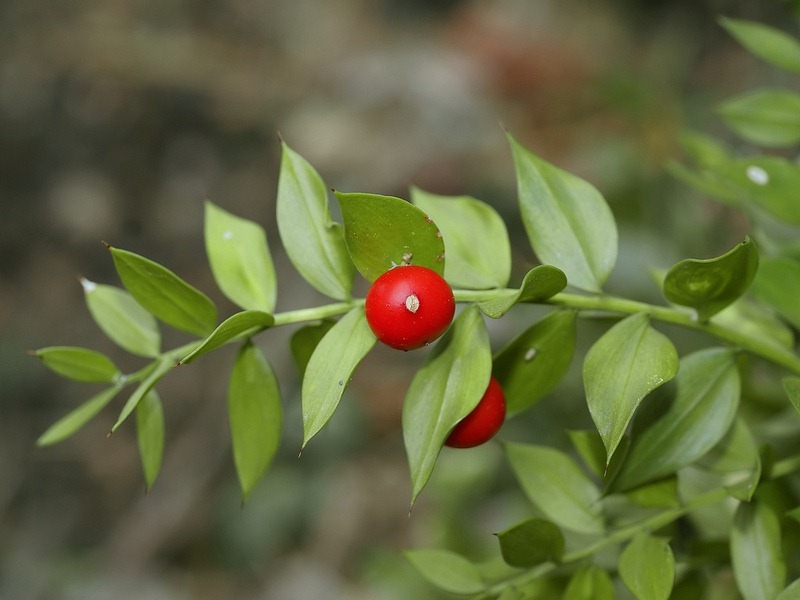
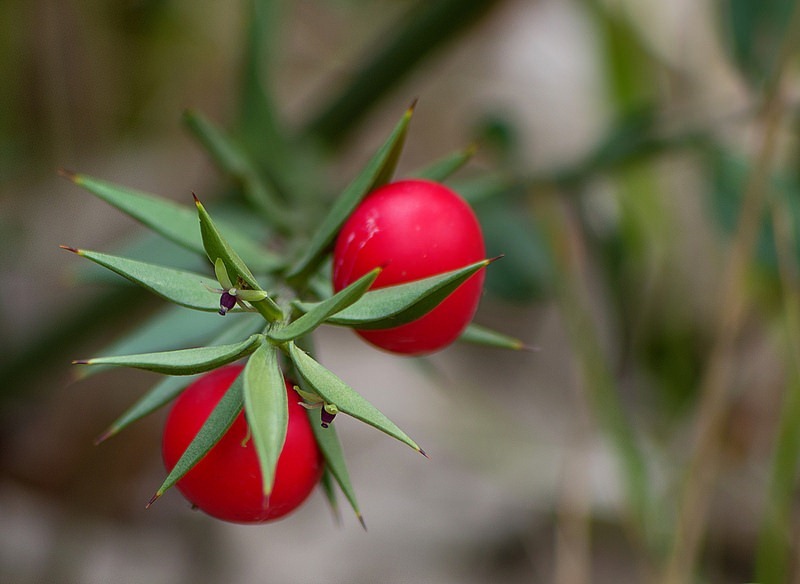
Butcher’s Broom, or Ruscus aculeatus, is a low-growing perennial shrub with tough, erect, stems and very rigid leaves that terminate in a sharp spine. From the center of the leaves grow small greenish-white flowers that blossom in early spring and develop into red berries in autumn. The tiny red berries are attached directly to the leaves by a short stem, making it a very strange looking plant.
The Butcher’s broom, however, is not breaking any rules of the plant kingdom, because what appears to be leaves are actually modified stems called cladodes, that have been flattened to not only look like leaves but serve their function as well.

Photo credit: Gil Costa/Flickr
Butcher’s broom is widely distributed, from Iran to the Mediterranean and the southern United States. They have been used for more than 2,000 years as laxative and diuretic and to treat various ailments such as hemorrhoids, varicose veins, itching, and swelling. The young shoots of the plant are also eaten like those of asparagus. The stiff twigs were once bundled together and used by butchers to keep their cutting boards clean, from which came its common English name: butcher’s broom. It is also known by others names such as “Knee Holly”, because of its knee height, “Jew’s Myrtle”, for its use during the Feast of Tabernacles, “Sweet Broom” and “Pettigree”, although its meaning is not clear.
Extracts of butcher’s broom have been used throughout the ages, but the medicinal use of this plant did not become common until the last century. Investigation in the 1950s indicated that butcher’s broom could induce constriction of veins, because of which it is still widely used for treating certain circulatory diseases. It also contains an alkaloid which inhibits the passing of sodium ions across the cell membrane and thus is an effective anti-arrhythmic substance.
Butcher’s broom is also widely planted in gardens and its berries used as decorations.

Photo credit: www.herbco.com

Photo credit: stories.rbge.org.uk

Photo credit: herbier.sesa-aude.fr

Photo credit: Franz Xaver/Wikimedia

Photo credit: Hans Hillewaert/Flickr

Photo credit: Katya/Flickr
Sources: Drugs.com / Botanical.com / Plant World Seeds via mantisshrimp.wordpress.com
Source….www.amusingplanet.com
Natarajan
At the time when many parts of Tamil Nadu were flooded due to incessant rains last year, and thousands of people were struggling to live through every passing day, there were a few localities in Chennai that remained unaffected. A. Vicky Kumar is the resident of one such area – there were no roadblocks, no power cuts, no loss to life and property. But he was deeply moved on seeing the plight of the rest of the city and his fellow citizens. With the view of helping as much as he could, he gathered about 12 volunteers including his wife Vishakha, and they set out to help in rescue operations. They called themselves ‘The C Team’. Closing their businesses for the entire month of December, the team started visiting slums, relief camps and individual homes to deliver rescue materials like food, clothing and medicines to people in need.
One of the most special volunteers of The C Team was Vicky’s 2-year-old daughter, Jiya. The student of a preschool named Developing Roots in Chennai, Jiya was a part of every field operation the team conducted.
“Many friends and well-wishers told us not to take her along for field work as she may fall sick stepping in to the dirty waters but we never bothered regarding what could happen because the need of the hour was to help the needy,” says Vishakha.
The entire team, including Jiya, were also recognized among thousands of other volunteers who put in their hearts and souls to work for Chennai, and she received a plant sapling and a certificate of appreciation from the music industry maestro Illayaraja, on December 17, 2015.
Jiya will be three years old this March. Kudos to her parents who were not scared of uncertain situations and ensured that their daughter got a glimpse of what such social activities look like, to make her understand the importance of helping others in need.


Source….Tanaya Singh in http://www.the betterindia.com
Natarajan
| A new business was opening and one of the owner’s friends wanted to send him flowers for the occasion. They arrived at the new business site and the owner read the card, which said: “Rest in Peace.”
The owner was angry and called the florist to complain. After he had told the florist of the obvious mistake and how angry he was, the florist replied: “Sir, I’m really sorry for the mistake, but rather than getting angry, you should imagine this – somewhere, there is a funeral taking place today, and they have flowers with a note saying: Source……www.ba-bamail.com Natarajan |