Message For the Day… ” One Common Divine Present in Everyone is the Basis for Brotherhood amongst all of Humanity…”

In the present Age of Kali, there is so much hatred between brothers. When there is no unity within the family, is it possible to bring about unity amidst all persons in this world? In many platform speeches, people address each other as brothers and sisters. We must ask ourselves whether such words are coming from the depths of our hearts or whether we are simply reading them from a piece of paper. If you truly mean the words ‘brothers and sisters’ from the depths of your heart, you most definitely will win the grace of the Lord and good consequences will follow. Never worry or fear that you may have to distribute your ancestral property, or share wealth with those whom you address as brothers and sisters. It is necessary and sufficient if you realise and accept that one common Divine is present in every one of you and is the basis for brotherhood amongst all of humanity. 

Sathya Sai Baba

Meet Australian Lady Leanne Murray …An Ardent Fan of Dhoni and his Team …..
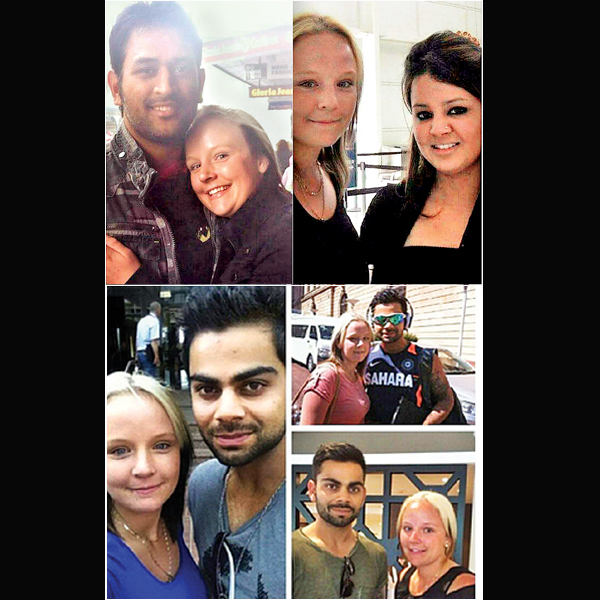
  • Leanne Murray with MS Dhoni, wife Sakshi and Virat Kohli Derek Abraham dna 

Management student Leanne Murray is also friends with others in team and quit job to watch the series Down Under this summer….

You don’t often see an Australian draped in an Indian flag. If you do, it must be Leanne Murray. A proud member of the ‘Swami Army’, the 23-year-old has been following MS Dhoni & Co. throughAustralia and New Zealand since 2007. Today, she is the undisputed No.1 fan of the Indian team in this part of the world. A few thousand selfies, some autographed jerseys and seamless access to the Men in Blue, she is the envy of many a supporter.

“I first saw Dhoni at a training session in Adelaide eight years ago. I had no idea who he was or how big an icon he was. I requested him for a photograph and I have not stopped ever since. I just fell in love with him that day,” she says. A 700-km drive from Adelaide, her hometown, to Melbourne for Sunday’s match is just another journey in Murray’s life. She has even traversed the Tasman Sea to watch the Indian team. “I went to New Zealand last year,” adds the management graduate.

Murray hasn’t gone to work since November. “A year ago, I told my boss that I want to attend each of the four Test matches as well as the World Cup. So I am actually on paid leave,” she gushes.

Murray doesn’t bother about the fact that Australia also have a cricket team. “I don’t really care about Australia,” she says as Dhoni & Co. go through the rigours of a four-hour-long training session at the Junction Oval. “I am not wearing my India shirt today. Otherwise, you’ll always see me in it. I don’t have an Australian shirt. And even if India were to play Australia, I’d be supporting India,” she says without batting an eyelid.

So what makes her love the Indian team so much? “It’s all because of Dhoni. He is just a calm guy and such a great leader. He is an inspiration. He just made me fall in love with the Indian team,” she says. Today, Murray counts the likes of Dhoni, Suresh Raina, R Ashwin, Mohammed Shami, Dinesh Karthik, R Vinay Kumar among her ‘friends’.

And guess what, she also plays the game. Actually, meeting the Indian players inspired me to take up the game. I didn’t know anything about cricket till 2007. About two years ago, I even enrolled myself in a cricket coaching clinic. I am a right-arm fast bowler and a left-handed batsman,” she informs. Within seconds, she rushes to her car, opens the boot and takes out a bat and a tennis ball. “Let’s play,” she says. Mind you, Murray is good at her game. A couple of journalists get a taste of her big hitting and neat bowling.

Murray has also strutted her stuff at the GM Cricket Academy in Delhi’s Najafgarh area. “I have played with the boys there. They really respect me,” she says. She knows Najafgarh is where Virender Sehwag hails from. “I have got a picture with him too. Do you want to see?” she enquires.

A casual look at her iPad confirms it’s a storehouse of collages. From Sachin Tendulkar to Virat Kohli to R Ashwin to Ravindra Jadeja, she has ‘framed’ them all. For the record, she has visited India on five occasions, including for the IPL.

Apart from Dhoni, Mohammed Shami is someone Murray admires a lot. “He is a nice bowler. In fact, he keeps giving me tips on bowling. The first thing he told me was to buy a cricket-specific pair of shoes,” she laughs. “We often talk on Skype,” she adds.

Murray has also met with Anushka Sharma and Sakshi Dhoni in New Zealand last year. “Sakshi was surprised I wanted a picture with her. But she was nice enough to pose for me,” Murray says. So did she tell her she “loves” Dhoni. “No, I didn’t. I am sure she knows of many women who do.”

SOURCE::::: http://www.dnaindia.com

Natarajan

Winner Airports For Airport Service Quality Awards ….

Awards recognise airports with the best passenger service

Incheon International Airport won best airport for the Asia-Pacific region and best airpo

Incheon International Airport won best airport for the Asia-Pacific region and best airport by size. Source: Getty Images

BALLOTS have been cast and the results are in. After surveying more than 550,000 passengers, the Airports Council International (ACI) has announced the winners of the 2014 Airport Service Quality (ASQ) Awards.

Reported in FlyerTalk, the trade group’s annual awards recognise the best of the best in airport passenger service, measuring 34 key service indicators.

“Airports are more than simply points of departure and arrival,” said Angela Gittens, director general of ACI World. “They are complex businesses in their own right. As such, a focus on serving the passenger has become increasingly important to ensuring success.”

Gittens noted there were many repeat airports on the list of winners, as well as many “new faces” that suggest promising changes.

Incheon International Airport in South Korea.

Incheon International Airport in South Korea won for the Asia-Pacific region. Source: Supplied

First-place winners by category are as follows:

Best Airport by Region

Africa — Sir Seewoosagur Ramgoolam International Airport (MRU)

Asia-Pacific — Incheon International Airport (ICN)

Europe — Keflavík International Airport (KEF)

Latin America-Caribbean — José Joaquín de Olmedo International Airport (GYE)

Middle East — Queen Alia International Airport (AMM)

North America — Indianapolis International Airport (IND)

Keflavík International Airport was voted the best airport in the European region. Picture

Keflavík International Airport was voted the best airport in the European region. Picture: Super Jet International. Source:Flickr

Best Airport by Size (Passengers per Year)

2 to 5 Million — José Joaquín de Olmedo International Airport (GYE)

5 to 15 Million — Haikou Meilan International Airport (HAK)

15 to 25 Million — Gimpo International Airport (GMP)

25 to 40 Million — Indira Gandhi International Airport (DEL)

Over 40 Million — Incheon International Airport (ICN)

Indira Gandhi International Airport made the cut for the best airport by size. AFP PHOTO/

Indira Gandhi International Airport made the cut for the best airport by size. AFP PHOTO/RAVEENDRAN Source: AFP

Best Small Airport (Fewer Than 2 Million Passengers) by Region

Africa — Upington Airport (UTN)

Asia-Pacific — Langkawi International Airport (LGK)

Europe — Murcia-San Javier Airport (MJV)

Latin America-Caribbean — Bachigualato Federal International Airport (CUL)

North America — Victoria International Airport (YYJ)

Victoria International Airport was the best small airport in North America. Picture: Andy

Victoria International Airport was the best small airport in North America. Picture: Andy M. Smith. Source: Flickr

Best Improvement by Region

Africa — Sir Seewoosagur Ramgoolam International Airport (MRU)

Asia-Pacific — Netaji Subhas Chandra Bose International Airport (CCU)

Europe — Pulkovo International Airport (LED)

Latin America-Caribbean — Las Américas International Airport (SDQ)

North America — San Antonio International Airport (SAT)

A new passenger terminal building of Pulkovo International Airport made it best airport b

A new passenger terminal building of Pulkovo International Airport made it best airport by improvement for the Europe region. Source: Getty Images 

SOURCE:::: news.com.au

Natarajan

Message For the Day…” Impartial Vision is Auspicious Vision …”

The lion, though crowned as the king of the forest, turns back every few steps while walking through the woods, because it is afraid of being pursued. Fear in the mind will make your vision falter. Violence within the heart distorts the vision and distracts the sight. Be vigilant! You must practice and develop impartial vision. All creation must appear equally auspicious in your eyes. You must look upon all with as much love and faith as they have in themselves, for absolutely nothing is evil in creation – no, not even an iota! Evil appears as such only through faulty vision. Creation is colored only by the nature of the glasses you wear. By itself, every creation is eternally pure and holy. Hence you must cultivate one-pointed steadfastness (ekagrata) in whatever you do. Impartial vision (sama-drishti) is auspicious vision (subha-drishti).  

Sathya Sai Baba

Interpersonal Communication Between Parents and Children…An Eye opener !!!

Phrases You Shouldn’t Say to Your Child

Raising a child puts parents in complex situations and presents them with many challenges. Nowadays there is a greater awareness of the importance of interpersonal communication within the family unit. It often feels like many of the old barriers between parents and their offspring have been torn down, especially when compared to the previous generation.

The tone parents use with their kids, as well as what they say requires ongoing sensitivity and awareness. There are times when you think that what you tell your child is exactly what they need to hear, but end up causing damage rather than encouraging them. The following are the ten most commonly used sentences parents say to their kids but shouldn’t.

Parenting

1. “Hurry up!”Your son finally learned to tie his shoelaces on his own, but it takes a very long time, your daughter is playing with her breakfast instead of eating it, and both of them are going to be late for school. Being a good parent, you want to make sure they’re not late for school, so you blurt out a “hurry up!”. Instead of getting them to speed up, you’re actually causing them stress. Soften your tone and say “let’s hurry” instead. This tells your child that you’re on the same team rather than making them feel like you’re blaming them. An even better option would be to turn it into a game (“Let’s see who finishes their breakfast fastest!”).

2. “You’re okay.”

When your child is in distress and crying, your parental instinct will tell you to reassure them by telling them that it’s okay. The only problem is, that when you tell them they’re okay, the message they get is that you are ignoring their distress. The reason your kid is crying is because they are not ok. What you should do instead is give them a hug and acknowledge their situation (“That was a scary moment”), and then ask them if they want a kiss or a Band-Aid to make it better.

Parenting

3. “Practice makes perfect.”The core of the saying is true – the more time you devote to learning a skill, the better you will become at it. However, the message your child is hearing is “what you’re doing is not perfect”. It puts pressure on your child to excel out of fear of disappointing you. Children beat themselves up feeling like they keep practicing, yet they’re still not good enough. The way to encourage your child to improve is by showing them how great improving feels, giving them a sense of pride in their own advancement.

4. “I’m on a diet.”

It’s great to stay healthy, but your kid doesn’t need to hear about it. Whether you’re checking your weight every day, calling yourself “fat” or repeating the “I’m on a diet” mantra – your child hears it, and it may lead to them developing an unhealthy body image. You can lead by example and say “I’m eating healthy because I like how it feels” or “It’s a lovely day, I think I’ll go for a run.” Using this type of phrasing will encourage your child to join you in a positive way.

5. “Great job.”

You may think that using such generic affirmation phrases helps build your child’s confidence, but research has shown that it actually makes them dependent on your affirmation instead of their own motivation. Congratulate your kid when they earned it and be more specific (“You were really good at sharing today” or “Nice pass, I like how you looked for your teammates”).

Parenting

6. “Let me help.”How many times have you seen your kid struggling with a task or a game and rushed to their aid? Even though the intention is good, doing it too soon can undermine your child’s independence and cause them to always look at others for answers. Your best way to help them is to ask guiding questions such as “Do you think that piece should go there? Why do you think that? Okay, let’s try it.”

7. “We can’t afford that.”

Every parent had to endure their child begging for something at the store, and often the easiest way out is to state money trouble. The only problem is that your child interprets that as you not being responsible, or that the family unit is in financial danger, which leads to stress. It will also cause anger if you then buy something expensive for the house, making them feel like their needs are unimportant to you. You can tell them that you won’t buy them the toy or candy that they want because you’re “saving money for more important things”. If your child persists in the matter, it can be a great doorway into a conversation about finance and saving.

8. “No dessert until you finish your meal.”

This phrase teaches the kid the value of the dessert rather than the meal. It makes the child want the dessert more and feel like the meal is nothing but an obstruction. The correct phrasing is similar but subtly different: “First we eat our meal, then we eat the dessert”. It may sound the same, but it doesn’t make the meal feel like punishment, but rather like a natural step.

Parenting
9. “Don’t talk to strangers.”While this is sound advice, it’s difficult for a young child to understand. Children associate “stranger” with a scary or unpleasant person, and might be encouraged to talk to someone who is nice to them. You may also drive your kid away from policemen and other civil servants they don’t know who may be able to help them. Add to that the fact that many child abductions occur by someone the child has previously known, and you have a rule of thumb that isn’t effective. The correct way to protect them, is to ask them “What do you do if a person you don’t know offers you candy and a ride home?” and let them explain to you the proper course of action and correct them if needed. It is also recommended to repeat this safety mantra: “If anyone makes you feel scared, confused, or sad, you need to tell me straight away.”

10. “Be careful.”

Using this phrase when you see your child doing something potentially dangerous can distract them and actively cause an accident. The correct course of action is to move quietly and calmly closer to them while keeping an eye on what they’re doing.

Parenting

H/T: parents.com  SOURCE:::: http://www.ba-bamail.com

Natarajan

This Date in Science…. Feb 20…1962…. John Glenn First American To orbit Earth !!!

This date in science: John Glenn first American to orbit Earth
John Glenn and Friendship 7
On February 20, 1962, John Glenn became the first American to orbit the Earth. He made three turns around the planet before returning safely.

February 20, 1962. John Glenn became the first American to orbit the Earth on this date. He made three turns around the planet before returning safely in his space capsule, which was called Friendship 7. He followed two Russian cosmonauts in making this early orbit of our planet: Yuri Gagarin ( April 1961) and Gherman Titov (August 1961).

While Glenn was in orbit, NASA controllers received an indication that the heat shield on his craft had come loose. They instructed Glenn not to jettison the rockets underneath the heat shield during re-entry, because the rockets might be able to hold the shield in place. Fortunately, the indication turned out to be a false alarm.

Glenn returned to space at age 77 aboard the space shuttle Discovery in 1995, making him the oldest person to fly in space. His mission’s primary scientific aim at that time was to study the effects of spaceflight on seniors.


John Glenn climbs into the Friendship 7 spacecraft just before making his first trip into space on February 20, 1962. Photo via NASA

John Glenn and Friendship 7

Here's What John Glenn saw on February 20, 1962.  Just 5 minutes and 44 seconds after launch, Glenn offered his first words about the view from his porthole: “This is Friendship 7. Can see clear back; a big cloud pattern way back across towards the Cape. Beautiful sight.” Three hours later, at the beginning of his third orbit, Glenn photographed this panoramic view of Florida from the Georgia border (right, under clouds) to just north of Cape Canaveral. His American homeland was 162 miles (260 kilometers) below. “I have the Cape in sight down there,” he noted to mission controllers. “It looks real fine from up here. I can see the whole state of Florida just laid out like on a map. Beautiful.”  Image via NASA
Here’s What John Glenn saw on February 20, 1962. Just 5 minutes and 44 seconds after launch, Glenn offered his first words about the view from his porthole: “This is Friendship 7. Can see clear back; a big cloud pattern way back across towards the Cape. Beautiful sight.” Three hours later, at the beginning of his third orbit, Glenn photographed this panoramic view of Florida from the Georgia border (right, under clouds) to just north of Cape Canaveral. His American homeland was 162 miles (260 kilometers) below. “I have the Cape in sight down there,” he noted to mission controllers. “It looks real fine from up here. I can see the whole state of Florida just laid out like on a map. Beautiful.” Image via NASA
Here’s what John Glenn saw on February 20, 1962. Just 5 minutes and 44 seconds after launch, Glenn offered his first words about the view from his porthole: “This is Friendship 7. Can see clear back; a big cloud pattern way back across towards the Cape. Beautiful sight.” Three hours later, at the beginning of his third orbit, Glenn photographed this panoramic view of Florida from the Georgia border (right, under clouds) to just north of Cape Canaveral. His American homeland was 162 miles (260 kilometers) below. “I have the Cape in sight down there,” he noted to mission controllers. “It looks real fine from up here. I can see the whole state of Florida just laid out like on a map. Beautiful.” Image via NASA
Bottom line: John Glenn became the first American to orbit Earth on February 20, 1962. His space capsule was called Friendship 7.

Bottom line: John Glenn became the first American to orbit Earth on February 20, 1962. His space capsule was called Friendship 7.

SOURCE:::: www. earthskynews.org

Natarajan

Do you Know That the Largest Air Evacuation in History was done by India …?

When thousands of Indians were stuck in Kuwait during Gulf war, the Indian government executed the world’s largest air evacuation mission ever. The operation continued for almost two months and managed to airlift over 1,70,000 Indians. Here is all you need to know about the amazing effort!

Air India might be largely known today for delayed flights and poor service. But did you know that the largest air evacuation in the history of mankind was executed by the much aligned national airline of India? In 1990, the Indian government airlifted over 1,70,000 Indians from Kuwait with help of 488 flights in just 59 days. Air India entered into Guinness Book of World Records for the civil airline that had evacuated the most people till date.

Why the evacuation?

During the Gulf war in 1990, when Saddam Hussain invaded Kuwait, the Iraqis took over the city in a few hours leaving the entire country in a state of terror. This included the fairly significant Indian community there as well. While the Kuwaiti royal family escaped to Saudi Arabia, the general population suffered great tragedies and loss. The responsibility came on the Indian government to safely evacuate the Indian community from Kuwait and hence, the largest air evacuation mission took shape.

“We did not use the word ‘condemn’ in our statement [about the Iraqi attack], for two reasons: one, we were concerned about our nationals there; second, we still believed that there was some scope for a negotiated solution to the problem. We were keen to play a role. If we condemned the development openly, it would have been difficult for us to deal with Iraq,” said K.P. Fabian, former Ambassador of India who was head of the Gulf Division of the Ministry of External Affairs during the First Gulf War.

What made it difficult?

Evacuating the Indian community from Kuwait was not an easy task. People were not ready to leave behind everything they had spent their entire lives earning in Kuwait. They underestimated the gravity of the situation and were reluctant to leave their well-settled lives.

Also, many people living there did not have valid travel papers as they had handed them over to their employers who were either missing or dead.

“Meanwhile, another problem was brewing. One set of Air India crew was stranded in Kuwait, having flown in a flight earlier. The Air India pilots and staff threatened that unless we got this crew out, they would ground the flights. The threat was indeed serious. As per Ministry of Overseas Indians (MOIA) annual report 2012-13, there are over 25 million overseas Indians across the globe and whenever need arises, it is the government’s responsibility to bring back the country’s citizens safely. Not only just the evacuation during Gulf war, Indian government has successfully executed many such missions. It was decided that the Foreign Minister should go to Baghdad and Kuwaitand urgently arrange repatriation of our nationals” said Fabian.

Also, Indian people took shelter in various schools and other buildings in various parts of Amman. They had to travel from various places to the Amman airport. It could not be predicted when these people would arrive and due to this, flights got delayed a lot. The crew had to stay on duty for a much longer time than the stipulated duty hours which created a lot of tiffs.

How did they do it?

Indian government officials went to Kuwait to meet Saddam Hussain and get him on board the arranged repatriation of Indian nationals.

“We conveyed our official viewpoint and also our plans to evacuate our nationals. He listened to our views and repeated his known position, and agreed to facilitate the repatriation of our nationals,” said Fabian.

As the help reached on August 14 (12 days after the invasion had taken place), Indian citizens were angry as they were expecting a quicker intervention by the Indian government. But, the then Foreign Minister I.K. Gujral quickly brought the crowd under control and in no time had them shouting “Bharat Mata ki Jai”.

Initially, a few military aircrafts were arranged to evacuate the elderly, women and children. But due to a lengthy air space clearance procedure, this did not seem like a feasible solution. So the government turned to Air India for assistance.

“You should have seen us. We were operating out of a hotel room in Amman with very little space and carrying out all our operations from there,” MP Mascarenhas, who organised the operation as the airline’s regional director in the Gulf & Middle East, told Scroll.

The Indian Air Force deployed its IL 76 aircraft for a steady communication link between Kuwait and Delhi government officials. The situation was severe and required immediate help and attention. The Kerala government came forward and dispatched food items for the Indian nationals in Kuwait.

“My suggestion was that we needed to first pick up mothers with babies, other children, women, sick and old people. And also, on the basis of some kind of distributive justice, we needed to select people from every region,” said Fabian.

There were far more people to be evacuated than expected. But, the coordination and team work of the people on the mission managed to evacuate all the Indian nationals out of the country. There was also a Pakistani Airline crew stranded in Kuwait and they wished to be evacuated by Indian aircrafts. On humanitarian grounds, the Indian officials agreed.

The successful operation that started on August 14 1990, continued for almost 2 months and created history, finally coming to an end on October 11.

Other notable achievements

This was not the only successful evacuation and heroic act by the Indian government. “Operation Sukoon” in 2006 by the Indian Navy was another great operation to evacuate Indian, Sri Lankan and Nepalese nationals, as well as Lebanese nationals with Indian spouses, from the conflict zone during the 2006 Lebanon War. Four naval ships – INS Mumbai, INS Betwa and INS Brahmaputra and oil tanker INS Shakti – executed the successful operation.

Another successful evacuation “Operation Blossom” took place in 2011 when mass protests against the military broke out in Libya. Around 8,000 Indians were evacuated with help from Indian Navy’s INS Jalashwa (an amphibious transport dock ship) and a destroyer INS Mysore – both these ships together could carry around 1,200 people at one go – and the fleet tanker the INS Aditya.

The Indian government has time and again proved that it leaves no stone unturned in bringing back its people safely to the country in times of distress anywhere in the world. Kudos to all the heroes who have showed immense courage and humanity in the toughest of times.

– See more at: http://www.thebetterindia.com/15179/heres-need-know-largest-air-evacuation-history-india/#sthash.53OtJbOP.dpuf

SOURCE:::: http://www.the betterindia.com

Natarajan

Message For the Day….” Difference Between Happiness and Bliss…”

Happiness generally relates to bodily comforts and is transient. Such temporary pleasure comes to us for a few moments but very soon plunges us into deep sorrow. But the kind of bliss that one gets through the Soul (Atma) is permanent, pure and selfless. Hence spiritual education (Brahma Vidya)advocates that love must be cultivated for love’s sake only. You must not express love to merely obtain material benefits. If love is showered to win temporary benefits, then it will last for a very short time only. Divine Atmasymbolises eternal truth and is permanent. Therefore Prema attached to Atmawill be true and permanent. This infinite love and eternal truth is present in every being (jīva). If we focus on developing love and truth for its own sake, then we will experience bliss supreme. That is why the Upanishads advocate Selfless Love as ‘Satyasya satyaṃ’ or the Truth of truths. 

Sathya Sai Baba


Some Postings in Face Book…. Who Wants It Really … !!!!

With great power comes great electricity bill and too much information about what others are doing and too many feeds on your Facebook wall. So much for digitization that you actually know the color of your friend’s pet dog’s vomit or the last time they bought a water bottle.!!!

Here are few Posts found in FB … As per an analysis …

No offence meant for anybody !!!….

Where they are going out for lunch….

Eating pani puri with tinku, minku, chinku and rinku.  !!!

What they ate last night for dinner…

That awkward moment when you read that people are having dinner with their family, at home.!!!

What’s the color of nail polish that they are wearing today ….

Yes girls, Facebook wasn’t meant for this.!!!


Their extreme Photoshop skills…

So much, so that you won’t recognize them  in person.!!!


. Birthday of their car/ cycle/ laptop/ mobile phone/ dogs….!!!


How much they love people who live in the same house…

Seriously. STOP !!!


What they dreamt last night….!!!


What song they are listening to…

You know what, it’s not your fault actually. One should totally blame Facebook for adding a feature like that.!!!!

Which movie/ serial that they are watching…

XYZ watching Sasural Simar Ka

Which level they crossed on Candy Crush….

On the great green God’s earth, who invented that? !!!

SOURCE:::: http://www.storypick.com

Natarajan


How an 11 Year old Girl got to Name the Planet Pluto … !!!

An 11-year-old British girl is responsible naming the planet Pluto, the once ninth planet of our solar system, after her grandfather read about the dwarf planet’s discovery at the family breakfast table.

pluto

The girl, Venetia Burney, recalled the event in an interview with NASA in 2006,

Venetia_Burney

“I think it was on March the 14th, 1930 and I was having breakfast with my mother and my grandfather. And my grandfather read out at breakfast the great news and said he wondered what it would be called. And for some reason, I after a short pause, said, “Why not call it Pluto?” I did know, I was fairly familiar with Greek and Roman legends from various children’s books that I had read, and of course I did know about the solar system and the names the other planets have. And so I suppose I just thought that this was a name that hadn’t’t been used. And there it was. The rest was entirely my grandfather’s work.”

Burney’s grandfather, Falconer Madan, the ex-head librarian at the Bodleian at Oxford, was so pleased by his granddaughter’s proposed name that he suggested it to Herbert Hall Turner, a retired astronomer who held the title of Astronomer Royal.

Turner immediately wired the idea to American astronomers at Lowell Observatory. The planet was officially named a in May 1930.


Despite many rumors that Burney named the planet Pluto after the Greek god of the underworld or that the first two letter “PL” are in honor of Percival Lowell, the founder of Lowell Observatory, Burney seems to have named the planet Pluto because it sounded good to her. “I just thought it was a name that hadn’t been used so far, and might be an obvious one to have,” Burney told NASA.

There was also a rumor that the planet was named after Pluto the dog because both, the cartoon and the planet, came out in 1930. However, Pluto the dog was originally named Rover in 1930. It wasn’t until 1931 that the beloved cartoon dog took the name Pluto, meaning that the dog took the name of the planet.
This article originally appeared at Modern Notion. Copyright 2015. Follow Modern Notion on Twitter
Read more: http://modernnotion.com/little-girl-named-pluto/#ixzz3SELJkgOQ

SOURCE::::

http://www.businessinsider.com

Natarajan