Message for the Day…”What is the true ‘tapas’…” ?

Sathya Sai Baba

Krishna says in the Gita, “In all yajnas, I am the Doer, the Donor, the Consumer and the Acceptor.” That is the reason the chief priest in ayajna, is named Brahma. He must guide the rest of the ritualists with his wife by his side, or else, his credentials are inadequate. The wife represents faith (shraddha). Without faith, praise is hollow, adoration is artificial and sacrifice is a barren exercise. Really speaking, the heart is the ceremonial altar, the body is the fire-place, the hair is the holy grass (darbha), wishes are the fuel-sticks to feed the fire, desire is the ghee poured into the fire to make it burst into flame, anger is the sacrificial animal, and the fire is the tapas (penance) we accomplish. People sometimes interpret tapas as ascetic practices like standing on the head. This is not correct; tapas is not physical contortion. It is the complete and correct coordination of thought, word and deed. When this is achieved, the Divine splendour will manifest.

Top Ten First Class Aeroplane Cabins in the World…

For those lucky enough to ride in a first class cabin, a 20-hour flight is actually something to look forward to.

AirlineRatings.com, which rates airlines on the level of comfort and safety they provide to passengers, recently ranked the top 10 airlines with the best first class cabins.

From multi-room suites to double beds covered in plush linens, here’s a look inside the cushiest first class cabins in the world.

Emirates

Emirates

Business class cabins on Emirates have privacy doors, personal mini bars, and ambient lighting for maximum relaxation. Each seat converts to a fully flat mattress.

On longer flights, take advantage of the onboard shower spa stocked with Bvlgari toiletries, or stretch your legs and grab a drink in the first and business class lounge.

Etihad Airways


Etihad

On Etihad Airways, cabins feature Poltrona Frau leather seats, ambient lighting, personal wardrobes, and a chilled drinks cabinet. Guests looking for the ultimate experience in luxury can stay in The Residence — an upper deck cabin on the A380 airbus that has a living room, separate double bedroom, ensuite shower room, personal butler, and chef.

Japan Airlines

Japan Airlines (JAL)

Each wood grain and leather cabin on Japan Airlines‘ 777 is designed with custom airweave bedding, a retractable privacy partition, and a 23-inch personal TV screen. Meals are prepared by chefs like Seiji Yamamoto, known for his three-Michelin star restaurant, Ryugin, in Tokyo.

Lufthansa

Lufthansa

Lufthansa’s first class suites include ergonomically shaped seats, lie-flat beds with a mattress topper, pillow, and duvet, and in-flight entertainment in up to eight languages. The wine list is curated by sommelier Markus Del Monego and caviar is served.

Singapore Airlines

Singapore Airlines

The seats on Singapore Airlines are 35 inches wide, with a bed length of 82 inches and curved side panels for privacy. Passengers are treated to pajamas and bedroom slippers as they relax in the ambient mood lighting. Each seat has a vanity corner with a mirror so you can freshen up before you disembark.

Qantas

International first class suites on Australia’s
Qantas airline are designed with lie-flat beds measuring 6.5 feet long. The mattress is made of plush sheepskin and the seat and leg rest are adjustable. There’s even an ottoman so you can have a guest in your cabin.

Dining options include an eight-course tasting menu or an à la carte menu designed by Chef Neil Perry, with selections from Quantas’ award-winning wine list.

SWISS

SWISS

Swiss International Air Lines’ first class armchairs are available on long-haul flights and can be turned into a lounge armchair, a table for two, or a 6.5 foot bed with a mattress and privacy walls.

Passengers are given pajamas by Zimmerli of Switzerland and toiletry bags that contain socks, eye masks, toothbrushes, toothpaste, earplugs, and skincare products by La Prairie.

Korean Air

Korean Air

Korean Air’s first class cabins offer a variety of seating options. The Kosmo Suite 2.0 includes a sliding door that’s see-through on the inside, a 9.4-inch partition, and a 79-inch seat. Kosmo Suite seats are 26.5 inches wide and have adjustable back support, a footrest, and one-touch controls to change positions.

There’s also a Kosmo Sleeper with a 78-inch lie-flat bed and a Sleeper Ottoman with a
180-degree lie-flat bed on B777-300, A330-300, and A330-200 aircrafts.

Seats come with personal LCD screens, individual reading lamps, and free noise-cancelling headphones.

All Nippon Airways

All Nippon Airways

ANA (All Nippon Airways) offers first class passengers a cabin with comfortable seating, a large adjustable dining table, and an adjustable cocktail table. What sets this cabin apart is its storage. There’s a mini closet for your jacket and shoes, a space underneath the ottoman for baggage, and multiple compartments for smaller items.

Seats have two LED personal lights, international telephones with personal satellites to make calls in privacy, a ‘do not disturb’ light, USB port, and 23-inch LCD wide-screen monitor.

Thai Airways

Guests flying Royal First Class on Thai Airways are greeted with chilled Champagne and caviar. The Airbus A380s and newly remodeled Boeing 747s feature semi-private suites that are almost eight feet long. Seats are either 23 or 27 inches wide on the 747 and Airbus A380, respectively.

Chairs convert to 180-degree lie-flat beds, in-flight entertainment systems boast 23-inch flat screes with over 300 programs, and passengers can relax with a full-body massage at the Royal First Lounge of Bankgkok’s Suvarnabhumi Airport before their flight.

Source….www.businessinsider.com.au

Natarajan

Here’s How a Facebook Group will Feed Over 1 Lakh People in Bangalore This October….

If every home in Bengaluru cooked 5 additional meals, would it ensure that the hungry don’t go to bed on an empty stomach? Here’s a community initiative that’s going to find out.

“This Dusshera, my aim is to try and ease Bangalore’s hunger problem.” So begins Mahita Fernandez’ post on the Facebook group Feed Your Neighbour.

The idea for the initiative, Feed Your Neighbour (FYN), came to Mahita in the wee hours of a night when she woke up hungry.

mahita

She says, “I woke up with a rumbling stomach around 3 am and felt thankful that I had food to eat. I then thought about the thousands in Bengaluru who are probably hungry and have nothing to eat. The very next morning, I put down the idea on paper and created the group to reach out to people.”

The Facebook group has since been joined by over 1,300 people.

Through the FYN initiative, Mahita aims to mobilise the community to cook and share food with the homeless and hungry in Bengaluru. The initiative, which will run from October 12-22, 2015, hopes to rally a minimum of 2,000 people who are willing to cook five extra meals each day. The food will then be distributed to the needy. This would also mean that across the eleven-day period, the initiative will have ensured that 1 lakh people do not go to bed on an empty stomach.

How does Feed Your Neighbour work?

FYN_F

While the FYN initiative primarily aims to do its part to ease Bengaluru’s hunger problem, it also hopes to build a sense of community among Bengalureans by giving them an opportunity to make a difference to the lives of those in need, via a ripple effect.

The initiative is simple – those interested in participating are required to cook a minimum of five meals which they will have to drop off at a particular point in their neighbourhood.

From here, volunteers will pick up the food and deliver them to the homeless and hungry.

pulav

Picture for representation only. Credit: vahrehvah.com

Mahita says that so far, around 900 people have agreed to provide food, and 75 others have signed up as volunteers to distribute the food. She is also looking for more volunteers to identify distribution points, and actually pick up and drop off the food. In addition, she is also looking for coordinators who can help with liaising with the volunteers, verifying the distribution points, etc. More details on this can be found here.

For those interested in being a part of the FYN initiative, here’s how you can get on board.

• Drop an SMS to +91 99723 24458 or a mail to feedyourneighbour@gmail.com with your name, locality, mobile number, email ID and what you would like to volunteer as.
• Those volunteering to cook are expected to cook a minimum of five packs of any rice-based dish like pulav, bisi bele bath, lemon rice, etc.
• Packing material will be provided so that quantities are standardised.
• The packed food will need to be dropped off at a designated point by 7 pm each day.
• From here, volunteers will distribute the food to the needy in various parts of the city.

Those people who are neither able to cook nor volunteer their time, but wish to be a part of the FYN initiative, can do so by donating money or by spreading the word. The funds collected will be used to purchase packing material, hire transportation for the pickup and distribution of food, etc. Mahita adds that if there is any excess money remaining after October 22, she will continue to distribute food to the needy till the money runs out.

How will the logistics be managed?

feeding1

Picture for representation only. Credit: Terry Feuerborn/pixabay.com

In addition to mobilising the community to cook, Mahita is also currently working with volunteers to identify areas where the food can be distributed. Most of the food that is collected from a particular neighbourhood, will be distributed in that neighbourhood itself.

Mahita clarifies, “There are some areas like MG road and Lavelle road from where people want to donate food. However, these areas do not have a proliferation of the homeless. We’re planning to distribute the food collected from such areas, elsewhere.”

She also adds that while most of the food will be distributed to people on the streets, homes for the destitute, beggars’ homes, slums etc. are also being looked at. She mentions how one of the volunteers suggested a colony of Metro workers in South Bengaluru as one of the distribution points.

Ask Mahita why she has targeted dinner time, and she responds, “Most volunteers are likely to be busy during the day with their jobs and home chores. And considering we are rolling this out during Dussehra, pujas even. Also, many of the people who we are distributing the food to are possibly employed, whether they are daily wage labourers or beggars. Dinner time is probably the most convenient for both our volunteers, and the people who we are looking to help out.”

Food to be packed in eco-friendly material

feeding2

Picture for representation only. Credit: Terry Feuerborn/Flickr

Mahita says that as far as possible, people are being handed eco-friendly material to pack the food.

“We are looking at giving out the food in boxes made from cardboard or other recyclable material,” she says. “However, there are some darshinis who have also agreed to send food. We can inform them, but we don’t really have control over what kind of packing material they will use.”

In addition, at the time of distributing the food, volunteers are being asked to inform the people who come to collect the food to dispose of the waste responsibly. Mahita hopes that educating them about this aspect will also sensitise them about proper waste management in the long run.

Mahita also believes that it is unlikely that there will be excess food. She says, “No matter how many people volunteer, the number of people who can do with a good meal will always be more. So we will ensure that the food reaches as many people as possible.”

She also expects that the number of people who come to collect the food is bound to increase over the ten days, as word gets out. Should this happen, she is in talks with caterers and darshinis who can help supply the additional food at subsidised costs.

To know more about the Feed Your Neighbour initiative and be a part of it, click here.

Written by Ganga Madappa for Women’s Feature Service (WFS) and republished here in arrangement with Citizen Matters. The story was originally published here. (c) Oorvani Foundation/Open Media Initiative. –

Source….Ganga Madappa….www.thebetterindia.com

Natarajan


‘நான் மகிழ்ந்த தருணம்!’ – அப்துல் கலாம்…..

அப்துல் கலாம் பிறந்த நாள் – அக். 15

குழந்தைகளே! மற்ற நாடுகளின் சுதந்திரத்தை நாம மதிக்கிறோம். நாமும் சுதந்திரமாக இருக்க விரும்புறோம். நாம சுதந்திரமா இல்லைன்னா, நம்மள யாராவது மதிப்பார்களா?

நாட்டின் பாதுகாப்பை மனதில் வைத்து வேலை செய்த முன்னோடிகளான விஞ்ஞானிகளோடு வேலை செய்கிற அதிர்ஷ்டம் எனக்குக் கிடைத்தது. இந்தியாவோட ராக்கெட்டுகளை வானத்தில் ஏவுகிற இஸ்ரோ நிறுவனத்தில் 20 ஆண்டுகளுக்கு நான் வேலை பார்த்தேன். இந்தியாவோட முதல் ராக்கெட்டை ஏவுகிற திட்டத்தின் இயக்குநரா நான் இருந்தேன். அப்போதுதான் முதலாவது செயற்கைக்கோள் ரோகிணி வெற்றிகரமாக வானத்தில் ஏவப்பட்டது.

அதுக்கப்புறம் நாட்டின் பாதுகாப்புக்கு அவசியமான ஏவுகணைகளை உருவாக்கும் பணியில் சேர்ந்தேன். இந்தியா இப்போ வளரும் நாடு அல்ல, வளர்ந்த நாடு என்று உலகத்துக்கு நிரூபிப்பது போல இருந்தன அந்தப் பணிகள். அப்போதுதான் ‘நான் ஒரு இந்தியன்’ என்ற பெருமிதம் எனக்கு அதிகமானது.

அப்போது நாங்கள் மிகவும் லேசான ஒரு கார்பன் பொருளைக் கண்டுபிடித்தோம். ஒருநாள் நிஜாம் இன்ஸ்டிடியூட் ஆஃப் மெடிகல் சயின்ஸ் நிறுவனத்திலிருந்து ஒரு டாக்டர் என்னைப் பார்க்க வந்திருந்தார். எலும்பு அறுவை சிகிச்சை நிபுணர் அவர். எனது ஆய்வகத்திலிருந்த லேசான பொருளை அந்த டாக்டர் தூக்கிப் பார்த்தார். அதன் பிறகு அவரது மருத்துவமனைக்கு என்னை அழைத்துப்போனார்.

அங்கே சின்னஞ் சிறுமிகளும் சிறுவர்களும்கூட நோயாளிகளாக இருந்தார்கள். அவர்கள் தங்களது உடலில் மூன்று கிலோவுக்கு அதிகமான எடைகொண்ட ‘காலிபர்’ எனும் கருவிகளைக் கால்களில் தாங்கியபடி இருந்தார்கள். அவற்றை நாங்கள் 300 கிராம் எடையுள்ளதாக மாற்றினோம். அதைப் போட்டுக்கொண்டு கஷ்டமில்லாமல் சுலபமாக நடந்தார்கள். அந்தக் குழந்தைகளால் அதை நம்பவே முடியவில்லை. அவர்களுடைய அம்மா, அப்பா மகிழ்ச்சியாக இருந்தார்கள். எனக்கும் மகிழ்ச்சியாக இருந்தது.

நம் தேசம் ஒரு மகத்தான தேசம். நமது சாதனைகளையும் ஆற்றல்களையும் நாம்தானே அங்கீரிக்க வேண்டும். அற்புதமான சாதனைச் செய்திகள் நம்மிடம் உள்ளன. பால் வளத்தில் நாம்தான் உலகில் முதல் இடம். தொலைதூர உணர்வு கொண்ட செயற்கைக்கோள்களை உருவாக்குவதில் நாமே முதல் இடம். கோதுமை, அரிசி உற்பத்தியில் இரண்டாம் இடம்.

ஒரு முறை இஸ்ரேல் நாட்டில் பேப்பர் படித்தேன். பாலைவனத்தை ஐந்தாண்டுகளில் சோலையாக்கிய ஒரு சாதனை மனிதன் பற்றிய செய்தி இருந்தது. உள்ளேதான் சண்டைகள், சச்சரவுகள் பற்றிய செய்திகள் இருந்தன. ஆனால், இந்தியாவில் தலைகீழாக உள்ளது.

பதினான்கு வயதுச் சிறுமி ஒருத்தியிடம் ‘உன் குறிக்கோள் என்ன?’ என்று கேட்டேன். ‘வளர்ச்சியடைந்த இந்தியாவில் வாழ விரும்புகிறேன்’ என்று சொன்னாள்.

நமது நாட்டைப் பற்றி பல புகார்கள் கூறுவார்கள். ஆனால், அப்படி புகார் கூறுபவர்கள்கூட வெளிநாடுகளுக்கு சென்றால் மிகவும் கட்டுப்பாடாக நடந்துகொள்வார்கள். அசுத்தப்படுத்த மாட்டார்கள். அதேமாதிரி உள்நாட்டில் நடந்துகொண்டால் என்ன?

யாரோ வந்து நாட்டின் பிரச்சினைகளை எல்லாம் தீர்த்து வைப்பார்களா? நாமே நமது பிரச்சினைகளைத் தீர்த்துக்கொள்ள ஆரம்பித்தால் என்ன? நன்றாக யோசித்துப் பாருங்களேன்!

(மறைந்த முன்னாள் குடியரசுத் தலைவர் அப்துல் கலாம் ஹைதராபாத் பள்ளிக் குழந்தைகள் மத்தியில் பேசியது)

சுருக்கமாகத் தமிழில்- த. நீதிராஜன்

Source…..www.tamil.thehindu.com

Natarajan

” முதல் I.C.S. பெண்மணி …. சி .பி .முத்தம்மா ….”

இந்தியாவின் முதல் பெண் ஐபிஎஸ் அதிகாரி கிரண் பேடி என்று தெரியும். இந்தியக் குடிமைப் பணிகள் தேர்வு என்று அழைக்கப்படும் ஐசிஎஸ் தேர்வில் முதன்முதலாக வெற்றிபெற்ற பெண் யார் தெரியுமா? அவர்தான் சி.பி. முத்தம்மா.

கர்நாடகாவின் குடகு மாவட்டத்தின் விராஜ்பேட் நகரில் 1924-ல் பிறந்தவர் முத்தம்மா. தனது 9-வது வயதில், தனது தந்தையைப் பறிகொடுத்தார். எனினும், வைராக்கியம் கொண்ட அவரது தாய், தனது நான்கு குழந்தைகளையும் நன்கு படிக்க வைத்தார். மடிகேரி புனித ஜோசப் பெண்கள் பள்ளியில் பள்ளிப்படிப்பை முடித்த முத்தம்மா, சென்னை பெண்கள் கிறிஸ்தவக் கல்லூரியில் பட்டப்படிப்பை மேற்கொண்டார். மூன்று தங்கப் பதக்கங்களுடன் படிப்பை முடித்த அவர், சென்னை பிரெசிடென்சி கல்லூரியில் ஆங்கில இலக்கியத்தில் முதுகலைப் பட்டப் படிப்பை முடித்தார்.

1949-ல் ஐசிஎஸ் தேர்வில் வென்ற பின்னர், வெளியுறவுத் துறையில் சேர்ந்தார். ஆண் அதிகாரிகளின் ஆதிக்க மனப்பான்மைக்கு எதிராகப் போராடினார். சவால்களை வெல்வதைப் பழக்கமாகக்கொண்டிருந்த முத்தம்மா, பெண்களுக்கு எதிராக இருந்த அரசு விதிகளை எதிர்த்து நீதிமன்றத்தை அணுகினார். அந்த வழக்கை விசாரித்த வி.ஆர். கிருஷ்ணய்யர் தலைமையிலான மூன்று நீதிபதிகளைக் கொண்ட அமர்வு, அவருக்குச் சாதகமாகத் தீர்ப்பு வழங்கியது. இந்தியப் பெண்கள் வரலாற்றில் மிக முக்கியமான தீர்ப்பு அது. பின்னர், ஐரோப்பா, ஆசியா, ஆப்பிரிக்கா ஆகிய மூன்று கண்டங்களின் பல்வேறு நாடுகளில் இந்திய வெளியுறவுத் துறையில் பணியாற்றினார். 1970-ல் ஹங்கேரிக்கான இந்தியத் தூதர் பதவி அவருக்கு வழங்கப்பட்டது. 1982-ல் ஓய்வுபெற்ற முத்தம்மா, பல்வேறு விஷயங்களைப் பற்றிய கட்டுரைகளை எழுதினார். 2009 அக்டோபர் 14-ல் காலமானார்.

Source…. சரித்திரன்   in  www.tamil.thehindu.com
Natarajan

Phone From Pepsi …?

File photo - A case of Pepsi Cola  is shown in this photo illustration in Encinitas, Calif. Oct. 10, 2013.

File photo – A case of Pepsi Cola is shown in this photo illustration in Encinitas, Calif. Oct. 10, 2013. (REUTERS/Mike Blake )

What do guitar amp maker Marshall and construction equipment companyCaterpillar have in common? They’ve both for some reason or another released branded smartphones. Now, you can add beverage conglomerate Pepsi to that not-so-exclusive list: a spec sheet leaked on Chinese social network Weibo shows the P1, a mid-range Pepsi-branded Android phone bound for overseas markets.

Like Marshall and Caterpillar before it, Pepsi seems to be betting on brand recognition rather than beefy hardware. The P1 features a 5.5-inch, 1,080p display, an unspecified 1.7GHz processor, 2GB of RAM, 16GB of onboard storage, and a 3,000 mAh battery. It’s got a 13-megapixel rear-facing shooter and 5-megapixel front camera, and leaked images seem to show capacitive buttons beneath the screen (back, home, and multitasking) and a fingerprint sensor around back.

Just what makes the P1 uniquely “Pepsi” isn’t obvious, except for the color scheme. The leaked renderings show a home screen background featuring Pepsi’s signature red, white, and blue logo, and the phone’s reverse sports an embossed logo beneath the camera. But that appears to be the extent of customization.

Related: Is the world ready for a Pepsi Phone?

Branded handsets are obviously trendy, but Pepsi and smartphones seem like a particularly unintuitive pairing. Marshall’s effort at least sports features most people would identify with the company’s history and expertise — the Marshall London sports twin headphone jacks and a dedicated audio chip. Caterpillar’s phone, appropriately enough for a construction equipment company, features a ruggedized design. The Pepsi P1 by comparison seems pretty homogenous.

One thing the P1 will have going for is price, apparently. The leaks show a 1,299 yuan price point — about $205.

Pepsi confirmed the P1 to Reuters Tuesday, but declined to share specifics. If there’s more to the P1 than meets the eye, we’ll find out as soon as October 20 — the rumored announcement date. Here’s hoping for a Crystal Pepsi dispenser, a body crafted from Pepsi-can aluminum, incredibly good waterproofing, or any combination of the three, really.

Source….www,foxnews.com

Natarajan

Boeing’s new overhead bin will increase carry-on bag capacity by 50 percent….

alaskaoverheadbin.jpg

Alaska Airlines Space Bins will give passengers almost 50 percent more space overhead for carry-on bags. Within two years, nearly half of Alaska Airlines’ fleet will be fitted with the larger bins, the airline said. (Boeing)

Is the end of scrambling for overhead bin space near?

Boeing revealed new overhead bins on its Boeing 737s that will give passengers almost 50 percent more space for carry-on luggage.

Alaska Airlines is one of the first major airlines outfitted with Boeing’s bigger and wider bins, it dubbed Space Bins, which will fit six bags instead of four.

In order to do that, it’s sacrificing about 2 inches of head space, says Boeing.

But the move could mean savings for passengers who spent $3.5 billion last year on fees to check their bags–and are trying to find ways around check bag fees, which average around $25 per bag.

On Alaska’s 737-800, the expanded bin space will increase the number of bags that can fit overhead from 118 to 178 — a difference of 60 more standard sized bags.

“Alaska is relentlessly focused on making the travel experience better,” Sangita Woerner, Alaska Airlines vice president of marketing said in a release. “We’ve been on a mission to improve our cabin experience for several years and Space Bins are part of a $150 million investment we’ve made to make flying more comfortable and enjoyable.”

Within two years, nearly half of Alaska Airlines’ fleet will be fitted with the larger bins, the airline said.   Delta will also have Space Bin 737s in early 2016 and United has also committed to the bins.

But that doesn’t mean you can bring on a bigger bag— the size limitations for carry-ons on Alaska will stay in place.

Source….www.foxnews.com

natarajan

Message for the Day… ” Truth is inseparable from ‘dharma ‘…”

Sathya Sai Baba

Dharma is the moral path, which is the light; the light is bliss (ananda). Scriptures convey that Dharma is the essence of spiritual wisdom (jnana). Dharma is characterized by sacredness, peace, truth, and fortitude. Dharma is yoga (union); it is truth (sathya). Its attributes are justice, sense control, sense of honour, love, dignity, goodness, meditation, sympathy, and nonviolence. It leads you onto universal love and unity. It is the highest discipline and the most profitable. All this ‘unfoldment’ began with Dharma;this is stabilized by truth (sathya). Truth is inseparable fromdharma. Truth is the law of the universe, which makes the sun and moon revolve in their orbits. Dharma is the course, the path, the law. Wherever there is adherence to morality, there you can see the law of Truth (sathya-dharma) in action. In the Bhagavata too, it is said, “Where there is Dharma, there is Krishna; where there are both Dharma and Krishna, there is victory.”

WHY DO WE CALL PARENTS “MOM” AND “DAD”……..?

Calling our parents anything other than mom, dad or one of the many variations thereof is an almost alien concept to many (and in some cultures is considered downright rude). So why is it we refer to our parents in this way? Where did it come from and perhaps, more curiously, is there any culture that forgoes this seemingly universal nickname custom for parental figures?

The words can be traced back to the 1500s for “dad” and the 1800s for “mom”. As with so many etymologies, where these words were first uttered and by whom is a mystery. Even the Oxford English Dictionary has admitted that they have “no evidence” on where the word “dad” originated. The word “mom”, on the other hand, is a slightly different story and it’s widely believed that the word was born from the much older word “mamma” which itself can be traced back to the 1500s in English. This, in turn, can be traced back to Latin where “mamma” meant “breast” or “teat”. From this word, we also got the word “mammalia” and later “mammal” to describe animals that suckle their young.

This brings us to the amazing part- a word extremely similar to “mom” occurs in almost every language on Earth. We don’t mean that there is a word for “mom” in every language; we mean that the word for “mom” is shockingly similar  across nearly all of the most commonly spoken languages on Earth.

dad

For example, if you wanted to address your mother in Dutch you’d say “moeder”, if you were to travel to Germany on the other hand you’d call her “mutter” while over in Italy you’d refer to her as, “madre”. Now we know what you’re thinking, those are all European languages. So let’s mix things up a bit and list the words for mom or mother in some more, shall we say, “exotic” languages, from an English speaker’s point of view, and see if you start to notice a pattern:

  • Chinese: Mãma
  • Hindi: Mam
  • Afrikaans: Ma
  • Ancient Egyptian: Mut
  • Swahili: Mama

As you can clearly see from this list, there’s a very peculiar trend with “mom” in various languages in that it’s nearly universally pronounced with an “m” sound. If you’re still not convinced or think that we’re perhaps cherry picking examples, here’s a pretty exhaustive list of ways to say “mother” in a number of languages for you to peruse at your leisure. With a few exceptions, our favorite of which is the Mapunzugun “Ñuke”, you’ll note that they pretty much all employ an “m” and often a “ma” sound.

As for the word “dad”, while there is certainly more variation in the ways to address your man-mum in foreign languages, similar trends can be observed. For example, the word “Papa” is present in several languages including Russian, Hindi, Spanish and English, while slight variations on it appear in German (Papi), Icelandic (Pabbi), Swedish (Pappa) and a number of other languages across the globe. Likewise in Turkish, Greek, Swahili, Malay and several other languages the word for dad is “Baba” or a variation of it.

The current working theory to explain this fascinating phenomenon is that the words parents use to refer to themselves are derived from the babblings of their child during its “baby-talk” phase. It has been observed that babies, regardless of where in the world they’re born, naturally learn to make the same few sounds as they begin to learn to speak. It has also been noted that during the babbling stage, babies will create what is known as “protowords” by combining nonsensical combinations of consonants and vowels.

The really interesting part about these protowords is that they’re consistent across different cultures for reasons that aren’t quite clear. The words babies make in this early babbling stage tend to use the softer contestants like B, P and M, often leading to the creation of otherwise non-words like baba, papa and mama by the child in question.

It’s further theorised that as these are often the first sounds babies are able to make consistently, parents came to use them to refer to themselves, which explains why words like “mama”, “papa,” “dada”, “tata” and “baba” are present in so many languages as a way of addressing one’s parents. It’s usually less complex to say than the parent’s real names and works as a substitute that ultimately sticks.

As to why the “ma” sound in derivations like “mamma” came to be assigned to women instead of men, it is generally thought that it derived from the sound babies make while suckling or feeding. It’s noted that the only sound a baby can really make while its mouth is full of his or her mother’s life giving bosom is a “slight nasal murmur” or a repeated “m” sound.  Further, when the baby is hungry and sees the object of its foodie desires, it is not uncommon for the baby to, as linguist Roman Jakobson put it, “reproduced [it] as an anticipatory signal”.  While no one can prove this is how “mom” and its predecessor “mamma” came about, it would at the least explain why there is an almost universal trend of the word for mother in varying languages utilising the “m”, and often “ma” sound.

There is no such precise theory for why the word “dad” was specifically chosen (presumably from “dada”), but this lack of a good reason to assign “dada” to male parents over other variations like “papa”, “tata”, “baba”, etc. is perhaps why there is such variation on this one in terms of which repeated consonant is used to go along with the a’s in a given culture.

So is there any culture in which this nicknaming practise isn’t observed? There are certainly examples of cultures that don’t adhere to the idea of a nuclear family, but as far as applying similar types of nicknames to parental figures, not really… At least as far as we could find and we’re usually very good at this sort of thing and spent more hours than we care to admit trying to find the obligatory exception.  But if you happen to be an anthropologist or just someone who knows different and you know of an exception where children don’t commonly give their parental figures (whether truly their biological parents or not) some sort of nickname, please do let us know. We came up empty on it, which makes us a little uncomfortable as there seemingly always is at least one exception somewhere for just about any issue. Is this an exception to the rule that there is always an exception? It would seem so.

Source…..www.todayifoundout.com

Natarajan

In Mumbai, Taxis Are Transforming Into Works of Art….

The Taxi Fabric project gives local designers a new vehicle to show off their work.

Image Taxi Fabric

The bright pink interior of this taxi, by artist Pranita Kocharekar, reflects the diversity of Mumbai.(Taxi Fabric)

When you hop into a taxi, there isn’t usually much to look at except out the window. But one graphic designer wants to change that by turning cabs in Mumbai into canvasses for emerging artists.

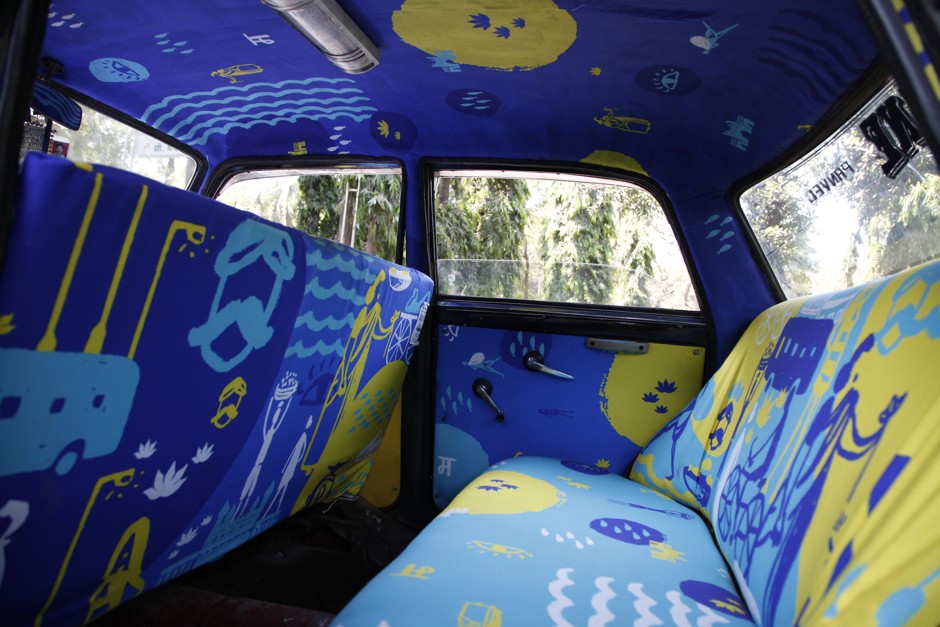
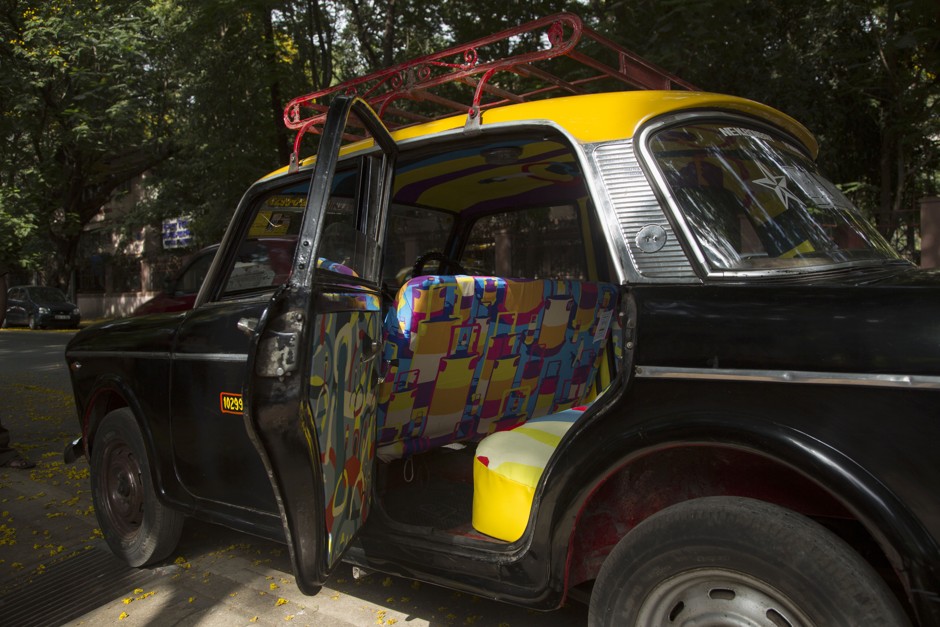
Sanket Avlani is the founder of Taxi Fabric, a project that has already turned seven of the city’s 50,000-plus taxicabs into works of arts. The interior of each taxi, from the ceiling and doors to the seats, has been specially designed by local Mumbai designers, and the designs themselves are inspired by India’s most populous city.

Take the latest taxi to get Taxi Fabric’s special treatment—the design, by 25-year-old typographer and designer Pavithra Dikshit, features jasmine flowers, peppers, and lemons against an eye-popping green background. Called “Urban Garden,” it’s Dikshit’s way of paying homage to Mumbai’s disappearing green space.

“As a fast-growing metropolis, it has building and buildings coming up in every space,” says Dikshit. “The green color is shrinking, so I wanted my taxi to show to all the green things around you.”

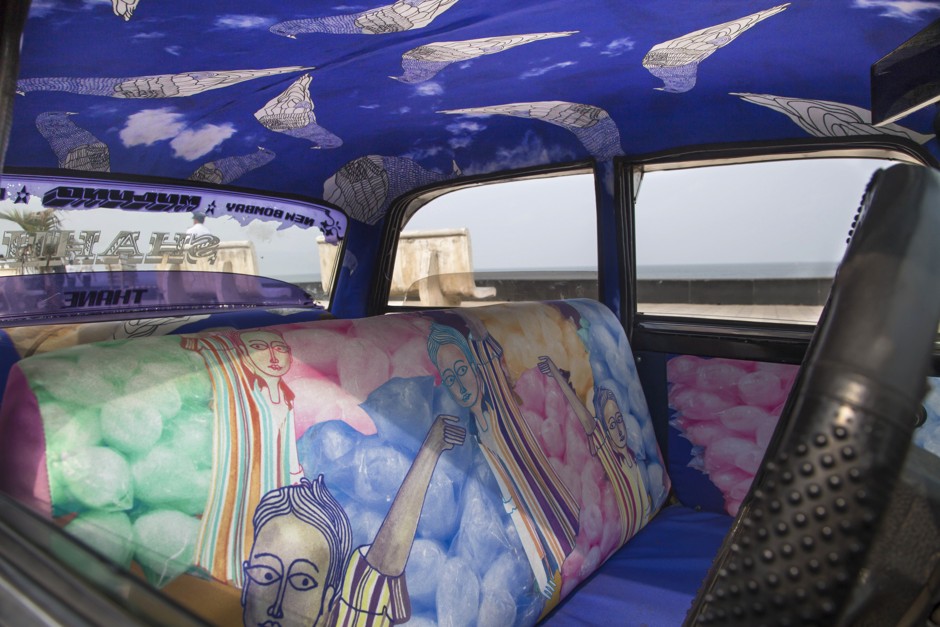
Other designs were inspired the daily life of a Mumbaikar—the different people you meet on the streets, from businessmen to children to vegetable vendors; and the personal stories of the cab drivers themselves.

Mumbai has a relatively small design community and an even smaller appreciation for the profession, says Avlani, who grew up in Mumbai and now works in London. “The design world is very small there, and most of the designers know each other,” he says. “If you wish to study design in India, not many people would understand or encourage it as much as they would in Europe or the United States.”

His hope is that the project will help spark conversation about the designs between taxi drivers and passengers. For Avlani, the iconic black-and-yellow taxis are the perfect medium because they’re everywhere.

”It’s so easy for people taking those taxis to react to those designs if the stories they tell are those that they recognize,” Avlani says. “If even the driver gets excited about it, it’s a win-win for everybody.”

As funding continues to trickle in from Taxi Fabric’s Kickstarter campaign, which runs until August 10, Avlani and his team hope to give at least 20 more cabs a special makeover by the end of the year.

Young designers and students who want to participate can submit a portfolioto the Taxi Fabric team, who will then select artists to work with. “We gauge if the designer can handle a project like this and if they can bring something new, and if the have their own style,” he says. Once accepted, artists will work with the team and, in some cases, cab drivers who want to be part of the program, to come up with a unique design.

The concept itself isn’t entirely new. It’s common for taxi drivers in Mumbai to customized their cars with colorful seat covers, eye-popping window decorations, lights, and little trinkets on the dashboard. “The taxi is like a desk at work. They spend their whole day in it so for them, it has to look interesting,”says Dikshit. “They don’t think that it attracts extra customers or anything, but it makes themselves feel good about spending [time] in it daily.”

But the bright pink, vibrant blue, and lively green colors that Taxi Fabric designers bring to cabs are a big step up from what drivers typically choose for their interior. Many drivers, Dikshit says, just go with fabric that’s already available at textile markets. “They’re very dull in color, like brown and maroon,” she says. “That’s how it’s always been, and nobody has the time to think about, ‘What if [the seat] is yellow?’”

Boring fabric doesn’t generate conversation, which Dikshit sees as a missed opportunity. “The drivers have their own stories, and they’re happy to discuss everything from politics to religion to traffic, to who they are as people,” she says. “You can almost consider them an extended part of the city landscape.”

Designed by Tasneem Amiruddin, this taxi art design reflects the daily life of a Mumbaikar. (Taxi Fabric)

A design by Taxi Fabric creator Sanket Avlani pays homage to “dawaballas,” who deliver hundreds of thousands of hot lunches across the city every day. (Taxi Fabric)

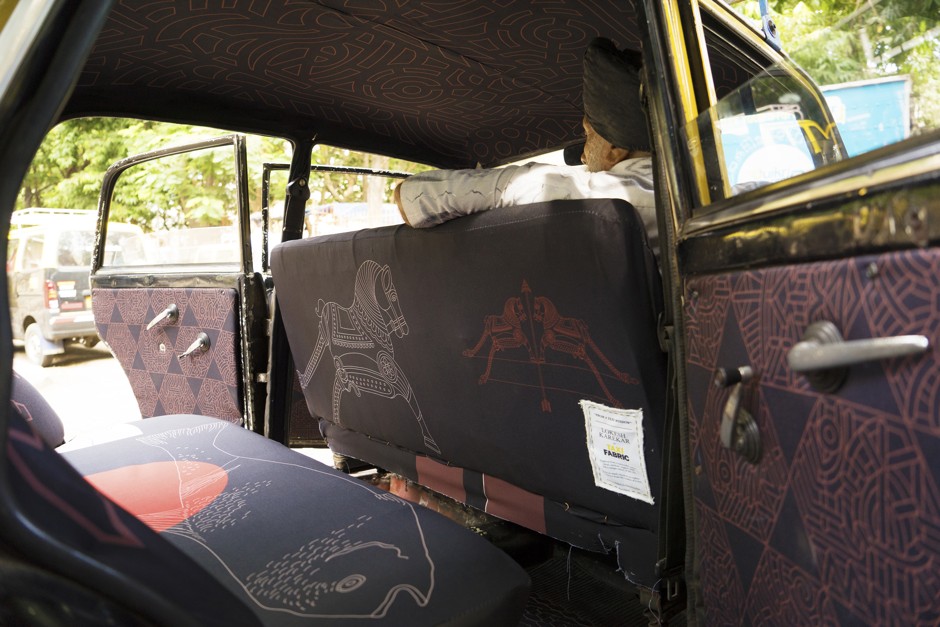
Artist Lokesh Karekar went for a minimalist design inspired by the 1980s. (Taxi Fabric)

Guarav Ogale wanted his design to reflect the life of the taxi’s driver. (Taxi Fabric)

Source…..Linda Poon ….www.citylab.com

Natarajan