வாரம் ஒரு கவிதை….” காந்திக்கு ஒரு கடிதம் “


காந்திக்கு ஒரு கடிதம்
———————-
விடுதலை பெற்று தந்தாய் என் தாய்
நாட்டுக்கு …உன்னையே விலையாகவும்
கொடுத்தாய் மத பேதம் இல்லா புதிய
பாரதம் ஒன்று படைக்க !
ஆனால் …
விடுதலை பெற்ற என் தேசம் இன்னும்
புது விடியலை தேடுதே …அது ஏன் ?
மதவாத அரசியலில் ஆதாயம் தேடுதே
ஒரு பெரும் கூட்டம் !
அது ஏன் ?
மூலைக்கு மூலை உன் சிலை
வைத்து காந்தி ஒரு பொம்மைதான் எங்கள்
அரசியல் விளையாட்டுக்கு என்று சொல்லாமல்
சொல்லுது ஒரு கூட்டம் !
காந்தியா …அது  யார் என்று கேக்குது
இன்னொரு கூட்டம் …காந்தி உன்னையே
மறந்த கூட்டம் காந்தீயக் கொள்கை கிடைக்குமா
ஒரு விலைக்கு என்று அலைவதும் உண்மை இன்று !
வேற்றுமையில் ஒற்றுமை என்பது வெறும் பேச்சு
மட்டுமா ?  ஒளிமயமான வலுவான பாரதம்
பிறப்பது எப்போது ?  என் தேசம் புது விடியல்
காண்பது எப்போது ?
சிலையாய் இருக்கும் காந்தி நீ இப்போது
எடுக்க வேண்டும் மீண்டும் ஒரு பிறவி !
காந்தி சிலைகள் எல்லாம்  உயிர் பெற்று
பல நூறு புதிய காந்திகளாய் என் மண்ணில்
பிறக்க வேண்டும் இப்போதே !
என் மண்ணின் விடுதலைக்கு ஒரே ஒரு
காந்தி நீ இருந்தாய்.. இன்று
இந்த  மண்ணின் புது விடியலுக்கு  பல  நூறு
காந்தி வேண்டுமே  அய்யா !
மறுக்காமல் நீ பிறப்பாயா அய்யா மீண்டும்
என் மண்ணில் ? ஒரு புதிய பாரதமும்
மலர்ந்து ஒளிருமா என் கண் முன்னால் ?
My kavithai as published in http://www.dinamani.com on 8th Oct 2017
Natarajan

Message for the Day…”Offer the flower of non-violence (ahimsa) to God. We regard ahimsa to mean not to cause harm and hurt to other living beings. The true meaning of ‘Ahimsa’ is to not cause hurt and harm through thoughts, words or deeds”

Source: http://media.radiosai.org/

Offer the flower of non-violence (ahimsa) to God. We regard ahimsa to mean not to cause harm and hurt to other living beings. The true meaning of ‘Ahimsa’ is to not cause hurt and harm through thoughts, words or deeds. The control of your sense organs is another flower that must be offered to God. Our senses run without any control. If running horses are not controlled, they pose a danger. God has created each organ of the human body for a specific purpose. It is only when we use these sensory organs along the right path for which they have been created will we be entitled to God’s grace. Our inner strength will decrease rapidly with agitation or unnecessary sorrow; body also suffers illness due to mental agitations and distractions. One ages very quickly through excitement and sorrow. The reason for your not preserving this sacred instrument in sound condition is lack of control over these sensory organs. Hence the second flower of sensory control should be used for worshipping God.

Moscow’s Bagel House…

In the early 1970s, Russian architect Evgeny Stamo and engineer Alexander Markelov came up with plans for an unusual house in the capital city Moscow. The house was to be shaped like a ring, about 150 meters across, enclosing a large inner courtyard with playgrounds and green spaces. The building was to have over nine hundred apartments, and all the necessary services and facilities, including shops, a pharmacy, a laundry room, a studio, post office, and so on. When completed in 1972, the authorities were so impressed that plans for more such house across Moscow were drawn up.

At that time, the Summer Olympic Games of 1980, which was to be hosted by the Soviet Union, was approaching, and the city decided to build five similar ring-shaped houses to symbolize the event. However, by the time the second ring house went up in 1979, on Dovzhenko street, the project was already shelved. The Soviet Union was on the brink of an economic collapse, and the buildings, it was realized, were too expensive to maintain. They are also bulky and inconvenient.

Besides, the proposed location of the buildings were spaced too far apart to provide any meaningful association with the five Olympic rings. Even if it did, a pedestrian could never see the rings from the street level or appreciate the composition.

Today, both buildings are still used as apartments. Each building has nine floors and over twenty entrances. Some say that finding the right entrance and locating the correct apartment is extremely difficult.

Locals affectionately call them the “bagel house”.

Source….kaushik in http://www.amusingplanet.com

natarajan

The Fascinating History of the Iconic Mysore Sandal Soap…

A soap that has held a special place in the hearts of Indians for more than a century, Mysore Sandal Soap’s legacy is intricately interwoven with Karnataka’s history and heritage.

There is something beautifully Indian about the fragrance of sandalwood. Sweet, warm, rich and woody, it is a scent that is deeply interwoven with the nation’s history and heritage. This is, perhaps, one of the many reasons why the Mysore Sandal Soap has held a special place in the hearts of Indians for more than a century.

Here’s the fascinating story behind India’s most-loved sandal soap.

One hundred and one years ago, in May 1916, Krishna Raja Wodiyar IV (the then Maharaja of Mysore) and Mokshagundam Visvesvaraya (the then Diwan of Mysore), set up the Government Sandalwood Oil factory at Mysore for sandalwood oil extraction.

The primary goal of the project was to utilise the excess stocks of the fragrant wood that had piled up after World War I halted the export of sandalwood from the kingdom of Mysore (the largest producer of sandalwood in the world at the time).

Two years later, the Maharaja was gifted a rare set of sandalwood oil soaps. This gave him the idea of producing similar soaps for the masses which he immediately shared with his bright Diwan. In total agreement about the need for industrial development in the state, the enterprising duo (who would go on to plan many projects whose benefits are still being reaped) immediately got to work.

A stickler for perfection, Visveswaraya wanted to produce a good quality soap that would also be affordable for the public. He invited technical experts from Bombay (now Mumbai) and made arrangements for soap making experiments on the premises of the Indian Institute of Science (IISc). Interestingly, the IISc had been set up in 1911 due to the efforts of another legendary Diwan of Mysore, K Sheshadri Iyer!

From the talent involved in the research happening at IISc, he identified a bright, young industrial chemist called Sosale Garalapuri Shastry and sent him to England to fine tune his knowledge about making soap. Affectionately remembered by many as Soap Shastry, the hardworking scientist would go on to play a key role in making Visveswaraya’s dream a reality.

After acquiring the required knowledge, Shastry quickly returned to Mysore where the Maharaja and his Diwan were waiting anxiously. He standardized the procedure of incorporating pure sandalwood oil in soaps after which the government soap factory was established near K R Circle in Bengaluru.

The same year, another oil extraction factory was set up at Mysore to ensure a steady supply of sandalwood oil to the soap making unit. In 1944, another unit was established in Shivamoga. Once the soap hit the market, it quickly became popular with the public, not just within the princely state but across the country.

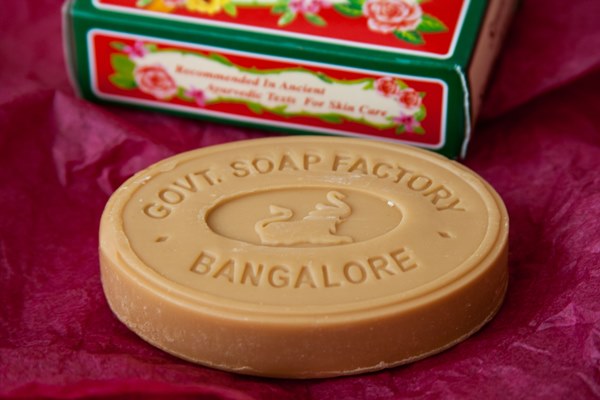
However, Shastry was not done yet. He also created a perfume from distilled sandalwood oil. Next, he decided to give the Mysore Sandal Soap a unique shape and innovative packaging. In those days, soaps would normally be rectangular in shape and packed in thin, glossy and brightly coloured paper. To help it stand out from the rest, he gave the soap an oval shape before working on a culturally significant packaging.

Cognizant of the Indian love of jewels, Shastry designed a rectangular box resembling a jewellery case— with floral prints and carefully chosen colours. At the centre of the design was the unusual logo he chose for the company, Sharaba (a mythical creature from local folklore with the head of an elephant and the body of a lion. A symbol of courage as well as wisdom, the scientist wanted it to symbolise the state’s rich heritage.

The message ‘Srigandhada Tavarininda’ (that translates to ‘from the maternal home of sandalwood’) was printed on every Mysore Sandal Soapbox. The aromatic soap itself was wrapped in delicate white paper, similar to the ones used by jewellery shops to pack jewels.

This was followed by a systematic and well-planned advertising campaign with cities across the country carrying vibrant signboards in neon colours. Pictures of the soapbox were noticeable everywhere, from tram tickets to matchboxes. Even a camel procession was held to advertise the soap in Karachi!

The out-of-the-box campaign led to rich results. The soap’s demand in India and abroad touched new heights, with even royal families of foreign nations ordering it for themselves. Another important turning point for the company was when, in 1980, it was merged with the oil extraction units (in Mysuru and Shivamoga) and incorporated into one company called Karnataka Soaps and Detergent Limited (KSDL).

However, in the early 1990s, the state-run firm did face a rough patch due to multinational competition, declining demand and lack of coordination between sales and production departments. As losses started rising, it was given a rehabilitation package by BIFR (Board for Industrial & Financial Reconstruction) and KSDL grabbed the lifeline with both hands.

The company streamlined its way of functioning and soon it had started showing profits again. Thanks to rising profits year after year, it had soon wiped out all its losses and repaid its entire debt to BIFR by 2003. The company also successfully diversified into other soaps, incense sticks, essential oils, hand washes, talcum powder etc.

Nonetheless, the Mysore Sandal Soap remains the company’s flagship product, the only soap in the world made from 100% pure sandalwood oil (along with other natural essential oils such as patchouli, vetiver, orange, geranium and palm rose). Due to tremendous brand recall and loyalty associated with the soap, it also bags a prized position on the shopping lists of visiting NRIs.

In 2006, the iconic was awarded a Geographical Indicator (GI) tag — that means anyone can make and market a sandalwood soap but only KSDL can rightfully claim it to be a ‘Mysore Sandalwood’ soap.

Thanks to this near-monopolistic presence in the market for sandalwood bathing soaps, KSDL has also become one of Karnataka’s few public sector enterprises that turns consistent profits. In fact, the company registered its highest gross sales turnover (of ₹476 crore) in 2015-16.

Such is the legacy of sandalwood and this earthy, oval-shaped soap in the state that even Karnataka’s thriving film industry calls itself Sandalwood!

Today, there are a multitude of branded soaps in the market but Mysore Sandal Soap continues to hold a distinctive place among all of them. Its production figures continue to rise, even as the availability of sandalwood is on the decline.

To counter this, KSDL has been running a ‘Grow More Sandalwood’ programme for farmers, that provides affordable sandalwood saplings along with a buy-back guarantee.Working in partnership with the forest department, it is also working to ensure that for every sandalwood removed for extraction, a sandalwood sapling is planted to replace it.

The story of Mysore Sandal Soap and its enduring appeal is an inspiration not just for Indian PSUs but for the entire FMCG sector. Here’s hoping that its future is aromatic as its history!

Source….www.the betterindia.com

Natarajan
 

Joke of the Day…”Let my chauffeur answer this…” !!!


When Albert Einstein was making the rounds of the speaker’s circuit, he usually found himself eagerly longing to get back to his laboratory work. One night as they were driving to yet another dinner, Einstein mentioned to his chauffeur (a man who somewhat resembled Einstein in looks & manner) that he was tired of speech-making.

“I have an idea, boss,” his chauffeur said. “I’ve heard you give this speech so many times, I’ll bet I could give it for you.”

Einstein laughed loudly and said, “Why not? Let’s do it!”

When they arrived at the dinner, Einstein donned the chauffeur’s cap and jacket and sat in the back of the room. The chauffeur gave a beautiful rendition of Einstein’s speech and even answered a few questions expertly.

Then a supremely pompous professor asked an extremely esoteric question about antimatter formation, digressing here and there to let everyone in the audience know that he was nobody’s fool.

Without missing a beat, the chauffeur fixed the professor with a steely stare and said, “Sir, the answer to that question is so simple that I will let my chauffeur, who is sitting in the back, answer it for me.” 

Source…..www.ba-bamail.com

Natarajan

Message for the Day…”The toughest fibre is anger; it is indeed the stickiest dirt! When you get angry, you forget everything and quickly descend to the lowest depth. You lose all discrimination during the agitation. Be Aware! Cultivate virtues assiduously. Virtue is your life-breath, character is the backbone.”

Source…..http://media.radiosai.org/

In temples or homes, you may have seen people breaking coconuts to offer to God. If you try to break the nut just as it fell from the tree, will it break? No! The fibrous outer cover must be removed to first expose the shell. The fibre protects the shell and lets it grow, preventing blows from the environment. Liberation results from breaking the mind filled with vagaries and wishes. But how can you break it when the fibrous armour of sensual desires encompasses it? So, carefully and persistently, remove them and dedicate your mind to God! Smash it open in His presence. At that very moment, you are set free! The toughest fibre is anger; it is indeed the stickiest dirt! When you get angry, you forget everything and quickly descend to the lowest depth. You lose all discrimination during the agitation. Be Aware! Cultivate virtues assiduously. Virtue is your life-breath, character is the backbone.

A Garden In A Sinkhole…

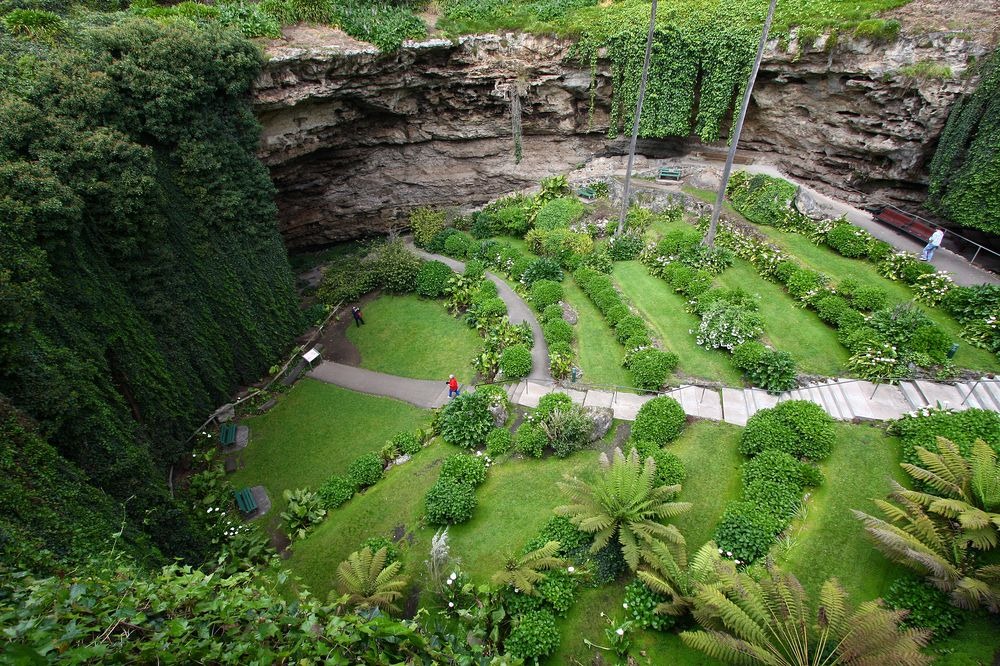
The region in the southeast of South Australia, near Mount Gambier, is littered with many volcanic and karst features such as volcanic craters, lakes, limestone caves, water-filled caves and sinkholes. One particular sinkhole, located just off Jubilee Highway East, is particularly worth visiting. What was once a typical limestone cave formed by the corrosion of limestone rocks by seawater, and the subsequent collapse of the chamber’s roof, has been transformed into a beautiful garden.

The Sunken Garden in the Umpherston Sinkhole was built by James Umpherston in the 1880s, after he purchased the property about twenty years prior. Being retired, Umpherson wanted to create a place where the people of Mount Gambier could come to relax and escape the heat of summer. He carved a path in the side of the rock and erected a set of wooden steps so people could descend into the sinkhole and to his sunken garden, where he planted all sorts of ferns, shrubs and flowers. The sinkhole even had a small lake within where visitors could take boat rides.

The garden became an immediate success and very popular among the residents of Mount Gambier. After James Umpherston died in 1900, his garden fell into disrepair, and it was only about forty years ago that the garden was rescued from a rubbish dump that it had become. The garden was restored by the employees of the South Australian Woods and Forests Department in 1976. They removed the rubbish and cleared the weeds, and planted hydrangeas and other species along the terraces.

Once again, the garden has become a popular recreation spot. In 1995, the garden was added to the South Australian Heritage Register.

Source….kaushik in http://www.amusingplanet.com

Natarajan

The Earth Pyramids of South Tyrol…


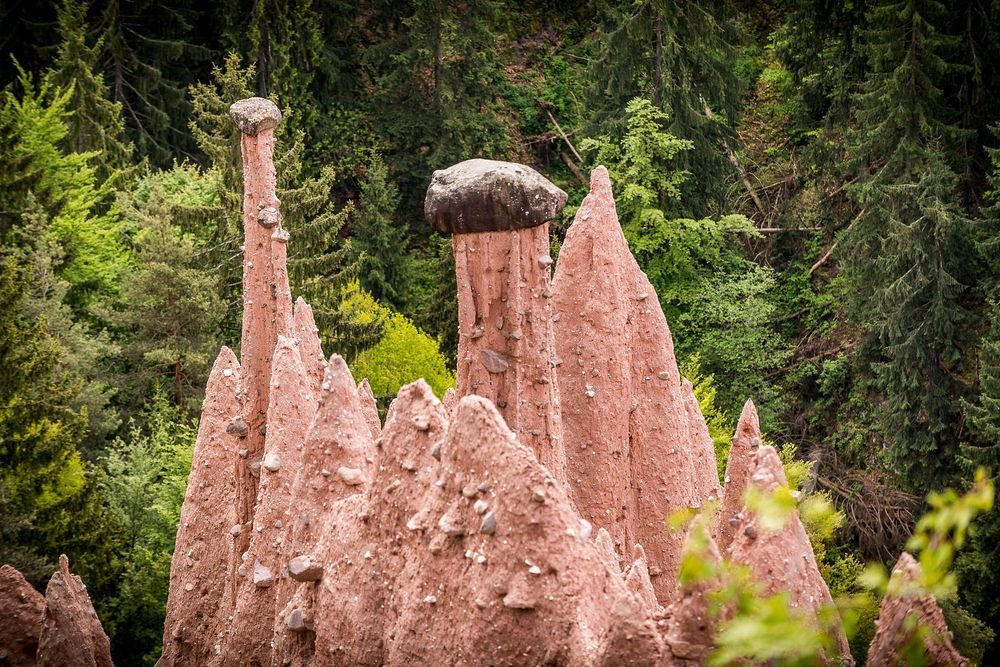
At many places across South Tyrol, in northern Italy, one can see a peculiar geological formation called “earth pyramids”. They consist of tall cone-shaped pillars made of clay, with a boulder resting on top.

These unusual structures started forming from moraine clay soil left behind after the last Ice Age when the glaciers melted away. In dry condition the soil is hard as stone, but as soon as it rains, it turns into a soft muddy mass, starts sliding, and forms large slopes 10 to 15 meters steep. When the rainy season starts, these slopes erode away. But when there are rocks in the mud, the clay soil underneath these rocks stays protected from the rain. So, while the surrounding material is continually carried off with the rain, the protected pillars rise out of the ground to form majestic earth pyramids. It can take hundreds to thousands of years for these pyramids to form.

The pillars continue to erode, but more slowly then the rest of the terrain. At some point in the future, the columns will lose the strength to hold the large rock overhead. Once the boulder falls from the peak, the column will erode away rapidly.

Earth pyramids are unique to South Tyrol, but fairly widespread. The best ones are located on the Ritten, a plateau not far from Bozen in northern Italy. Earth pyramids are also found at Platten near Percha in the Puster Valley.

Source….Kaushik in http://www.amusingplanet.com

Natarajan

Message for the Day….”The only way to get everlasting joy is through Bhakti (devotion); that is the best among the yuktis (the paths dictated by intelligence). That alone gives the shakti (the strength)”

Source:http://media.radiosai.org

The world around is full of sorrow and strife; you are trying to avoid them and derive a little joy and peace somehow, overlooking the grief and disappointment. Your efforts are like digging a well in a sand heap. The deeper you dig, the faster it caves in, and then, you begin the whole process at a slightly different place! When piles of sensual desires overwhelm you and drag you down to grief, you think of a way out! The only way to get everlasting joy is through Bhakti (devotion); that is the best among the yuktis (the paths dictated by intelligence). That alone gives the shakti (the strength). The seed of devotion grows only in a well-prepared ground. The method of preparation is given in the Vedas. It clearly articulates the code of conduct, the method of living and the ideals to be followed. Adhere to the code of conduct. Even if you have not been able to study the Vedas, listen to the words of those who follow its teachings and have been overcome by the joy of that experience!

Message for the Day…”We worship God with flowers, offer ritual adoration (puja) and pay obeisance. There is something sacred and superior than this! It is to offer God a pure mind and good conduct. This is called Paraa Bhakti.”

Source: http://media.radiosai.org

We worship God with flowers, offer ritual adoration (puja) and pay obeisance. There is something sacred and superior than this! It is to offer God a pure mind and good conduct. This is called Paraa Bhakti. By worshiping God with puja and flowers, the spiritual aspirant remains stationary in their journey to God; failing to rise to a higher position is unwise. The worldly flowers always fade, lose fragrance and develop unpleasant odours. Instead of worshipping with worldly, impermanent flowers and receiving transient rewards from God, worship Him with what is lasting to attain a much higher stage. The first flower to offer God is non-violence (ahimsa). The second is control of senses (dhama). The third is compassion to all living beings (daya). The fourth is forbearance (kshama). The fifth is peace (shanti). The sixth is tapas (penance). The seventh is meditation (Dhyana). And the eighth is the flower of Truth (Sathya).