I pride myself on being patient when teaching driver education, something I have done for 30 years. I have encountered many, many students, who didn’t seem to be able to hit the floor with their hat. But one incident was just too much.
I had a sweet young thing behind the wheel for the first lesson of the semester. She had volunteered to go first and seemed ready to show the other two kids how well she could drive. We left the rural school and started toward town.
As we approached the first stop sign, the young lady gave no sign that she saw it. We got closer, but she still did not slow down. Finally, I used the “teacher’s brake” pedal, on my side of the car, to get us stopped.
When I asked her why she didn’t slow down to stop for the stop sign, she replied, “but, Mr. Smith, the speed limit is 35 ALL the way to the stop sign!”
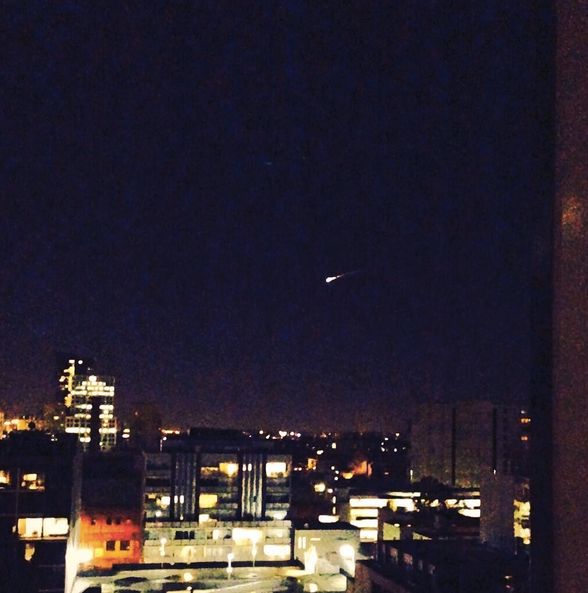
Bright meteor over Australia on July 10 was a rocket reentry
That bright meteor over Australia – seen by many – was likely the reentry of the upper state of a Soyuz rocket, launched two days earlier. over
UPDATE JULY 10 AT 1815 UTC (1:15 P.M. CDT). Experts are now reporting that today’s bright meteor – widely reported over southeastern Australia today (July 10, 2014) – was not a piece of natural space debris, but instead was the reentry of the upper state of a Soyuz rocket, launched on July 8. It seems the meteor was part of the vehicle used to launch Russia’s second Meteor-M weather satellite. Jonathan McDowell (@planet4589), an astronomer at the Harvard-Smithsonian Center for Astrophysics, tweeted that the Australian meteor was:
… Object 40077, 3rd stage from Meteor-M launch, reentered over Australia at about 1145 UTC Jul 10
Daniel Fischer (@cosmos4u) pointed out that time and location of the Australian meteor event appear to match the last TIP (Tracking and Impact Prediction) message for the reentry. And, as Fischer pointed out on Twitter just now:
He’s talking about the video below, caught by in Australia via mobile phone. You can see that the meteor does take awhile to streak across the sky, and, indeed, in verbal reports of the meteor from earlier today, people were commenting on how slow it was.
Thursday night in Australia, reports of a very bright and slow-moving shooting star flooded into the Brisbane Times, which covers the widely populated states of Victoria and New South Wales in southeastern Australia. People in the city of Melbourne, Australia’s second-largest city, also reported a bright object streaking through the sky. The Sun Herald in Melbourne reported:
Social media lit up when the unusual spectacle was seen at around 10pm.
The object – described by witnesses as like a flame – was reported to be flying rapidly.
Charmaine Harris from Thornbury said it lasted more than a minute.
The Australia Bureau of Meteorology, which received reports of the July 10 meteor around 10 p.m., at first said it could be natural debris from space or artificial space junk. Now, it appears it was space junk.
Aviation Week reported on the launch of a Russian Soyuz-2.1b rocket with a Fregat upper stage – carrying a Russian weather satellite and six small spacecraft to orbit on July 8. According to Aviation Week, liftoff took place at 9:58 p.m. local time from the Baikonur Cosmodrome in Kazakhstan.
They said this satellite – Russia’s second Meteor-M weather satellite – is designed to monitor global hydrometeorological data for weather forecasting and to gather data on the ozone and radiation environment in near-Earth space. It will also measure sea-surface temperature, monitoring icy conditions at the poles for navigation. The satellite itself, presumably still safely in orbit, has a design life of five years.
Bottom line: A bright meteor was seen by many in Australia around 10 p.m. local time on July 10, 2014. Experts are now reporting that the meteor was not a piece of natural space debris, but instead was the reentry of the upper state of a Soyuz rocket, launched on july8.
‘Auto Anna’ Annadurai has upped the ante this football season. By streaming the FIFA World Cup live in his auto, he has managed to douse many Chennaiites’ angst against auto-drivers! Photos: Vikas Vasu
Annadurai, a share auto driver on the Thiruvanmiyur-Sholinganallur route, live streams the FIFA World Cup for his customers.
With the FIFA fever catching up with him as well, the innovative auto driver from Thanjavur district says, “I support Argentina and I love Messi!”
Apart from the FIFA live streaming, Annadurai also live streamed the Lok Sabha Election results and all IPL matches (he has subscribed to Sony Six).
The posters on his auto are too catchy to miss. His ‘Amazing Auto’ offers live streaming of the FIFA World Cup and also asks customers to ‘like’ him in his facebook page.
Traditional mouthwash is usually made with a sharp mint flavor to make our breath smell fresh and pleasant. However, mint only masks the smell and actually feeds the odor-causing bacteria with more sugar. Also, most commercial brands of mouthwash are made up mostly from synthetic colors, flavors and chemicals that are nowhere near good for you.
Instead of just pretending to freshen your breath, you can make your own mouthwash at home using natural ingredients that will clean your mouth from the bottom up. This mouthwash is made from ingredients that you likely have at home, so give it a shot (literally) and get to know the homemade goodness you’ve been missing!
About the ingredients:
Honey: This ingredient has a number of anti-bacterial properties that kill off all the bad bacteria in your mouth, instead of feeding them with sugar. Also, adding honey makes the wash taste better. Use organic or raw honey for the best results.
Cinnamon: A miracle spice in every way, cinnamon gets rid of odor by killing off the odor-causing bacteria in one blast. The International Association for Dental Research found that people who chewed cinnamon gum had a 50 percent decrease in oral bacteria versus people who chewed mint gum.
Lemon: The last ingredient of this mouthwash is a given; lemon is strong, refreshing and cleansing, so it will wash all the hidden food and bacteria from your mouth. It has whitening properties. Just make sure not to add too much lemon because it can erode your enamel if not used properly.
Recipe makes: One small bottle of mouthwash
Ingredients:
Juice of 2 freshly squeezed lemons
1/2 tablespoon of ground cinnamon
1/2 or 1 teaspoon baking soda (more whitening properties)
1 1/2 teaspoon of honey
1 cup of warm water (to melt the honey)
A clean bottle or jar with a lid
Mix together all of the ingredients and give it a shake. Swish or gargle 1-2 tablespoons of the mouthwash for a minute after brushing your teeth or whenever you want to freshen your breath. Don’t use the mouthwash more than once to twice a day (the lemon is very acidic).
Enjoy your fresh breath and clean mouth and take pride in your fantastic homemade mouthwash!
Poornima means the effulgent fullmoon. Guru is One who removes darkness and delusion from the heart and illumines it with the higher wisdom. The moon and the mind are interrelated, as object and image. On this day, the moon is full, fair and cool, its light pleasant and peaceful; the light of the mind too has to be pleasing and pure. In the firmament of your heart, the moon is the mind. Sensual desires and worldly activities are the clouds, thick and heavy which mar your joy at the light of the moon. Let the strong breeze of love scatter the clouds away and confer on you the cool glory of moonlight. When devotion shines full, the sky in the heart becomes a bowl of beauty and life is transformed into a charming avenue of Ananda (bliss). That beauty of heart, that bliss in life can be won through the mind, if the lesson of this day is remembered and realised.
After Florida coach Steve Spurrior passes away and enters the Pearly Gates, God takes him on a tour. He shows Steve a little 2-bedroom house with a faded UF banner hanging from the front porch. “This is your home, Coach. Most people don’t get their own house up here,” God exclaims.
Little Steve looks at the house, then turns around and looks at the one sitting on the top of the hill. It’s a huge two-story mansion with white marble columns and little patios under all of the windows. LSU flags line both sides of the sidewalk with a huge purple and gold LSU banner hanging between the marble columns.
“Thanks for the home, God, but let me ask you a question. I get this little 2 bedroom house with a faded Florida banner, and Nick Saban gets a mansion with new LSU banners and flags flying all over the place. Why is that?”
God looks at him seriously for a moment and then replies, “That’s not Saban’s house, that’s mine!!!!!”
In this photograph taken on July 5, 2014, the Salal Hydro Power project dam on India’s Chenab river is seen in Riasi.
Kauri: Indian engineers are toiling in the Himalayas to build the world’s highest railway bridge which is expected to be 35 metres taller than the Eiffel Tower when completed by 2016.
The arch-shaped steel structure is being constructed over the Chenab River to link sections of the spectacular mountainous region of India’s northern Jammu and Kashmir state.
The bridge is expected to be 359 metres (1,177 feet) high when completed — surpassing the world’s current tallest railway bridge over the Beipanjiang River in China’s Guizhou province, which stands at 275 metres high.
“It is an engineering marvel. We hope to get this bridge ready by December 2016,” a senior Indian Railways official told AFP.
“The design would ensure that it withstands seismic activities and high wind speeds,” he said Wednesday.
Work on the bridge started in 2002 but safety and feasibility concerns, including the area’s strong winds, saw the project halted in 2008 before being green-lighted again two years later.
The estimated cost of the project, which is being handled by Konkan Railway Corporation, a subsidiary of state-owned Indian Railways, is $92 million.
The bridge will connect Baramulla to Jammu in the Himalayan state with a travel time of six-and-a-half hours, almost half the time it currently takes.
The main arch is being erected using two cable cranes attached on either side of the river which are secured on enormous steel pylons, according to engineers of the project.
The 1,315-metre long bridge will use up to 25,000 tonnes of steel with some material being transported by helicopters due to the tough terrain, they said.
“One of the biggest challenges involved was constructing the bridge without obstructing the flow of the river,” the railways official said.
“Approach roads had to be constructed to reach the foundations of the bridge,” he added
Older than Indian cinema, Zohra Sehgal had a glorious performing career that inspired
generations.
Zohra Sehgal, a quintessential Bollywood diva who essayed character roles with aplomb in a career spanning over seven decades in both theatre and cinema, died in New Delhi on Thursday at the age of 102. Photo: S. Subramanium The Hindu
Often called the grand old lady of Bollywood, she last appeared in Sanjay Leela Bhansali’s Saawariya(with Ranbir Kapoor and Sonam Kapoor) in 2007. She acted in hits like Cheeni Kum (with Amitabh Bachchan), Dil Se (with Shah Rukh Khan and Manisha Koirala), Veer Zaara (Shah Rukh and Preity Zinta), Hum Dil De Chuke Sanam (Salman Khan and Aishwarya Rai) and Bend It Like Beckham.
Born on April 27, 1912 in Saharanpur in Uttar Pradesh in a traditional Muslim family, Sehgal, third of her seven siblings, grew up in Chakrata near Dehradun and was sent to Lahore to pursue her higher education.
As a dancer, she performed across Japan, Egypt, Europe and the U.S.. She married scientist, painter and dancer Kameshwar Sehgal in August 1942. The couple had two children, Kiran and Pavan. Kameshwar died in 1952 and Zohra raised the children all by herself.
On her return from foreign trips, Sehgal had to don the burqa while studying in Lahore’s prestigious Queen Mary College, meant for daughters of aristocratic families, an institution where strict purdah was observed and males invited to speak there were put behind a screen.
Considered the doyenne of Indian theatre, Ms. Sehgal acted with Indian People’s Theatre Association (IPTA) and Prithviraj Kapoor’s Prithvi Theatre for 14 years. In 1946, she debuted in IPTA’s first film production Dharti Ke Lal, which dealt with the Bengal famine. She also acted in another IPTA film — Chetan Anand’s Neecha Nagar.
She choreographed for a few Hindi films as well, including classics like Guru Dutt’s Baazi (1951) and the dream sequence song in Raj Kapoor’s film Awaara.
Sehgal moved to London on a drama scholarship in 1962, where she appeared in many TV productions including The Jewel in the Crown, Tandoori Nights, My Beautiful Laundrette and The Raj Quartet.
Born Sahibzadi Zohra Begum Mumtaz-Ullah Khan on April 27, 1912 in Saharanpur, Uttar Pradesh, Zohra Sehgal began her career as a dancer with Uday Shankar in 1935 and performed across Japan, Egypt, Europe and the U.S. In this April 2012 photo, Zohra Sehgal reacts while cutting a cake on her 100th birthday in New Delhi. Photo: PTI
Zohra Sehgal was awarded the Padma Shri in 1998 and the Kalidas Samman in 2001. The Sangeet Natak Akademi presented her with its highest award, the Sangeet Natak Akademi Fellowship in 2004. She received the Padma Vibhushan, India’s second-highest civilian honour in 2010. In this April 2010 photo, then President Pratibha Patil presents the Padma Vibhushan to Zohra Segal. Photo: PTI
A rare photo of Zohra Sehgal with Uday Shankar’s wife Amala Shankar at Uday Shankar’s dance centre in Almora. Photo: The Hindu Archives
Zohra Sehgal with her sister from Pakistan Uzra Butt in New Delhi in 2003. “All my life I have been active in my profession since October 8, 1935. Even when my children were born, or my husband committed suicide, I managed to carry on. After the 75th year of my career, I decided to stop,” Zohra Sehgal had said in April 2012 when she turned 100. And when asked whether she had any wishes left, she memorably had said, “I want long blonde hair, an hourglass figure and 5 foot 6 inches height.” Photo: The Hindu
Considered the doyenne of Indian theatre, Zohra Sehgal was associated with the Indian People’s Theatre Association (IPTA) and Prithviraj Kapoor’s Prithvi Theatre for 14 years. She choreographed for a few Hindi films as well, including classics like Guru Dutt’s “Baazi” (1951) and the dream sequence song in Raj Kapoor’s film “Awaara”. In this June 13, 2009 photo, Zohra Sehgal gets emotional during a meeting in the memory of eminent theatre personality and another IPTA veteran Habib Tanvir at Abhimanch Theatre, NSD, in New Delhi. Photo: The Hindu