Will the Mist Lift in Kodaikanal….?

“If the company accepts its mistake and compensates us, it would serve as justice.” Helen Margaret with her mentally-disabled son Nitesh Kumar. Photo: Sruthisagar Yamunan

The focus on mercury poisoning following a popular rap song raises hopes for victims in Kodaikanal

The serene view of the Kodaikanal hills from the ‘Coaker’s Walk’ hides a tale of melancholy and everyday struggle. As she flitted from one pushcart to another attending to a rare tourist in this off-season, Helen Margaret, now 39, recalled in a tremulous voice her days as a worker at the defunct thermometer factory of Hindustan Unilever on St. Mary’s road. “In the three years from 1996 when I worked there, I did not know the hazards of mercury. We used to play with the silvery liquid, often throwing it at each other,” she recollects, making the “bhoni” (first sale of the day) of her small fruit cart.

Playing with mercury, recognised as one among top ten chemicals of major public health concern, came with a price, she says. Her second son Nitesh Kumar was born with mental disability in 2000.

Subsequently, her husband, a chronic diabetic, died. Today, Ms. Margaret takes care of three school-going sons from a meagre income of Rs 150 a day. “I cannot leave Nitesh alone for a minute. He studies at the Church-run school for the disabled nearby. I make multiple visits to check on him. My life is a struggle that I cannot explain,” she rues, outraged by a recent comment by Unilever CEO Paul Polman that he wants only facts and not “false emotions” on Kodaikanal.

The ‘Kodaikanal Won’t’ rap video released this month has brought focus to the plight of these former workers, and the pristine environment of this Western Ghat hill station.

According to the World Health Organisation, foetuses are most susceptible to developmental effects due to mercury. “It can adversely affect a baby’s growing brain and nervous system. The primary health effect of methylmercury is impaired neurological development.” Industrial processing is listed as one of the two important ways of exposure to mercury. And former workers say they were exposed to a lot of mercury.

“I never wore a glove when I handled the thermometer. I had severe skin rashes, which were treated as allergies. It was only after the factory was shut in 2001 that we came to know of the dangers of mercury. We were never told about it when we worked,” says P. Sangeetha, who claims to have worked at the site in 1996 when she was just 14 years old.

The company maintained women were never allowed to work in mercury area.

Her father, Govindhan, was contractually employed as a security staffer which involved several inspection rounds around the site. In 2000, Govindhan died following an alarming drop in haemoglobin levels.

An HUL-driven study published in 2006 in the Indian Journal of Occupational and Environmental Health, based on the examination of 255 employees and contract workers in 2001, found many showing symptoms of various possible disorders that activists state were the result of exposure to mercury vapour. However, supported by clean chits from three institutions of repute–the All India Institute of Medical Sciences , National Institute of Occupational Health and Industrial Toxicology Research Centre–the company has maintained that mercury in its factory had nothing to do with the health issues of the workers. Nor has it had any effect on the environment.

S.A. Mahindran of the 550–strong Ex-Mercury Employees Welfare Association, which has approached the Madras High Court for compensation to workers, states that the three reports cited by HUL were given by experts without meeting any of the workers. “On the contrary, a Ministry of Labour constituted committee concluded that there was prima facie evidence that not only ex-workers, but also their children have suffered on account of mercury exposure. This committee met the workers in October 2011 and was a first-hand study.”

In many cases, the company has replied that it does not possess records of annual medical check-ups of workers.

Many though claim to have continuing symptoms while over 40 former workers have allegedly died due to mercury-related issues, the association says. K.M. Gias Mohammed Gori was one of the first to join the thermometer plant when it opened in 1984. “At that time, Kodaikanal had no industries. People were begging for employment. When the plant opened, we all rushed to join and saw it as a blessing,” he recalls. But within a year or two, Mr. Gori began experiencing loss of teeth, which the committee in 2011 noted as one ill-effect of mercury exposure. “Soon, I experienced severe fatigue and backache and left the job. I live in poverty in this 10 ft x10 ft thatched hut. Let Mr. Polman come and see if my emotion is fake,” he says.

The long-drawn legal battle has also tired out the workers. The Madras High Court has not heard the matter since 2013 even as workers complain of great financial burden from medical expenses.

On the environment front, the battle has been raging on the standards to which the mercury contaminated soil needs to be cleaned up. Citing media reports, Member of Parliament and Pattali Makkal Katchi leader, Anbumani Ramadoss, one of the first to react, stated that the company was proposing a remediation norm that was 25 times laxer than those prevalent in the United Kingdom, where Unilever has its headquarters.

“They are providing techno-commercial reasons as justification of the lax standard. In the UK, the permissible mercury level is 1mg/kg whereas the company wants a standard of 20-25mg/kg of soil here. By its own estimation, it let out 1.2 tonnes of mercury into the Pambar Shola forests. This is environmental colonialism,” says environment activist Nityanand Jayaraman, who has worked on the issue since 2001 when the company was shut by the Tamil Nadu Pollution Control Board (TNPCB) after evidence emerged that mercury-contaminated glass was sold to scrap dealers a few kilometers away from the factory site.

With the rap song, viewed over two million times on YouTube, building up pressure, HUL has now submitted the Detailed Project Report (DPR) for remediation in Kodaikanal to the TNPCB. However, questions from The Hindu on what the cleaning standard the DPR proposed went unanswered. An HUL spokesperson said via email that preparatory work for the process will begin immediately. In 2003, an expert decontamination team from the U.S. removed tonnes of partially treated mercury sludge from the site. The workers have accused TNPCB of collusion.

With upcoming Assembly elections, the Kodaikanal Municipality, blamed for being silent all along, has got into the act, with its chairman M. Sridhar committing to pass a resolution against the company with a demand for compensation for environmental degradation during a public consultation meeting on August 12.

Activists note that water flowing through contaminated soil finally reaches the Vaigai dam, which irrigates thousands of hectares in South Tamil Nadu. “We have also decided to campaign for the boycott of Unilever products and to boycott elections if no solution is found,” says Mr. Mahindran.

But these technicalities have very little relevance for Ms. Margaret. “If the company accepts its mistake and compensates us, it would serve as justice and would reduce the burden on our lives,” she says, as she helps her son Nitesh back into the classroom.

Timeline:

2001 TNPCB shuts down the HUL thermometer factory after sale of mercury contaminated glass to scrap dealers is detected. Health study of workers done
2003 Large amount of mercury scrap sent back to the U.S.
2006 Ex-employees move Madras High Court against Unilever. Health effects such as miscarriages, kidney and nervous system damages, mental disability in children etc. stated
2011 Committee constituted by Ministry of Labour concludes there was prima facie evidence of mercury-related ailments in workers
2015 Unilever CEO Paul Polman says he is determined to solve the issue after international focus following rap song

Source…..

Natarajan

Saina Nehwal At Cusp Of Indian Badminton History….

SAINA NEHWAL ALL ENGLAND

Wounded by a humiliating defeat by Sri Lanka in the Galle Test, India will know on Sunday if another champion, in another sport, can salvage that loss. If badminton ace, Saina Nehwal, can overcome world no.1 Carolina Marina of Spain in the final of the Badminton World Championships, it would be the first time an Indian has won at this tournament.

World No.2 Nehwal notched up a 21-17 21-17 win over Indonesia’s Lindaweni Fanetri, who was struggling with her right knee, in the semifinals of the women’s singles on Saturday.

Irrespective of Saina’s win or loss, it is already India’s best ever performance at these championships. Saina’s silver or gold would be India’s fifth medal and the furthest any Indian has progressed at the World Championship. P V Sindhu clinched the bronze twice in 2013 and 2014 and Jwala Gutta and Ashwini Ponnappa notched up a bronze in women’s doubles at the 2011 edition.

Legendary shuttler Prakash Padukone was the first Indian to win a bronze at the 1983 edition.

Nehwal, who has won close to 20 international titles including the Olympics bronze, was always unlucky when it came to the World championship. She was struck down by chicken pox once, stomach bug later – the 24-year-old was always laid low by some off-court problems. Even before the Worlds she was suffering from shoulder niggle but she did not allow that to affect her game.

The semi-finals on Saturday between Nehwal and Fanetri was a grinding duel. Fanetri, the home-crowd favourtie, was playing with a strapping on her right knee, engaged in long rallies and gave Nehwal a tough fight at the Gelora Bung Karno Stadium.

Lindaweni opened up a 6-2 lead early on in the first game as Saina tried to get a hang of the drift in the stadium. The Indonesian had to take some tips from the team doctor after feeling some pain in her knee at 7-6.

The Indonesian looked restricted in her movement as Saina clawed back at 9-9 and grabbed the lead next when Lindaweni hit wide. A service fault helped Lindaweni to level score at 10-10 but Saina went into the break with a 11-10 lead after winning a long rally.

After the interval, Saina increased the gap to 15-12 but the Indian committed a few unforced errors to allow Lindaweni draw parity at 15-15. A net fault and a wide shot by the Indonesian gave Saina a 18-16 lead.

(With inputs from PTI)

Source….Jacob Koshy in http://www.huffington post.com

Natarajan

India Celebrates 69th Independence Day….

Patriotic fervour swept the nation on Saturday as it celebrated its 69th Independence Day, with chief ministers announcing development initiatives, flagging the challenges ahead and pledging to take their states forward on the path of peace and progress.  

The celebrations marked by unfurling of tricolour, colourful parades and other events in the state capitals passed off peacefully.

A view of the 69th Independence Day function at the historic Red Fort in New Delhi.Photograph: PTI

BSF soldier wave the Tricolour as they mark the occasion of Independence Day at the Attari Border in Wagah. Photograph: PTI

Female cops take part in the Independence Day celebrations at the Bakshi stadium in Srinagar. The functions in Jammu and Kashmir were held in the heavy presence of security personnel. Photograph: Umar Ganie/Rediff.com 

The mobile phone services remained suspended till the ceremonies were over in the valley. Photograph: Umar Ganie/Rediff.com

The Indian Army hosted the Chinese PLA to a Special Border Personnel Meeting at Chushul in Eastern Ladakh. Photograph: PROArmy

Participants holding the Tricolour conduct stunts on a motorbike during Independence Day celebrations in Guwahati. Photograph: Rediff.com

Students of Swaminarayan Gurukul holds tricolour to mark the celebrations of 69th Independence Day in Ahmedabad. Photograph: PTI

Wearing their patriotism on their sleeve, in this case, their body. Boys with the Tricolour painted on their bodies take out a procession in Bhubhaneshwar. Photograph: PTI

Bihar Chief Minister Nitish Kumar inspecting the parade during 69th Independence Day celebration at Gandhi Maidan. Photograph: PTI

Uttar Pradesh Chief Minister Akhilesh Yadav salutes after unfurling the national flag during the 69th Independence Day function at Vidhan Sabha in Lucknow. Photograph: Nand Kumar/PTI

School children celebrate after being rewarded for their dance performance during India’s Independence Day celebrations in Chandigarh. Photograph: Ajay Verma/Reuters

Village children show their patriotic spirit near Balurghat. Photograph: PTI Photo

The future of India, its kids. This photograph was taken at a school in Mumbai. Photograph: Shashank Parade/PTI Photo

This human chain at a college in Coimbatore, Tamil Nadu comprised of 6,900 students, creating a record of sorts. Photograph: PTI Photo

School children perform during Independence Day celebrations at Guru Nanak Stadium in Amritsar, Punjab. Photograph: PTI Photo

India’s vibrant culture on display at the Bakhshi Stadium in Srinagar. Photograph: PTI Photo

Schoolchildren dressed in tricolour patterns listen to the prime minister speak at Red Fort in New Delhi. Photograph: PIB Photo 


Source…….www.rediff.com

Natarajan

20 years of Internet in India: On August 15, 1995 public Internet access was launched in India…

It was on August 15, 1995 Videsh Sanchar Nigam Limited (VSNL) formally launched the Internet for the Indian public

Today, it has been exactly 20 years since the Internet entered our country’s e-sphere and has been powering our lives in ways unimaginable back then. From education, banking, shopping, to the notorious hacks and scams; Internet has become ubiquitous. It has moved from the bulky desktops in cyber cafés and arrived into the palms of people; the future looks even more sweeping with balloon Internet complete with flying cars and virtual reality zones where all that is needed to explore is – human imagination.

The early history of Internet in India, in fact, dates back to 1986 when it was launched in the form of Educational Research Network (ERNET) meant only for the use of educational and research communities. It was a joint undertaking of the Department of Electronics (DOE) of the Government of India, and the United Nations Development Program (UNDP), which provides technical assistance to developing nations.

There was also the NICNet that began in 1988, the network was operated by the National Informatics Centre with the purpose of improving communications between government institutions.

Bringing the technology to India wasn’t exactly a smooth process; rather marred by negative criticism and publicity when it was first launched as Videsh Sanchar Nigam Limited (VSNL) Gateway Internet Access Service (GIAS).

People who spearheaded the digital revolution included tech evangelists like Kanakasabapathy Pandyan, VSNL chairman BK Syngal, technology director at VSNL Amitabh Kumar, and other corporate honchos, and also an iconic Hindi cinema personality – Shammi Kapoor. Bringing them together was their love for computers and the digital revolution they could foresee in Internet.

The Gateway Internet Access Service (GIAS) was launched on August 15, 1995 in Bombay (now Mumbai), Delhi, Calcutta (now Kolkata) and Madras (now Chennai). The initial launch of Internet services in India was with a rate of Rs 25,000 for a 250 hour TCP/IP account for commercial organisations at 9.6 kbps speed.

The official launch of the Internet for the Indian public ended up being a big goof up as VSNL had no estimation about the hidden demand, this was coupled with hardware and network issues. However, post the botched launch, VSNL was able to add 10,000 Internet users in just six months.

Twenty years later, according to the latest data released by the Telecom Regulatory Authority of India (TRAI), there are a total of 302.35 million Internet subscribers in India.

Source….Deepali Moray IBNLIVE.COM

Natarajan

Google Doodle Celebrates India’s Independence Day…

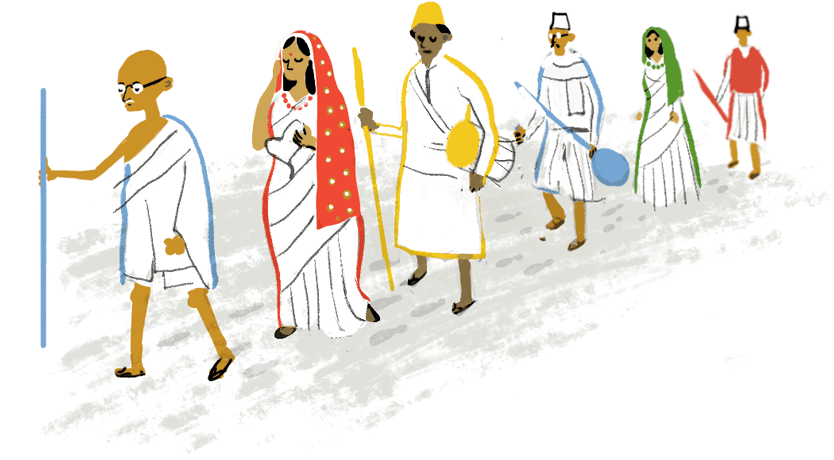
Illustration on Google India shows Gandhi leading the Dandi March of 1930

In honor of the 69th Anniversary of India’s Independence on Aug. 15,Google India’s Doodle features Mahatma Gandhi leading the Dandi March of 1930.

India Independence Day 2015

The scene depicts a significant moment in India’s push for freedom from the rule of the British Raj and the beginning of the Civil Disobedience Movement. Seventy-eight Congress volunteers participated in the 240-mile march in protest of unfair salt laws.

Leon Hong illustrated the Doodle for Google users in India as they celebrate the Indian Independence Act of 1947 on Saturday.


Source…Julia Zorthian   http://www.times.com

Natarajan

Transgenders Singing Jana Gana Mana Remind us What it Means to be Free….


As India marks its 69th Independence Day, The Internet finds itself flooded with celebratory videos. Several are versions of the National Anthem but none are as powerful a reminder of what it means to be independent in India than this one.

Uploaded by Yathartha Pictures on YouTube, this is Jana Gana Mana sung by the third gender. Seven transgenders or hijras, as they are known in India, take centre stage to perform a goosebump-inducing, beautiful rendition of the National Anthem.

The message in this video goes beyond patriotism. It celebrates the Supreme Court’s landmark 2014 judgment which recognised transgenders as the third gender, assigning them their own identity and directing the government to provide them with quotas in jobs and education. The ruling allows transgenders to make their own choices of profession, helping many dreams come true.

The seven transgender participants in the video are all dressed in outfits or uniforms that signal the career choices they can now make – they can be doctors, chefs, police inspectors, lawyers. They can now be anything they want.
“The idea behind this video is to show that just like Indian men and women, Indian Hijras too have the right to choose an employment which fits their talent, skill and passion,” it says in the descriptor of the video.

Source….www.ndtv.com and http://www.youtube.com

Natarajan

Message for the Day…” Good Moral Character is the Basic Foundation for one’s Life …”

Sathya Sai Baba

The happiness that one derives from virtues is far superior to the happiness that we get from the possession of wealth. Unfortunately the educated youth are striving for wealth, physical strength and friendship. But all these have little value without the wealth of character. For men or women, character is the foundation. If one lacks character, one becomes feeble in all other respects. People of those days strove for noble character. They were prepared to give up their very lives for a righteous cause. Women strived to uphold the honor of their husbands. The strength of an individual lies in one’s character, not in the wealth one earns. One should be prepared to face any hardship to lead a virtuous life. The country is in dire straits due to the absence of men and women of character. Materialistic wealth is not what we need today. We need to earn the wealth of virtues.

This Independence Day, The Tiranga Has a Message for Every Indian…

This Independence Day, The Tiranga Has a Message for Every Indian

Image Courtesy: Screengrab taken from YouTube video uploaded by BeingIndian

I was born in 1947 made out of hand-spun cotton on a charkha , dyed in the three colours of courage, peace and the earth. I symbolize Independence…”

As India prepares to celebrate its 69th Independence Day on August 15, this powerful video has a poignant message for every Indian — ‘Freedom is the absolute truth… and in truth there is valour…’

Put beautifully in words by Priyan Redican and expressed by six dancers in Bhatnatyam and Mohini Attam,  five mminute video  tries to explain the meaning of freedom and why we should not take it for granted

India is just a  country,
mere lines on a map,
and I’m just a flag,
a simple piece of cloth,
We’re nothing but mere ideas,
reflections of your passions,
we’re nothing but you fighting for freedom anew…

Watch the video and let the powerful words inspire you.

Source….www.you tube.com  and http://www.ndtv.com

Natarajan


The quiet, nerdy schoolboy who went all the way….Read What SundarPichai’s Grandmother says about him ….

Sundar Pichai was inquisitive and eager to learn, says grandmother Ranganayaki

Kamikaze auto drivers on Chennai’s streets may make you fear for life and limb. But as a school-boy, auto rides to school did not faze the newly-anointed CEO of Google Sundar Pichai, who, a school-mate who shared the rides recalls, had his nose in his books all the way to school.

Quiet, nerdy and studious is how friends of Pichai remember him from his days at Jawahar Vidyalaya, a CBSE school in Ashok Nagar, Chennai. Pichai was so focused on studies and wanted to fare well in academics that most of his associates don’t remember him participating in sports or any other extra-curricular activities.

A classmate recalls, “Sundar was academically bright, though he wasn’t the first in class. He was always ranked third, behind two girls, who took the first two ranks. He wasn’t very participative and kept to himself.”

Cool guy

Another classmate, chary of having her name on record, recalls that he always had a smile on and never got upset over anything.

The school put all the brightest students and achievers in the 9th standard in section A, where Pichai too was placed. Though, of course, there was nothing to indicate that one day he would go on to head a major global corporation.

That he could be fiercely competitive was, however, evident as this classmate recalls: “When the mark-sheets were distributed in class, he would be the first one to rush to take them from the teacher and compare his marks with other toppers in the class.”

Pichai moved out of Jawahar Vidyalaya to join Vana Vani, a school inside the IIT-Madras campus to pursue his Plus Two under the Tamil Nadu State board syllabus.

Born in Madurai, Pichai grew up in Chennai, where his father worked for switchgear-maker English Electric Co Ltd. Pichai did not have very many friends but he was inquisitive and eager to learn, even at a young age, says Ranganayaki, Pichai’s grandmother, who is 92 years old and lives in the same modest house in a quiet lane in Ashok Nagar where Pichai grew up.

Street cricket

Ranganayaki, her memory still strong, recalls that Rajesh, as Pichai is called at home, hated wasting time and was diligent when it came to his studies.

“Both the brothers liked to play cricket in front of the house after school, though it was mostly just the two of them,” she says.

Another classmate, who is still in touch with him from his school days, says Pichai remains the same quiet person he always was.

“It’s difficult for us to imagine that he now heads Google,” she says.

(This article was published on August 11, 2015)
Source…..

    SWATHI MOORTHY and,
    Natarajan

” சுந்தர் பிச்சை: இணைய சாம்ராஜ்யத்தின் தமிழ்ப் புயல்…”

சுந்தர் பிச்சை | கோப்புப் படம்: கமல் நரங்

சுந்தர் பிச்சை | கோப்புப் படம்: கமல் நரங்

இது கூடத் தெரியாதா உனக்கு? போய் கூகுள் பண்ணுப்பா’ என்று அறிவுறுத்துகிற புதிய வழக்கு உருவாகிவிட்டது. தேடுதல் என்ற வார்த்தைக்குச் சமமாக இன்று கூகுள் என்ற இணையத் தேடுபொறி மாறிவிட்டது. 2006-ம் ஆண்டு ஆக்ஸ்போர்டு டிக்ஷனரியிலும் அந்தச் சொல் சேர்ந்துவிட்டது.

கூகுள் சாம்ராஜ்யம்

எந்த ஒரு விசயத்தைப் பற்றி நாம் கேட்டாலும் அதனை கோடிக்கணக்கான இணையதளங்கள் செயல்படுகிற கணினிகளில் இருந்து தேடி எடுக்கிறது கூகுள். நல்லது, கெட்டது, சரி, தவறு எல்லாவற்றையும் நம்முன் படைக்கிறது. அதிலிருந்து அன்னப்பறவை போல உங்களுக்கு தேவையானதை எடுத்துக்கொள்ள வேண்டும்.

இன்றைய இணைய உலகில் கூகுள் ஓர் அசைக்க முடியாத நிறுவனமாக மாறிவிட்டது. உலகம் முழுவதும் பத்து லட்சத்துக்கும் அதிகமான ஆதார தகவல் மையங்களை அது வைத்துள்ளது. அமெரிக்காவை மையமாகக் கொண்டு உலகின் பல நாடுகளில் கூகுள் செயல்படுகிறது. 52 ஆயிரம் பேருக்கும் மேலாக தற்போது இந்த கம்பெனியில் பணியாற்றுகின்றனர்.

அத்தகையப் பெரும் இணைய சாம்ராஜ்யத்தின் தலைமை செயல் அதிகாரி (சி.இ.ஓ) ஆக தமிழகத்தைச் சேர்ந்த சுந்தர் பிச்சை நியமிக்கப்பட்டுள்ளார். ‘ஆண்ட்ராய்ட் ஒன்’ என்பதைப் புதிதாக கூகுள் அறிவித்தபோது அவர் பிரபலமடைந்தார்.

ஆலமரமாய்…

சுந்தர் பிச்சை 2004-ம் ஆண்டு கூகுளில் இணைந்துள்ளார். 2011- ல் கூகுள் குரோம் ப்ரவுசர், ஜிமெயில், ஆப்ஸ் உள்ளிட்ட பிரிவுகளுக்கான உலகளாவிய பொறுப்பாளராக அவர் நியமிக்கப்பட்டார். 2013 முதல் ஆண்ட்ராய்ட் மென்பொருளுக்கான பொறுப்பாளராகவும் அவர் நியமிக்கப்பட்டுள்ளார்.

1998-ல் லாரி பேஜ் மற்றும் சேர்ஜி பிரின் எனும் இரண்டு நண்பர்களால் இந்த கூகுள் நிறுவனம் தொடங்கப்பட்டது. உலகிலுள்ள தகவல்களை ஒருங்கிணைப்பதே கூகுளின் நோக்கமாகும்.

ஒரு நாளில் 100 கோடிக்கும் மேலான தகவல்கள் கூகுளில் தேடப்படுகின்றன. அதி விரைவாக கூகுள் வளர்ச்சியடைந்துள்ளது. பல புதிய மென்பொருள் சேவைகளும் அதனால் வெளியிடப்பட்டுள்ளன.

ஜிமெயில் எனப்படும் கூகுள் மெயில், கூகுள் டாக்குமெண்டுகள், கூகுள் பிளஸ், கூகுள் டாக், கூகுள் மேப்ஸ், கூகுள் நியூஸ், பிளாக்கர், யூ ட்யூப் போன்ற பல்வேறு கிளைகளை பரப்பி பிரம்மாண்டமான ஆலமரமாய் அது வளர்ந்துள்ளது.ஆண்டுதோறும் லட்சக்கணக்கான கோடிகள் ரூபாய் மதிப்பில் அதன் வியாபாரம் விரிந்துள்ளது.

விரியும் ஆதிக்கம்

சமீபத்தில் குரோம் ப்ரவுசர் என்னும் இணைய உலவியையும் கூகுள் வெளியிட்டது. அது தற்போது இணைய ப்ரவுசர்களின் மார்க்கெட்டில் 32 சதவீதத்தை கைப்பற்றி உள்ளது. ஆண்ட்ராய்டு என்னும் செல்போனை இயக்கும் மென்பொருள்தளத்தையும் அது வெளியிட்டது. அதனால் செல்போன்களின் துறையில் பெரும்தாக்கம் ஏற்பட்டுள்ளது.

உங்கள் கைகளில் விளையாடும் டச் ஸ்கிரீன் செல்போன்களில் ஏற்பட்டுள்ள புதுமைகளுக்கு எல்லாம் ஆண்ட்ராய்ட் இயங்குதளம் எனும் மென்பொருளும் ஒரு காரணம். தற்போது செல்போன் உள்ளிட்ட 120 கோடி கருவிகளில் ஆண்ட்ராய்ட் மென்பொருள் பயன்படுகிறது.

சென்னையின் புதல்வர்

சுந்தர் பிச்சை சென்னையில் பிறந்தவர். மேல்படிப்புக்காக மேற்குவங்கத்தை சேர்ந்த கரக்பூரில் உள்ள ஐஐடியில் சேர்ந்து படித்தவர். அமெரிக்காவின் ஸ்டான்ஃபோர்டு பல்கலைக்கழகத்தில் எம்.எஸ் பட்டமும், பென்சில்வேனியாவில் இருக்கும் வார்டன் கல்லூரியில் எம்.பி.ஏ. பட்டமும் பெற்றவர். கூகுள் நிறுவனத்தில் சேருவதற்கு முன்பு மெக்கென்சி நிறுவனத்தின் சாஃப்ட்வேர் நிறுவனங்களுக்கு கன்சல்டன்டாக இருந்திருக்கிறார்.

சுந்தர் பிச்சையைப் பற்றி கூகுளின் இணை நிறுவனரான லாரி பேஜ் “அவர் ஆழமான தொழில்நுட்ப அனுபவம், உற்பத்தி மீதான சிறப்பான கண்காணிப்பு, தொழில் முனைப்புத் திறமை ஆகியவற்றின் அரிய ஒருங்கிணைப்பாக இருக்கிறார்” எனப் பாராட்டுகிறார்.

சுந்தர் பிச்சையின் அப்பா சென்னையில் உள்ள பிரிட்டிஷ் பன்னாட்டு கம்பெனியான ஜிஇசியில் எலக்ட்ரிகல் இன்ஜினீயராக இருந்துள்ளார். சுந்தர் பிச்சைக்கு 12 வயதில் ஒரு மகள் இருக்கிறார்.

அடுத்த பாய்ச்சல்

கூகுள் நிறுவனம் ஆண்ட்ராய்ட் மென்பொருள் மூலம் தனது அடுத்த தயாரிப்புகளைத் திட்டமிட்டு செயல்படுத்தி வருகிறது. இவை போன்ற தயாரிப்புகள் எல்லாம் மனித வாழ்வில் பெரிய தாக்கத்தை ஏற்படுத்த உள்ளன. இத்தகைய திட்டங்களில் முக்கிய பங்காற்றுபவராக சுந்தர் பிச்சை இருக்கிறார்.

ஆண்ட்ராய்ட் ஜீனியஸ் என அழைக்கப்படும் சுந்தர் பிச்சை இப்போது சி.இ.ஓ.வாக நியமிக்கப்பட்ட நிலையில், கூகுளின் அடுத்த பாய்ச்சல் நிச்சயம் மகத்தானதாக இருக்கும் என்ற எதிர்பார்ப்பு கூடியிருக்கிறது.

Source….த.நீதிராஜன்  in http://www.tamil .thehindu.com

Natarajan