The Gift of Maria Montessori….

Maria Montessori

Maria Montessori

From a humble beginning, a great movement was born

As I write about one of the greatest educators of our times, Maria Montessori, my first question to myself is: “Why is a Waldorf teacher writing about Montessori”. Then I ask myself – why not? I think the first question comes from my conventional education and dogmatic beliefs. The second – from my unlearning over the years and becoming a free human being. To belong in one ideology or school of thought does not mean you can not see beauty in the other. So here is a Waldorf teacher from a completely different tradition, writing about Maria Montessori, not as a Montessorian but as someone deeply interested in learning how different educators used different lenses to view children and in doing so, how each one had a gift to give to them.

In early 1900, there existed in Rome a slum known as the San Lorenzo Quarter. Two buildings there housed the poorest class. During the day, the adults living at San Lorenzo would go off to work, the older children would be sent to school and the younger children between the ages of three and six began to vandalise the buildings, with no one to care for them. The governing body decided it would be less expensive to set aside one room for these kids and an adult as a caregiver than to continue to repair and repaint the whole building being damaged by these children. And, as history would have it, that caregiver was Dr. Maria Montessori. It was here in this Roman slum with those 60 children where she made discoveries that would direct her life’s work.

The news of her unprecedented success in Casa Dei Bambini or House of Children in San Lorenzo soon spread. Soon, Montessori was invited by several countries to set up centres for children. Alexander Graham Bell and Thomas Edison invited her to USA to give talks about her methods that gained immense popularity all over the world.

So what was it that was so special about her methods? Maria Montessori strongly believed that education is not what the teacher gives; education is a natural process spontaneously carried out by the human individual and is acquired not by listening to words but by experiences upon the environment. She writes about it: “Supposing I said there was a planet without schools or teachers, study was unknown, and yet the inhabitants – doing nothing but living and walking about – came to know all things, to carry in their minds the whole of learning , would you not think I was romancing? Well, just this, which seems so fanciful, is a reality. It is the child’s way of learning. This is the path he follows. He learns everything without knowing he is learning it, and in doing so passes little from the unconscious to the conscious, treading always in the paths of joy and love.’

Maria Montessori received a doctor of Medicine degree in 1896, the first woman in Italy to achieve this status. She campaigned vigorously on women’s rights. She wrote and spoke on the need for greater opportunities for women and was recognised in Italy and beyond as a leading feminist voice. It was this outspokenness and leadership in thinking that landed her in trouble. She was also vociferous about her anti-fascist views and was forced to go into exile.

And, the country that became her home in exile was India. The Theosophical Society invited her to in 1939 and she made Adyar, Chennai her home for eight years. It was here that she developed her work ‘Education for peace’. And she was nominated twice for the Nobel Peace Prize.

Today, most Montessori teachers use the materials used in Montessori classrooms – called the Didactic Apparatus, which was her discovery. But it would be a shame to reduce Montessori and her teachings to the mere apparatus. She and the children whom she crusaded for are much larger than that.

(Santhya is an educator and founder of Yellow Train) 

SOURCE:::::  Santhya Vikram in http://www.the hindu.com

Natarajan

Message For the Day…” Life Has got Greater Meaning and Deeper Significance …”

One has only a short span of life on earth. But even in this short life one can attain divine bliss, by wisely and carefully using the time. Two people, same in appearance, ostensibly of the same mould, and also grown under the same conditions, but one turns out to be an angel while the other stays on with one’s animal nature. What’s the reason for this differential development? Habits, behaviour formed out of these habits, and the character into which that behaviour has solidified. People are creatures of character. To a superficial observer, life appears to be a rotation of eating and drinking, toiling, and sleeping. But verily life has a much greater meaning, and a deeper significance. Life is a sacrifice (yajna). Each little act is an offering to the Lord. If the day is spent in deeds performed in this spirit of surrender, what else can sleep be except total immersion in the Godhead (samadhi)? 

Sathya Sai Baba

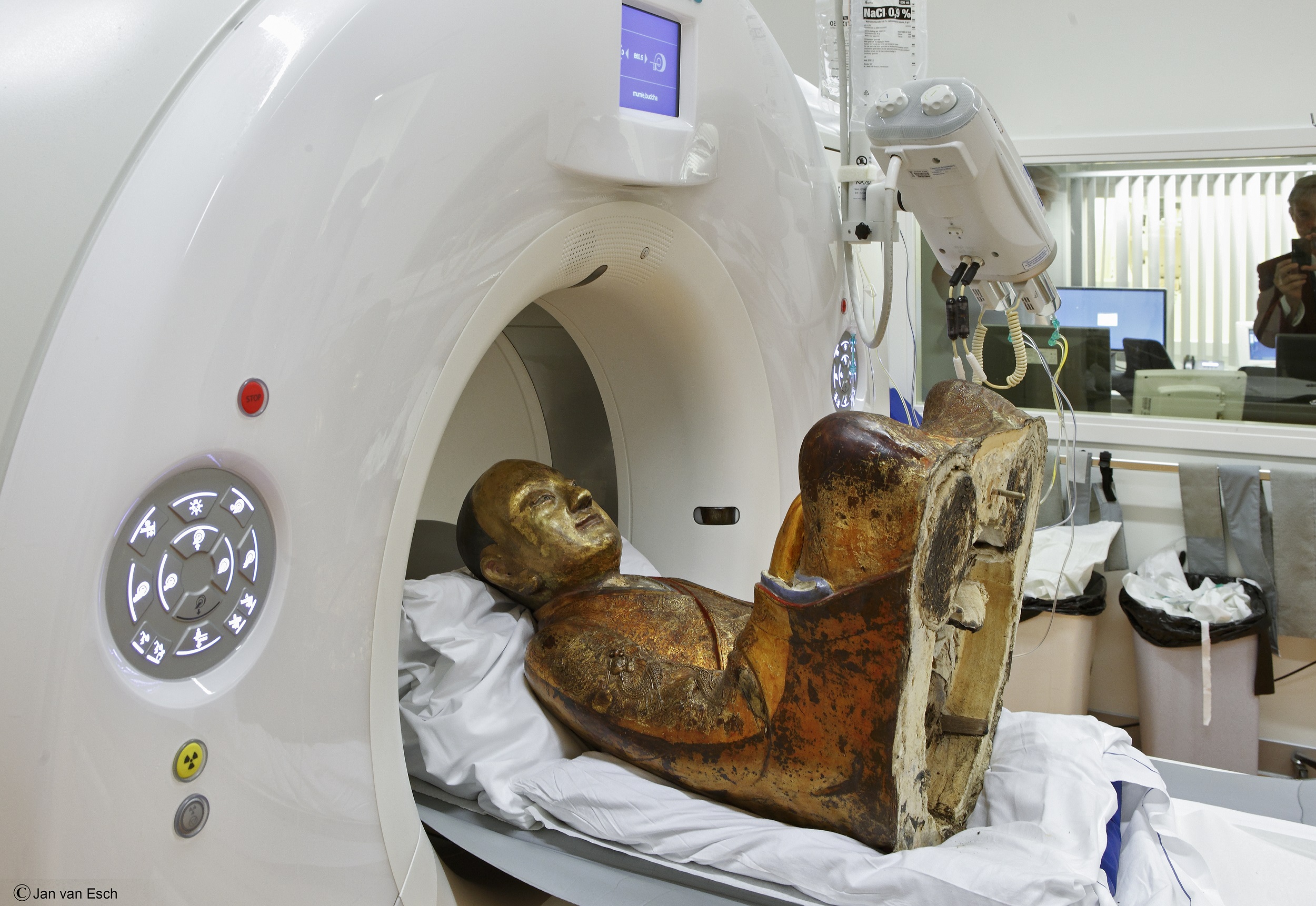
Mummified Monk Inside Buddha Statue …. ?

The mummified remains of a monk have been revealed inside a nearly 1,000-year old Chinese statue of a Buddha.

635603189441117628-mummy-buddha

The mummy inside the gold-painted papier-mâché statue is believed to be that of Liuquan, a Buddhist master of the Chinese Meditation School who died around the year 1100, researchers said. It’s the only Chinese Buddhist mummy to undergo scientific research in the West.

The statue was on display last year at the Drents Museum as part of an exhibit on mummies. It was an cited as an example of self-mummification, an excruciating, years-long process of meditation, starvation, dehydration and poisoning that some Buddhist monks undertook to achieve enlightenment and veneration.

When the exhibit ended in August, a CT scan at the Meander Medical Center in the Netherlands revealed the seated skeleton. Samples taken from organ cavities provided one big surprise: paper scraps printed with ancient Chinese characters indicating the high-status monk may have been worshiped as a Buddha.

A CT scan has revealed a mummified Chinese monk inside a Buddha statue. The remains date back about 1,000 years. Video provided by Newsy Newslook

The finding was first reported in December but did not get wide notice. Irish Archaeology carried a report over the weekend, which apparently started the news ball rolling.

But the revelation is not, as some reports claim, “a shocking discovery,” The History Blog notes: “It was known to be inside the statue all along … that’s why it was sent to the Drents Museum in the first place as part of the Mummies exhibition.”

The mummy’s existence was discovered in 1996 when the statue was being restored in the Netherlands, Live Science writes, explaining what was found, how its age was determined and when the first detailed skeletal imaging was performed.

DNA tests were conducted on bone samples, and the Dutch team plans to publish its finding in a forthcoming monograph.

Researchers still have not determined whether the monk mummified himself, a practice that was also widespread in Japan and that was outlawed in the 19th century. If he did, the process was gruesome, asAncient Origins explains:

For the first 1,000 days, the monks ceased all food except nuts, seeds, fruits and berries and they engaged in extensive physical activity to strip themselves of all body fat. For the next one thousand days, their diet was restricted to just bark and roots. Near the end of this period, they would drink poisonous tea made from the sap of the Urushi tree, which caused vomiting and a rapid loss of body fluids. It also acted as a preservative and killed off maggots and bacteria that would cause the body to decay after death.

In the final stage, after more than six years of torturous preparation, the monk would lock himself in a stone tomb barely larger than his body, where he would go into a state of meditation. He was seated in the lotus position, a position he would not move from until he died. A small air tube provided oxygen to the tomb. Each day, the monk rang a bell to let the outside world know he was still alive. When the bell stopped ringing, the tube was removed and the tomb sealed for the final thousand day period of the ritual.

At the end of this period, the tomb would be opened to see if the monk was successful in mummifying himself. If the body was found in a preserved state, the monk was raised to the status of Buddha, his body was removed from the tomb and he was placed in a temple where he was worshiped and revered. If the body had decomposed, the monk was resealed in his tomb and respected for his endurance, but not worshiped

If you find yourself in Budapest before May, the Buddha mummy statue is on display at the Hungarian Natural History Museum.

SOURCE::::: Michael Winter, USA TODAY …www.usatoday.com

Natarajan

Message For the Day…” What is Immortality …” ?

We must clearly understand the meaning of ‘death’ and ‘immortality’. We regard death as synonymous with all kinds of strength in the body being lost. In other words, death is the ebbing away of the life force from the body. If the life force remains in the body forever, we regard that situation as immortality. This is incorrect. To be able to completely identify oneself with the aspect of God and completely forget the aspect of the body is true immortality. If at all times we are totally immersed only in the thought of the body and its comforts, and forget the aspect of Atma, that is death. It is only when we are able to clearly recognise the connection between birth and death that the sacred desire for securing immortality will sprout in us. There is birth and death for the body, but there is no birth or death for the Atma. To be able to understand this eternity of theAtma is the real meaning of attaining immortality.

Sathya Sai Baba

” Point Where Indian Ocean and Atlantic Ocean Meet…” Watch this Video clip !!!

Though the oceans’ waters “meet”, they don’t get mixed!
Believe, the Quranic  sura rendering by Abdul Basit
Abdessamad says, the day the two waters of the  oceans
get mixed, the world will end.
An
amazing phenomenon!!! It is stated it is because of the salt
content…. salt in Atlantic is more than in Indian ocean… 
SOURCE :::::www. you tube.com
Natarajan


Aero India Show Bengaluru … A Glimpse …

Aero India 2015, India’s largest airshow was underway at the Yelahanka Air Base in Bengaluru. Here are few glimpses of the aircraft in action.


Image: UK’s AeroSuperBatics team Breitling Wingwalkers performs in Bengaluru. Photograph: Shailendra Bhojak / PTI Photo

Image: Swedens aerobatic display team Scandinavian Air Show performs at Aero India 2015. Phortograph: Shailendra Bhojak/PTI
Photo

Image: A Rafale multi-role combat aircraft from Dassault Aviation of France manoeuvres at Asia’s premier air show at Yelhanka
Air Base. Photograph: PTI Photo

Image: The Red Bulls aerobatic display team performs in Bengaluru. Photograph: Ministry of Defence

Image: An SU-30 fighter aircraft takes off during the second day of Aero India. Photograph: PTI Photo

Image: Another great shot of India’s Light Combat Helicopter. Photograph: Twitter

Image: UK’s AeroSuperBatics team Breitling Wingwalkers performs in Bengaluru. Photograph: Shailendra Bhojak / PTI Photo

Image: A great shot of India’s Light Combat Helicopter. Photograph: MakeinIndia/Twitter

Image: A roaring take off by US F-16 at Yelahanka Air Base. Photograph: Ministry of Defence

Image: India’s Sarang aerobatic display team performing a routine. Photograph: Ministry of Defence

SOURCE::: http://www.rediff.com

Natarajan


Message For the Day…” Impartial Vision is Auspicious Vision …”

The lion, though crowned as the king of the forest, turns back every few steps while walking through the woods, because it is afraid of being pursued. Fear in the mind will make your vision falter. Violence within the heart distorts the vision and distracts the sight. Be vigilant! You must practice and develop impartial vision. All creation must appear equally auspicious in your eyes. You must look upon all with as much love and faith as they have in themselves, for absolutely nothing is evil in creation – no, not even an iota! Evil appears as such only through faulty vision. Creation is colored only by the nature of the glasses you wear. By itself, every creation is eternally pure and holy. Hence you must cultivate one-pointed steadfastness (ekagrata) in whatever you do. Impartial vision (sama-drishti) is auspicious vision (subha-drishti).  

Sathya Sai Baba

Do you Know That the Largest Air Evacuation in History was done by India …?

When thousands of Indians were stuck in Kuwait during Gulf war, the Indian government executed the world’s largest air evacuation mission ever. The operation continued for almost two months and managed to airlift over 1,70,000 Indians. Here is all you need to know about the amazing effort!

Air India might be largely known today for delayed flights and poor service. But did you know that the largest air evacuation in the history of mankind was executed by the much aligned national airline of India? In 1990, the Indian government airlifted over 1,70,000 Indians from Kuwait with help of 488 flights in just 59 days. Air India entered into Guinness Book of World Records for the civil airline that had evacuated the most people till date.

Why the evacuation?

During the Gulf war in 1990, when Saddam Hussain invaded Kuwait, the Iraqis took over the city in a few hours leaving the entire country in a state of terror. This included the fairly significant Indian community there as well. While the Kuwaiti royal family escaped to Saudi Arabia, the general population suffered great tragedies and loss. The responsibility came on the Indian government to safely evacuate the Indian community from Kuwait and hence, the largest air evacuation mission took shape.

“We did not use the word ‘condemn’ in our statement [about the Iraqi attack], for two reasons: one, we were concerned about our nationals there; second, we still believed that there was some scope for a negotiated solution to the problem. We were keen to play a role. If we condemned the development openly, it would have been difficult for us to deal with Iraq,” said K.P. Fabian, former Ambassador of India who was head of the Gulf Division of the Ministry of External Affairs during the First Gulf War.

What made it difficult?

Evacuating the Indian community from Kuwait was not an easy task. People were not ready to leave behind everything they had spent their entire lives earning in Kuwait. They underestimated the gravity of the situation and were reluctant to leave their well-settled lives.

Also, many people living there did not have valid travel papers as they had handed them over to their employers who were either missing or dead.

“Meanwhile, another problem was brewing. One set of Air India crew was stranded in Kuwait, having flown in a flight earlier. The Air India pilots and staff threatened that unless we got this crew out, they would ground the flights. The threat was indeed serious. As per Ministry of Overseas Indians (MOIA) annual report 2012-13, there are over 25 million overseas Indians across the globe and whenever need arises, it is the government’s responsibility to bring back the country’s citizens safely. Not only just the evacuation during Gulf war, Indian government has successfully executed many such missions. It was decided that the Foreign Minister should go to Baghdad and Kuwaitand urgently arrange repatriation of our nationals” said Fabian.

Also, Indian people took shelter in various schools and other buildings in various parts of Amman. They had to travel from various places to the Amman airport. It could not be predicted when these people would arrive and due to this, flights got delayed a lot. The crew had to stay on duty for a much longer time than the stipulated duty hours which created a lot of tiffs.

How did they do it?

Indian government officials went to Kuwait to meet Saddam Hussain and get him on board the arranged repatriation of Indian nationals.

“We conveyed our official viewpoint and also our plans to evacuate our nationals. He listened to our views and repeated his known position, and agreed to facilitate the repatriation of our nationals,” said Fabian.

As the help reached on August 14 (12 days after the invasion had taken place), Indian citizens were angry as they were expecting a quicker intervention by the Indian government. But, the then Foreign Minister I.K. Gujral quickly brought the crowd under control and in no time had them shouting “Bharat Mata ki Jai”.

Initially, a few military aircrafts were arranged to evacuate the elderly, women and children. But due to a lengthy air space clearance procedure, this did not seem like a feasible solution. So the government turned to Air India for assistance.

You should have seen us. We were operating out of a hotel room in Amman with very little space and carrying out all our operations from there,” MP Mascarenhas, who organised the operation as the airline’s regional director in the Gulf & Middle East, told Scroll.

The Indian Air Force deployed its IL 76 aircraft for a steady communication link between Kuwait and Delhi government officials. The situation was severe and required immediate help and attention. The Kerala government came forward and dispatched food items for the Indian nationals in Kuwait.

“My suggestion was that we needed to first pick up mothers with babies, other children, women, sick and old people. And also, on the basis of some kind of distributive justice, we needed to select people from every region,” said Fabian.

There were far more people to be evacuated than expected. But, the coordination and team work of the people on the mission managed to evacuate all the Indian nationals out of the country. There was also a Pakistani Airline crew stranded in Kuwait and they wished to be evacuated by Indian aircrafts. On humanitarian grounds, the Indian officials agreed.

The successful operation that started on August 14 1990, continued for almost 2 months and created history, finally coming to an end on October 11.

Other notable achievements

This was not the only successful evacuation and heroic act by the Indian government. “Operation Sukoon” in 2006 by the Indian Navy was another great operation to evacuate Indian, Sri Lankan and Nepalese nationals, as well as Lebanese nationals with Indian spouses, from the conflict zone during the 2006 Lebanon War. Four naval ships – INS Mumbai, INS Betwa and INS Brahmaputra and oil tanker INS Shakti – executed the successful operation.

Another successful evacuation “Operation Blossom” took place in 2011 when mass protests against the military broke out in Libya. Around 8,000 Indians were evacuated with help from Indian Navy’s INS Jalashwa (an amphibious transport dock ship) and a destroyer INS Mysore – both these ships together could carry around 1,200 people at one go – and the fleet tanker the INS Aditya.

The Indian government has time and again proved that it leaves no stone unturned in bringing back its people safely to the country in times of distress anywhere in the world. Kudos to all the heroes who have showed immense courage and humanity in the toughest of times.

– See more at: http://www.thebetterindia.com/15179/heres-need-know-largest-air-evacuation-history-india/#sthash.53OtJbOP.dpuf

SOURCE:::: http://www.the betterindia.com

Natarajan

Message For the Day….” Difference Between Happiness and Bliss…”

Happiness generally relates to bodily comforts and is transient. Such temporary pleasure comes to us for a few moments but very soon plunges us into deep sorrow. But the kind of bliss that one gets through the Soul (Atma) is permanent, pure and selfless. Hence spiritual education (Brahma Vidya)advocates that love must be cultivated for love’s sake only. You must not express love to merely obtain material benefits. If love is showered to win temporary benefits, then it will last for a very short time only. Divine Atmasymbolises eternal truth and is permanent. Therefore Prema attached to Atmawill be true and permanent. This infinite love and eternal truth is present in every being (jīva). If we focus on developing love and truth for its own sake, then we will experience bliss supreme. That is why the Upanishads advocate Selfless Love as ‘Satyasya satyaṃ’ or the Truth of truths. 

Sathya Sai Baba


Some Postings in Face Book…. Who Wants It Really … !!!!

With great power comes great electricity bill and too much information about what others are doing and too many feeds on your Facebook wall. So much for digitization that you actually know the color of your friend’s pet dog’s vomit or the last time they bought a water bottle.!!!

Here are few Posts found in FB … As per an analysis …

No offence meant for anybody !!!….

Where they are going out for lunch….

Eating pani puri with tinku, minku, chinku and rinku.  !!!

What they ate last night for dinner…

That awkward moment when you read that people are having dinner with their family, at home.!!!

What’s the color of nail polish that they are wearing today ….

Yes girls, Facebook wasn’t meant for this.!!!


Their extreme Photoshop skills…

So much, so that you won’t recognize them  in person.!!!


. Birthday of their car/ cycle/ laptop/ mobile phone/ dogs….!!!


How much they love people who live in the same house…

Seriously. STOP !!!


What they dreamt last night….!!!


What song they are listening to…

You know what, it’s not your fault actually. One should totally blame Facebook for adding a feature like that.!!!!

Which movie/ serial that they are watching…

XYZ watching Sasural Simar Ka

Which level they crossed on Candy Crush….

On the great green God’s earth, who invented that? !!!

SOURCE:::: http://www.storypick.com

Natarajan