” சென்னை சாலைகள் ….பெயர் காரணம் ….ஒரு அலசல் …”

சென்னையில் இருக்கும், முக்கிய சாலைகள் பலவற்றின், பெயர் காரணம் குறித்து, திண்ணைப் பெரிசு ஒருவர், சொன்ன விவரம்:


சார்லஸ் பின்னி என்பவர், 1769ல், இந்தியாவில், வாணிபம் செய்ய வந்தார். இவர் பெயரில், பின்னி தெரு உள்ளது. இது, அண்ணா சாலையையும், கமாண்டர்- இன் -சீப் பாலத்தையும், இணைக்கும் சிறிய தெரு. இங்கு, பின்னி வாழ்ந்த மாளிகைதான், இப்போது கன்னிமாரா ஓட்டலாக உள்ளது.
கிழக்கிந்திய கம்பெனி காலத்தில், ஐரோப்பிய குடியேறிகளின், பொழுதுபோக்கு மன்றமாக இருந்த இடம் பாந்தியன் எனப்பட்டது. (அதுவே இன்றைய மியூசியம் தியேட்டர்) இதை நினைவுபடுத்தும் வகையில், இங்குள்ள சாலைக்கு, ‘பாந்தியன் சாலை’ எனப் பெயரிடப்பட்டது.
ரிச்சர்ட் எல்டாம்ஸ் என்பவர், பிரபல ஆங்கிலேய வர்த்தகர். இவர், சென்னை மேயராக இருந்து, 1820ல், இறந்தார். இவர் பெயரில் தான், எல்டாம்ஸ் சாலை உள்ளது.
ஜேம்ஸ் டெய்லர் என்பவர், 1795ல், சென்னையில், நிர்வாக அதிகாரியாக இருந்ததால், கீழ்பாக்கத்தில், இவர் பெயரில், டெய்லர்ஸ் சாலை உள்ளது.
சிங்கண்ணை செட்டி என்பவர், செயின்ட் ஜார்ஜ் கோட்டைக்குள், அடகுக்கடை வைத்திருந்தார். இவர் பெயரில், சென்னையில் மூன்று தெருக்களும், சிந்தாதிரிப் பேட்டையில் இரண்டு சந்துகளும் உள்ளன.
ஆளுநரின் பாதுகாவலர் இருந்த வீதிக்கு, பாடிகார்ட்ஸ் சாலை என்று பெயர். அக்காலத்தில், கப்பல்படை வீரர்களுக்குப் பயன்பட்ட இடத்திற்கு, ஓல்டுநேவல் மருத்துவமனை சாலை என்று பெயரிட்டு, பெரியமேட்டில், ஒரு வீதி உள்ளது.
‘தி மெட்ராஸ் ஆர்மி’ என்ற பெயரில், சென்னைக்கு பிரத்யேகமாக, ஒரு தனிப்படை ராணுவம் இருந்தது. இதன் தளபதி இருந்த இடம்தான், ‘கமாண்டர் – இன்- சீப் சாலை’ என, அழைக்கப்படுகிறது.
வெள்ளையர் அரசால், நடத்தப்பட்ட கல்லூரி இருந்த இடம், கல்லூரி சாலை என்ற பெயரில் உள்ளது.
வேப்பேரியில், டவுட்டன் பிராட்டஸ்டண்டு கல்லூரி இருந்த இடம், சுருக்கமாக, டவுட்டன் என்று அழைக்கப்பட்டது. இன்றும், அதுவே பெயர்.
இந்தியர்கள் வாழும் பகுதி கறுப்பர் தெரு, (பிளாக்கர்ஸ் ஸ்ட்ரீட் ) என அழைக்கப்பட்டு, இன்றும் அதே பெயரில் உள்ளது. கெயிட்டி தியேட்டர் இருக்கும் சாலை இது.
பஞ்சாமிர்தம் (1925) இதழ் ஆசிரியர், அ.மாதையா எழுதிய கட்டுரையிலிருந்து…
சென்னையில், குஜிலியின் முக்கில், ஒரு வீதிக்கு, ‘ஈவினிங் பஜார்’ என்றும், அடுத்த வீதிக்கு, ‘தீவிங் பஜார்’ என்றும் பெயர் இருந்தது. இதை, நான் முதலில் கவனித்த போது, உண்மை எவ்வாறிருப்பினும், ராஜதானி நகரத்தில், ஒரு வீதிக்கு, ‘தீவிங் பஜார் சாலை’ அதாவது, ‘திருட்டுக் கடை தெரு’ என்றிருப்பது நகரவாசிகளுக்கும் போலீசாருக்கும் கவுரவம் தருவதன்று என்று நினைத்து, அப்போது முனிசிபல் கமிஷனராயிருந்த என் நண்பர், மலோனி துரைக்கு அதைப்பற்றி எழுத, அவர், ‘தீவிங் பஜார்’ என்ற பெயரை, ‘குஜிலி பஜார்’ என்று மாற்றினார்.

‘அமரர் கல்கியின் ஹாஸ்யம்’ நூலிலிருந்து: வைணவ மதம், ரொம்ப ருசியான மதம் என்பது பிரசித்தம். கண்ணனை வெண்ணெய் திருடும் கடவுளாகச் செய்தவர்கள், ரொம்பவும் சுவை அறிந்த மனிதர்களாகத் தானே இருக்க வேண்டும். இன்னும், வைணவ மதத்தின் ருசியை, ஸ்ரீரங்கம் மற்றும் காஞ்சிபுரம் கோவில் பிரசாதங்கள் எவ்வளவு தெளிவாக நிரூபிக்கின்றன!
தன்னை விட, 153 மடங்கு உயரமான ஈபிள் டவரை கட்டி, சாதனை படைத்திருக்கிறான் மனிதன். ஆனால், கரையான் புற்றை, கரையான், தன்னை விட, 1,000 மடங்கு உயரமாக கட்டுகிறது. ஆனால், அதை சாதனையாக அவை வெளியே சொல்வதில்லை.
குப்பண்ணா சொன்னது.

Source….www.dinamalar.com

Natarajan

ஈரோடு பெண்ணுக்கு ‘கல்பனா சாவ்லா’ விருது: கனரக வாகனம் ஓட்டுவதற்காக கிடைத்த கவுரவம்

கனரக வாகனமான லாரியை இயக்கும் ஜோதிமணி

கனரக வாகனமான லாரியை இயக்கும் ஜோதிமணி

ஈரோட்டை சேர்ந்த பெண் லாரி ஓட்டுநர் வீர தீரச் செயலுக்கான கல்பனா சாவ்லா விருதை பெற்றுள்ளார்.

வீர தீரச் செயலுக்கான கல்பனா சாவ்லா விருதுக்கு ஈரோடு மாவட் டத்தை சேர்ந்த ஜோதிமணி(30) தேர்வு செய்யப்பட்டிருந்தார். அவருக்கு இந்த விருதை நேற்று முதல்வர் ஜெயலலிதா சென்னை யில் நடைபெற்ற சுதந்திர தின விழாவில் வழங்கி கவுரவித்தார். விருதுடன் ரூ.5 லட்சம் ரொக்கப் பரிசு மற்றும் ரூ.5 ஆயிரம் மதிப் புள்ள தங்கப் பதக்கம் மற்றும் பாராட்டுச் சான்றிதழ் வழங்கப்பட் டன.

ஈரோடு மாவட்டம், கோபிசெட் டிப்பாளையம் வட்டம், கணக்கம் பாளையம் கிராமத்தில் உள்ள மஜ்ரா வடகள்ளிப்பட்டியைச் சேர்ந்த ஜோதிமணி, லாரி ஓட்டு நராக பணிபுரிகிறார். இவர் துணிச் சலாக கனரக வாகனம் இயக்கி வருவதற்காக, அவருக்கு இந்த விருது வழங்கப்பட்டது.

ஆண்களுக்கு, பெண்கள் சளைத்தவர்கள் அல்ல என்பதை மெய்பிக்கும் வகையில், ஈரோட்டை சேர்ந்த ஜோதிமணி தமிழகத்தின் ஒரே பெண் லாரி ஓட்டுநர் என்பது குறிப்பிடத்தக்கது.

இவர் 16 டன் எடை கொண்ட கனரக வாகனத்தை லாவகமாக ஓட்டுவதில் வல்லவர். இவரது கணவர் கவுதமனும் லாரி ஓட்டுநர். அவருக்கு சொந்தமான லாரி மூலம் இவர் கனரக வாகனம் ஒட்டுவதை கற்று தேர்ந்தார். பின்னர் கணவருக்கு இணையாக சொந்தமாக ஜோதிமணி மற்றொரு லாரியை வாங்கி இயக்கி வருகி றார்.

கடந்த 2009-ம் ஆண்டு முதல் தேசிய நெடுஞ்சாலையில் சரக்கு லாரி பயணத்தை தொடங்கிய ஜோதிமணி ஒரே ஒரு விபத்தை தவிர, லாரியை லாவகமாக இயக்கி வருவது அவரின் திறமைக்கும், பொறுமைக்கும் உதாரணமாக உள்ளது.

வெளிமாநிலங்களுக்கு தன்னந் தனியாக ஜோதிமணி ஒரு மாதம் வரை பயணம் செய்வதுண்டு. இவரது இரு குழந்தைகளையும் பாட்டி கவனித்துக் கொள்வதால், ஜோதிமணி குடும்ப கவலையின்றி செய்யும் தொழிலை திறம்பட வும், நேர்த்தியாகவும் செய்து, வீரதீரச் செயலுக்கான கல்பனா சாவ்லா விருதை முதல்வர் ஜெய லலிதாவிடம் பெற்று ஒட்டுமொத்த தமிழக பெண்களுக்கும் ஒரு எடுத்துக்காட்டாக வலம் வருகிறார்.

Source…..www.tamil.thehindu.com

Natarajan

Will the Mist Lift in Kodaikanal….?

“If the company accepts its mistake and compensates us, it would serve as justice.” Helen Margaret with her mentally-disabled son Nitesh Kumar. Photo: Sruthisagar Yamunan

The focus on mercury poisoning following a popular rap song raises hopes for victims in Kodaikanal

The serene view of the Kodaikanal hills from the ‘Coaker’s Walk’ hides a tale of melancholy and everyday struggle. As she flitted from one pushcart to another attending to a rare tourist in this off-season, Helen Margaret, now 39, recalled in a tremulous voice her days as a worker at the defunct thermometer factory of Hindustan Unilever on St. Mary’s road. “In the three years from 1996 when I worked there, I did not know the hazards of mercury. We used to play with the silvery liquid, often throwing it at each other,” she recollects, making the “bhoni” (first sale of the day) of her small fruit cart.

Playing with mercury, recognised as one among top ten chemicals of major public health concern, came with a price, she says. Her second son Nitesh Kumar was born with mental disability in 2000.

Subsequently, her husband, a chronic diabetic, died. Today, Ms. Margaret takes care of three school-going sons from a meagre income of Rs 150 a day. “I cannot leave Nitesh alone for a minute. He studies at the Church-run school for the disabled nearby. I make multiple visits to check on him. My life is a struggle that I cannot explain,” she rues, outraged by a recent comment by Unilever CEO Paul Polman that he wants only facts and not “false emotions” on Kodaikanal.

The ‘Kodaikanal Won’t’ rap video released this month has brought focus to the plight of these former workers, and the pristine environment of this Western Ghat hill station.

According to the World Health Organisation, foetuses are most susceptible to developmental effects due to mercury. “It can adversely affect a baby’s growing brain and nervous system. The primary health effect of methylmercury is impaired neurological development.” Industrial processing is listed as one of the two important ways of exposure to mercury. And former workers say they were exposed to a lot of mercury.

“I never wore a glove when I handled the thermometer. I had severe skin rashes, which were treated as allergies. It was only after the factory was shut in 2001 that we came to know of the dangers of mercury. We were never told about it when we worked,” says P. Sangeetha, who claims to have worked at the site in 1996 when she was just 14 years old.

The company maintained women were never allowed to work in mercury area.

Her father, Govindhan, was contractually employed as a security staffer which involved several inspection rounds around the site. In 2000, Govindhan died following an alarming drop in haemoglobin levels.

An HUL-driven study published in 2006 in the Indian Journal of Occupational and Environmental Health, based on the examination of 255 employees and contract workers in 2001, found many showing symptoms of various possible disorders that activists state were the result of exposure to mercury vapour. However, supported by clean chits from three institutions of repute–the All India Institute of Medical Sciences , National Institute of Occupational Health and Industrial Toxicology Research Centre–the company has maintained that mercury in its factory had nothing to do with the health issues of the workers. Nor has it had any effect on the environment.

S.A. Mahindran of the 550–strong Ex-Mercury Employees Welfare Association, which has approached the Madras High Court for compensation to workers, states that the three reports cited by HUL were given by experts without meeting any of the workers. “On the contrary, a Ministry of Labour constituted committee concluded that there was prima facie evidence that not only ex-workers, but also their children have suffered on account of mercury exposure. This committee met the workers in October 2011 and was a first-hand study.”

In many cases, the company has replied that it does not possess records of annual medical check-ups of workers.

Many though claim to have continuing symptoms while over 40 former workers have allegedly died due to mercury-related issues, the association says. K.M. Gias Mohammed Gori was one of the first to join the thermometer plant when it opened in 1984. “At that time, Kodaikanal had no industries. People were begging for employment. When the plant opened, we all rushed to join and saw it as a blessing,” he recalls. But within a year or two, Mr. Gori began experiencing loss of teeth, which the committee in 2011 noted as one ill-effect of mercury exposure. “Soon, I experienced severe fatigue and backache and left the job. I live in poverty in this 10 ft x10 ft thatched hut. Let Mr. Polman come and see if my emotion is fake,” he says.

The long-drawn legal battle has also tired out the workers. The Madras High Court has not heard the matter since 2013 even as workers complain of great financial burden from medical expenses.

On the environment front, the battle has been raging on the standards to which the mercury contaminated soil needs to be cleaned up. Citing media reports, Member of Parliament and Pattali Makkal Katchi leader, Anbumani Ramadoss, one of the first to react, stated that the company was proposing a remediation norm that was 25 times laxer than those prevalent in the United Kingdom, where Unilever has its headquarters.

“They are providing techno-commercial reasons as justification of the lax standard. In the UK, the permissible mercury level is 1mg/kg whereas the company wants a standard of 20-25mg/kg of soil here. By its own estimation, it let out 1.2 tonnes of mercury into the Pambar Shola forests. This is environmental colonialism,” says environment activist Nityanand Jayaraman, who has worked on the issue since 2001 when the company was shut by the Tamil Nadu Pollution Control Board (TNPCB) after evidence emerged that mercury-contaminated glass was sold to scrap dealers a few kilometers away from the factory site.

With the rap song, viewed over two million times on YouTube, building up pressure, HUL has now submitted the Detailed Project Report (DPR) for remediation in Kodaikanal to the TNPCB. However, questions from The Hindu on what the cleaning standard the DPR proposed went unanswered. An HUL spokesperson said via email that preparatory work for the process will begin immediately. In 2003, an expert decontamination team from the U.S. removed tonnes of partially treated mercury sludge from the site. The workers have accused TNPCB of collusion.

With upcoming Assembly elections, the Kodaikanal Municipality, blamed for being silent all along, has got into the act, with its chairman M. Sridhar committing to pass a resolution against the company with a demand for compensation for environmental degradation during a public consultation meeting on August 12.

Activists note that water flowing through contaminated soil finally reaches the Vaigai dam, which irrigates thousands of hectares in South Tamil Nadu. “We have also decided to campaign for the boycott of Unilever products and to boycott elections if no solution is found,” says Mr. Mahindran.

But these technicalities have very little relevance for Ms. Margaret. “If the company accepts its mistake and compensates us, it would serve as justice and would reduce the burden on our lives,” she says, as she helps her son Nitesh back into the classroom.

Timeline:

2001 TNPCB shuts down the HUL thermometer factory after sale of mercury contaminated glass to scrap dealers is detected. Health study of workers done
2003 Large amount of mercury scrap sent back to the U.S.
2006 Ex-employees move Madras High Court against Unilever. Health effects such as miscarriages, kidney and nervous system damages, mental disability in children etc. stated
2011 Committee constituted by Ministry of Labour concludes there was prima facie evidence of mercury-related ailments in workers
2015 Unilever CEO Paul Polman says he is determined to solve the issue after international focus following rap song

Source…..

Natarajan

The Secrecy of the Film ” Psycho”….

hitchcock

When it was released in 1960, Psycho was one of the most controversial films of the day, thanks in part to the surprising (for the time) depictions of violence and sexuality it contained. In an effort to keep spoilers to a minimum and thus ensure audiences were as surprised as possible by the film’s more shocking twists and scenes, Hitchcock went to some rather extreme lengths to keep the film’s basic plot a secret.

For starters, one of the first things Hitchcock did after reading the original 1959 novel the film was based on-Psycho, by Robert Bloch- and deciding that he just had to adapt it to film, was charge his assistant with purchasing as many copies of the book as possible to keep it out of public hands. Exactly how many copies Hitchcock managed to get his hands on isn’t known, but it is generally thought that he came reasonably close to purchasing every copy on the shelves at the time. This must have been nice for Bloch, at least financially, who not only got a little over $9,000  (about $71,000 today) for the movie rights to the novel, but a nice payout for all the extra copies Hitchcock purchased.

Although Hitchcock was positively enamoured by the novel’s twists and shocking content (which was partly inspired by the killings of Ed Gein, who also inspired the Texas Chainsaw Massacre movies) Paramount Pictures weren’t. They particularly didn’t like the fact that Hitchcock’s contract with them only guaranteed he’d do one other film for them.  They did not want it to be Pyscho.

To try and dissuade Hitchcock from pursuing the film any further, executives more or less attempted to halt production at every turn, which only strengthened the director’s resolve. For example, the studio refused to give Hitchcock his usual budget, offering him just shy of a million dollars instead of the $3 million and change they’d given him for his previous film, North by Northwest.

Rather than scrap the project, as they hoped, a defiant Hitchcock decided instead to simply film the movie using a television crew mostly borrowed from his show, Alfred Hitchcock Presents and shoot the entire thing in black and white. Hitchcock also managed to secure the film’s main two actors, Janet Leigh and Anthony Perkins, for a fraction of their usual fees saving tens of thousands of dollars. He also, as a demonstration of his faith in the project, turned down his normal pay and instead very wisely opted for a percentage of the film’s ultimate returns, reportedly at a whopping 60%.

In a further attempt to get him to scrap the project in favour of something they deemed better to complete his contract with them, Paramount Pictures told Hitchcock their sound stages and other such needed equipment were completely booked, even though they weren’t. Again, Hitchcock was undeterred and moved production over to Universal Studios. Ultimately Paramount gave in and green-lighted the project, though at this stage not nearly as involved in it as they’d normally have been.

This proved to be a boon to Hitchcock as he was free from executive meddling. It also allowed him to film on what was essentially a closed set, helping to insure that no details of the plot leaked.

To further make sure of this, Hitchcock made every member of the cast and crew promise that they wouldn’t talk about the film, its plot, or twists- rumor has it by making each and every one of them say in front of him “I promise I shall not divulge the plot of Psycho”.

Even after the film was finished, Hitchcock barred both Leigh and Perkins from giving any interviews concerning it, instead choosing to promote the film almost entirely by himself.

To avoid giving away any potential details about the plot, Hitchcock promotional efforts focused wholly on alluding to the film’s shocking twists and content, without giving away any details.  For instance, he sent a guide to theatres instructing them what to do in the event someone had a heart attack while watching the film. This is something Hitchcock would later double down on at initial screenings by hiring “nurses” to stand around theatre lobbies.

Hitchcock also took out a number ads in the lead up to the film’s release that merely featured an image of himself pointing sternly at his watch with a statement that said nobody who turned up to the film late would be permitted to see that showing of it.

Other ads, and even a clip at the end of the film, featured an image of Hitchcock encouraging those who watched it not to spoil the film for others saying things like,”After you see Psycho, don’t give away the ending, it’s the only one we have.” and “If you can’t keep a secret, please stay away from people after you see Psycho.

The final means with which the plot could potentially be spoiled early was with movie critics. As such, Hitchcock didn’t allow critics to see an advanced copy, suggesting instead that they watch it on release day like everybody else. Annoyed critics generally responded by savaging the film and, as Hitchcock had suspected they would, giving away plot points he’d tried so hard to protect in their rushed, release day reviews. For example, in their 1960 review of the film, Variety mentioned that the film contained several “graphically-depicted knife murders”.  After the film was a smashing success with the public, many of the critics who’d initially called the film a schlock,  bravely changed their opinion and began referring to it as a masterpiece of cinema.

Paramount similarly forgot all about how they’d initially tried to can the film before production began and heroically tried to ride Hitchcock’s coattails after the film proved to be one of the most profitable they’d ever produced up to that point, grossing about $32 million (about $252 million today) in its initial run off the ultra-tight budget they’d given Hitchcock.

Source…..www.todayifoundout.com

Natarajan

India Celebrates 69th Independence Day….

Patriotic fervour swept the nation on Saturday as it celebrated its 69th Independence Day, with chief ministers announcing development initiatives, flagging the challenges ahead and pledging to take their states forward on the path of peace and progress.  

The celebrations marked by unfurling of tricolour, colourful parades and other events in the state capitals passed off peacefully.

A view of the 69th Independence Day function at the historic Red Fort in New Delhi.Photograph: PTI

BSF soldier wave the Tricolour as they mark the occasion of Independence Day at the Attari Border in Wagah. Photograph: PTI

Female cops take part in the Independence Day celebrations at the Bakshi stadium in Srinagar. The functions in Jammu and Kashmir were held in the heavy presence of security personnel. Photograph: Umar Ganie/Rediff.com 

The mobile phone services remained suspended till the ceremonies were over in the valley. Photograph: Umar Ganie/Rediff.com

The Indian Army hosted the Chinese PLA to a Special Border Personnel Meeting at Chushul in Eastern Ladakh. Photograph: PROArmy

Participants holding the Tricolour conduct stunts on a motorbike during Independence Day celebrations in Guwahati. Photograph: Rediff.com

Students of Swaminarayan Gurukul holds tricolour to mark the celebrations of 69th Independence Day in Ahmedabad. Photograph: PTI

Wearing their patriotism on their sleeve, in this case, their body. Boys with the Tricolour painted on their bodies take out a procession in Bhubhaneshwar. Photograph: PTI

Bihar Chief Minister Nitish Kumar inspecting the parade during 69th Independence Day celebration at Gandhi Maidan. Photograph: PTI

Uttar Pradesh Chief Minister Akhilesh Yadav salutes after unfurling the national flag during the 69th Independence Day function at Vidhan Sabha in Lucknow. Photograph: Nand Kumar/PTI

School children celebrate after being rewarded for their dance performance during India’s Independence Day celebrations in Chandigarh. Photograph: Ajay Verma/Reuters

Village children show their patriotic spirit near Balurghat. Photograph: PTI Photo

The future of India, its kids. This photograph was taken at a school in Mumbai. Photograph: Shashank Parade/PTI Photo

This human chain at a college in Coimbatore, Tamil Nadu comprised of 6,900 students, creating a record of sorts. Photograph: PTI Photo

School children perform during Independence Day celebrations at Guru Nanak Stadium in Amritsar, Punjab. Photograph: PTI Photo

India’s vibrant culture on display at the Bakhshi Stadium in Srinagar. Photograph: PTI Photo

Schoolchildren dressed in tricolour patterns listen to the prime minister speak at Red Fort in New Delhi. Photograph: PIB Photo 


Source…….www.rediff.com

Natarajan

Message for the Day… ” Acquire such Education and knowledge Which will Make You to walk on the Right Path…”

Sathya Sai Baba

In spite of education and intelligence, a foolish person will not know one’s true Self, and an evil minded person will not give up wicked qualities. Modern education leads only to argumentation, not to true wisdom. What is the use of acquiring worldly education if it cannot lead you to immortality? Acquire that knowledge which will make you immortal. Modern education can help you only to eke out a livelihood. It is meant for a living and not for life. In fact, it is responsible for the present decline of morality in society. In olden days, people gave topmost priority to truth and righteousness. They considered divine love as their very life. The women of Bharat sacrificed their lives for the sake of truth. Women should develop the wealth of virtues and also safeguard the honor of their husbands and families. Both men and women should have good character. Without good character, all your learning will prove futile.

20 years of Internet in India: On August 15, 1995 public Internet access was launched in India…

It was on August 15, 1995 Videsh Sanchar Nigam Limited (VSNL) formally launched the Internet for the Indian public

Today, it has been exactly 20 years since the Internet entered our country’s e-sphere and has been powering our lives in ways unimaginable back then. From education, banking, shopping, to the notorious hacks and scams; Internet has become ubiquitous. It has moved from the bulky desktops in cyber cafés and arrived into the palms of people; the future looks even more sweeping with balloon Internet complete with flying cars and virtual reality zones where all that is needed to explore is – human imagination.

The early history of Internet in India, in fact, dates back to 1986 when it was launched in the form of Educational Research Network (ERNET) meant only for the use of educational and research communities. It was a joint undertaking of the Department of Electronics (DOE) of the Government of India, and the United Nations Development Program (UNDP), which provides technical assistance to developing nations.

There was also the NICNet that began in 1988, the network was operated by the National Informatics Centre with the purpose of improving communications between government institutions.

Bringing the technology to India wasn’t exactly a smooth process; rather marred by negative criticism and publicity when it was first launched as Videsh Sanchar Nigam Limited (VSNL) Gateway Internet Access Service (GIAS).

People who spearheaded the digital revolution included tech evangelists like Kanakasabapathy Pandyan, VSNL chairman BK Syngal, technology director at VSNL Amitabh Kumar, and other corporate honchos, and also an iconic Hindi cinema personality – Shammi Kapoor. Bringing them together was their love for computers and the digital revolution they could foresee in Internet.

The Gateway Internet Access Service (GIAS) was launched on August 15, 1995 in Bombay (now Mumbai), Delhi, Calcutta (now Kolkata) and Madras (now Chennai). The initial launch of Internet services in India was with a rate of Rs 25,000 for a 250 hour TCP/IP account for commercial organisations at 9.6 kbps speed.

The official launch of the Internet for the Indian public ended up being a big goof up as VSNL had no estimation about the hidden demand, this was coupled with hardware and network issues. However, post the botched launch, VSNL was able to add 10,000 Internet users in just six months.

Twenty years later, according to the latest data released by the Telecom Regulatory Authority of India (TRAI), there are a total of 302.35 million Internet subscribers in India.

Source….Deepali Moray IBNLIVE.COM

Natarajan

Message for the Day….” What is ‘dharma’ ?” ….

Sathya Sai Baba

What is meant by Dharma? What is its essence? Can common people lead a happy life and survive if they stick to Dharma? These doubts confuse people’s minds in the course of their natural livelihood. Solving them is necessary, even urgent. As soon as the word Dharma is mentioned, people relate it to giving of alms, providing food and shelter to pilgrims, adherence to one’s traditional profession or craft, law-abiding nature, the discrimination between right and wrong, the pursuit of one’s innate nature over the freaks of one’s own mind, the fruition of one’s fondest desires, etc. Of course, it is a long, long time since the spotless countenance of Dharma has been tarnished beyond recognition. Now, who can cure the present blindness? All of you! All you need to do is to slay the six-fold beast of inner enemies, leading you on to disaster through the pulls of lust, anger, greed, delusion, pride and hate. Only then Dharma can be restored.

Google Doodle Celebrates India’s Independence Day…

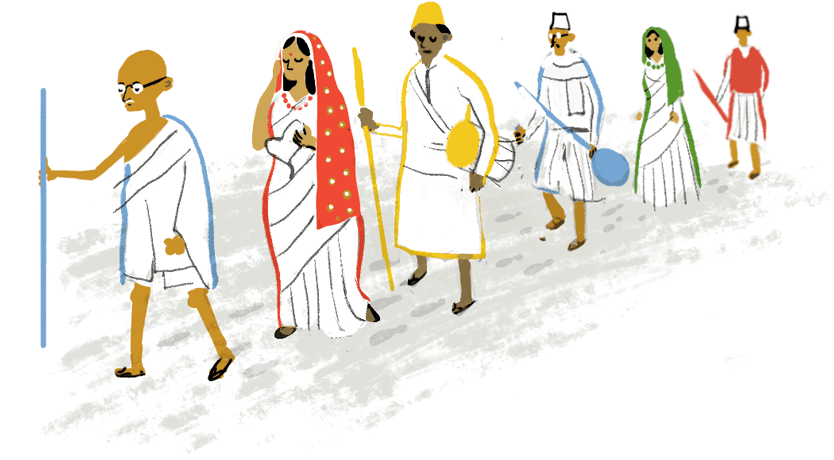
Illustration on Google India shows Gandhi leading the Dandi March of 1930

In honor of the 69th Anniversary of India’s Independence on Aug. 15,Google India’s Doodle features Mahatma Gandhi leading the Dandi March of 1930.

India Independence Day 2015

The scene depicts a significant moment in India’s push for freedom from the rule of the British Raj and the beginning of the Civil Disobedience Movement. Seventy-eight Congress volunteers participated in the 240-mile march in protest of unfair salt laws.

Leon Hong illustrated the Doodle for Google users in India as they celebrate the Indian Independence Act of 1947 on Saturday.


Source…Julia Zorthian   http://www.times.com

Natarajan