A soap that has held a special place in the hearts of Indians for more than a century, Mysore Sandal Soap’s legacy is intricately interwoven with Karnataka’s history and heritage.
There is something beautifully Indian about the fragrance of sandalwood. Sweet, warm, rich and woody, it is a scent that is deeply interwoven with the nation’s history and heritage. This is, perhaps, one of the many reasons why the Mysore Sandal Soap has held a special place in the hearts of Indians for more than a century.
Here’s the fascinating story behind India’s most-loved sandal soap.
One hundred and one years ago, in May 1916, Krishna Raja Wodiyar IV (the then Maharaja of Mysore) and Mokshagundam Visvesvaraya (the then Diwan of Mysore), set up the Government Sandalwood Oil factory at Mysore for sandalwood oil extraction.
The primary goal of the project was to utilise the excess stocks of the fragrant wood that had piled up after World War I halted the export of sandalwood from the kingdom of Mysore (the largest producer of sandalwood in the world at the time).
Two years later, the Maharaja was gifted a rare set of sandalwood oil soaps. This gave him the idea of producing similar soaps for the masses which he immediately shared with his bright Diwan. In total agreement about the need for industrial development in the state, the enterprising duo (who would go on to plan many projects whose benefits are still being reaped) immediately got to work.
A stickler for perfection, Visveswaraya wanted to produce a good quality soap that would also be affordable for the public. He invited technical experts from Bombay (now Mumbai) and made arrangements for soap making experiments on the premises of the Indian Institute of Science (IISc). Interestingly, the IISc had been set up in 1911 due to the efforts of another legendary Diwan of Mysore, K Sheshadri Iyer!
From the talent involved in the research happening at IISc, he identified a bright, young industrial chemist called Sosale Garalapuri Shastry and sent him to England to fine tune his knowledge about making soap. Affectionately remembered by many as Soap Shastry, the hardworking scientist would go on to play a key role in making Visveswaraya’s dream a reality.
After acquiring the required knowledge, Shastry quickly returned to Mysore where the Maharaja and his Diwan were waiting anxiously. He standardized the procedure of incorporating pure sandalwood oil in soaps after which the government soap factory was established near K R Circle in Bengaluru.
The same year, another oil extraction factory was set up at Mysore to ensure a steady supply of sandalwood oil to the soap making unit. In 1944, another unit was established in Shivamoga. Once the soap hit the market, it quickly became popular with the public, not just within the princely state but across the country.
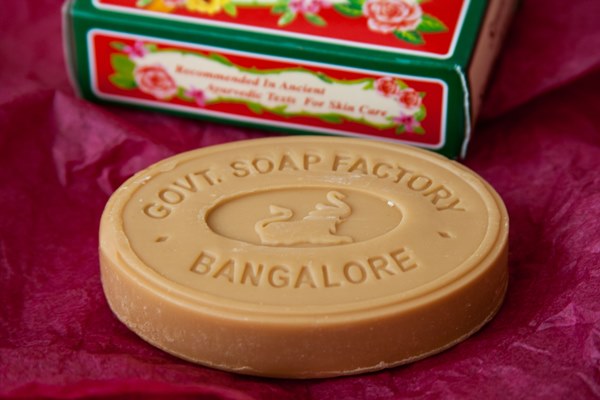
However, Shastry was not done yet. He also created a perfume from distilled sandalwood oil. Next, he decided to give the Mysore Sandal Soap a unique shape and innovative packaging. In those days, soaps would normally be rectangular in shape and packed in thin, glossy and brightly coloured paper. To help it stand out from the rest, he gave the soap an oval shape before working on a culturally significant packaging.
Cognizant of the Indian love of jewels, Shastry designed a rectangular box resembling a jewellery case— with floral prints and carefully chosen colours. At the centre of the design was the unusual logo he chose for the company, Sharaba (a mythical creature from local folklore with the head of an elephant and the body of a lion. A symbol of courage as well as wisdom, the scientist wanted it to symbolise the state’s rich heritage.
The message ‘Srigandhada Tavarininda’ (that translates to ‘from the maternal home of sandalwood’) was printed on every Mysore Sandal Soapbox. The aromatic soap itself was wrapped in delicate white paper, similar to the ones used by jewellery shops to pack jewels.
This was followed by a systematic and well-planned advertising campaign with cities across the country carrying vibrant signboards in neon colours. Pictures of the soapbox were noticeable everywhere, from tram tickets to matchboxes. Even a camel procession was held to advertise the soap in Karachi!
The out-of-the-box campaign led to rich results. The soap’s demand in India and abroad touched new heights, with even royal families of foreign nations ordering it for themselves. Another important turning point for the company was when, in 1980, it was merged with the oil extraction units (in Mysuru and Shivamoga) and incorporated into one company called Karnataka Soaps and Detergent Limited (KSDL).
However, in the early 1990s, the state-run firm did face a rough patch due to multinational competition, declining demand and lack of coordination between sales and production departments. As losses started rising, it was given a rehabilitation package by BIFR (Board for Industrial & Financial Reconstruction) and KSDL grabbed the lifeline with both hands.
The company streamlined its way of functioning and soon it had started showing profits again. Thanks to rising profits year after year, it had soon wiped out all its losses and repaid its entire debt to BIFR by 2003. The company also successfully diversified into other soaps, incense sticks, essential oils, hand washes, talcum powder etc.
Nonetheless, the Mysore Sandal Soap remains the company’s flagship product, the only soap in the world made from 100% pure sandalwood oil (along with other natural essential oils such as patchouli, vetiver, orange, geranium and palm rose). Due to tremendous brand recall and loyalty associated with the soap, it also bags a prized position on the shopping lists of visiting NRIs.
In 2006, the iconic was awarded a Geographical Indicator (GI) tag — that means anyone can make and market a sandalwood soap but only KSDL can rightfully claim it to be a ‘Mysore Sandalwood’ soap.
Thanks to this near-monopolistic presence in the market for sandalwood bathing soaps, KSDL has also become one of Karnataka’s few public sector enterprises that turns consistent profits. In fact, the company registered its highest gross sales turnover (of ₹476 crore) in 2015-16.
Such is the legacy of sandalwood and this earthy, oval-shaped soap in the state that even Karnataka’s thriving film industry calls itself Sandalwood!
Today, there are a multitude of branded soaps in the market but Mysore Sandal Soap continues to hold a distinctive place among all of them. Its production figures continue to rise, even as the availability of sandalwood is on the decline.
To counter this, KSDL has been running a ‘Grow More Sandalwood’ programme for farmers, that provides affordable sandalwood saplings along with a buy-back guarantee.Working in partnership with the forest department, it is also working to ensure that for every sandalwood removed for extraction, a sandalwood sapling is planted to replace it.
The story of Mysore Sandal Soap and its enduring appeal is an inspiration not just for Indian PSUs but for the entire FMCG sector. Here’s hoping that its future is aromatic as its history!
Source….www.the betterindia.com
Natarajan



 Take off with Natarajan