Meet Harjit Sajjan, An Indian-Origin Who Will Be Canada’s New Defence Minister….

We told you about this monumental move – Punjab being listed as the third language in the Parliament of Canada and that a new cabinet will be unveiled.

Canadian Prime Minister Justin Trudeau announced his new cabinet. And now, Canada’s new Defence Minister will be Indian origin Harjit Sajjan.

He is one of the 20 Punjabi speaking members elected to the latest Canadian cabinet.

Here are a few things that you probably didn’t know about him:

1. He hails from a small village of Bombeli, which is located in Hoshiarpur District of Punjab. He shifted to Canada because of his father, who left for Canada when he was young.

2. He has been living in Vancouver South since he was 5 years old.

3. He served in the gang squad of the Vancouver Police Department for 11 years.

4. After that, he became Lieutenant-Colonel in the Canadian Armed Force. As demanded by this post, he went to Afghanistan 3 times. Among many other recognitions, he was awarded Meritorious Service Medal and the Order of Military Merit.
He was known for his bravery. Canadian Brigadier General, David Fraser praised him for his diligence, bravery, and unwavering determination.

He took to Twitter to announce about his new ‘post’. His jubilance was quite noticeable.

Other than Harjit Singh Sajjan, there are three other Indian-origin Sikh ministers in the newly formed cabinet.

Amarjeet Sohi:  Minister of Infrastructure and Communities

Navdeep Bains: Minister of Innovation, Science and Economic Development

Bardish Chagger:  Minister for Small Business and Tourism

Also, Canada’s Prime Minister has shown that he’s a staunch believer of gender equality by appointing the equal number of men and women in his cabinet.

This is definitely a big step for Canada and also for India. We congratulate them for this feat

News Source: Times Of India

Cover Image Source

Source….Aparajita Mishra in http://www.storypick.com

Natarajan


Message for the Day…” Start Searching for the Faults and Weaknesses within Yourself First…”

The unceasing toil of each succeeding day has as its aim and justification this consummation: to make one’s last days sweet and pleasant. But each day also has its evening. If the day is spent in good deeds, then the evening blesses us with deep, invigorating and refreshing sleep, the sleep about which it is said that it is akin tosamadhi. One has only a short span of life on earth. But even in this short life one can attain divine bliss by using the time wisely and carefully. Two people may be same in appearance, and might have ostensibly been of the same mould and also grown under the same conditions, but one could turn out to be an angel while the other stays on with their animal nature. What’s the reason for this differential development? It is habits, the behaviour formed out of these habits, and the character into which that behaviour has solidified. People are creatures of character. Hence the very first spiritual practice (sadhana)is to search for the faults and weaknesses within yourself and to strive to correct them to become perfect.

Sathya Sai Baba

An 83-Year-Old On Oxygen Begins To Sing…By The Time He’s Done, Everyone’s In Tears….

The Young@Heart chorus based in western Massachusetts is comprised of senior citizens ranging from their early 70s and beyond. Established at an elderly housing project in 1982, the program has given countless aging individuals an exciting, fun, and productive pastime to look forward to each day.

During a performance in 2007, 83-year-old Fred Knittle stepped on stage to perform the lead vocal in their cover of Coldplay’s “Fix You.” Though he had retired from their group a few years before and was struggling with health issues, his incredible voice still managed to bring the house down. Prepare for your heart to melt.

Sadly, Knittle passed away just two short years after this stirring performance. But thank goodness they captured this amazing moment so his legacy can live on. You can find more of the chorus’s beautiful renditions over on their YouTube page.
Source…..Jessica Catcher  in http://www.viralnova.com
Natarajan


Stunning Performance on Ice… !!!

Competing at the World Synchronized Skating Championships earlier this year, Team Canada stepped onto the ice with something to prove. They wanted to be the best and weren’t going to let anyone get in their way. Because after all the practice, hard work, and dedication, they knew they wanted it more than their peers.

That’s why when the music started, and their performance began, you could tell something special was about to happen…

It must be incredibly difficult to work so seamlessly with so many people — and on ice, nonetheless! But, as you can see, when it’s pulled off correctly, the result is simply stunning.

Source….www.viral nova.com and http://www.you tube .com

Natarajan

Message for the Day…” ‘seva’ is the highest path of Devotion which wins the Grace of God…”

Sathya Sai Baba

Today, we are confronted everywhere by statistics parading quantities and reports in glowing terms. Do not bother about adding to the number or achieving a target. I value quality, not quantity. Genuine and intensive devoted service offered in a few spots or villages is more fruitful than superficial service offered to a large number. Convince yourselves that life cannot continue long without others serving you and you serving others. Every relationship – be it master-servant, ruler-ruled, guru-disciple, employer-employee, or parents-children and so on – is bound by mutual service. Everyone is a sevak (servitor). The farmer and labourer whom you serve, produce by their toil your food and clothing as their service to you. Remember that the body, with its senses-mind-brain complex has been awarded to you to be used for helping the helpless. Seva is the highest of paths of Devotion which wins the Grace of God. Service promotes mental purity, diminishes egoism and enables one to experience, through empathetic understanding, the unity of mankind.

“Smile…It makes people wonder what you are thinking….”

Even if it its repeated …. Read with a Smile for a Good Laugh !!!””

And Start your day with a Big Smile ….


A good 30 laughs – Dilbert’s one liners :
Old Classics

🔺 I say no to alcohol, but it just doesn’t listen.
🔺 A friend in need is a pest indeed.
🔺 Marriage is one of the chief causes of divorce.
🔺 Work is fine if it doesn’t take too much of your time.
🔺 When everything comes in your way you’re in the wrong lane.
🔺 The light at the end of the tunnel may be an incoming train..
🔺 Born free, taxed to death.
🔺 Everyone has a photographic memory, some just don’t have film.
🔺 Life is unsure; always eat your dessert first.
🔺 Smile, it makes people wonder what you are thinking.

If you keep your feet firmly on the ground, you’ll have trouble putting on your pants.
🔺 It’s not hard to meet expenses, they are everywhere.
🔺 I love being a writer… what I can’t stand is the paperwork..
🔺 A printer consists of 3 main parts: the case, the jammed paper tray and the blinking red light.
🔺 The guy who invented the first wheel was an idiot. The guy who invented the other three, he was the genius.
🔺 The trouble with being punctual is that no one is there to appreciate it.
🔺 In a country of free speech, why are there phone bills?
If you cannot change your mind, are you sure you have one?
🔺 Beat the 5 O’clock rush, leave work at noon!
🔺 If you can’t convince them, confuse them.
🔺 It’s not the fall that kills you. It’s the sudden stop at the end.
🔺 I couldn’t repair your brakes, so I made your horn louder.
🔺 Hot glass looks same as cold glass. – Cunino’s Law of Burnt Fingers
🔺 The cigarette does the smoking you are just the sucker.
🔺 Someday is not a day of the week
Whenever I find the key to success, someone changes the lock.
🔺 The road to success…. Is always under construction.
🔺 Alcohol doesn’t solve any problems, but if you think again, neither does Milk.
🔺 In order to get a Loan, you first need to prove that you don’t need it !!!
Source…input from a friend of mine
natarajan

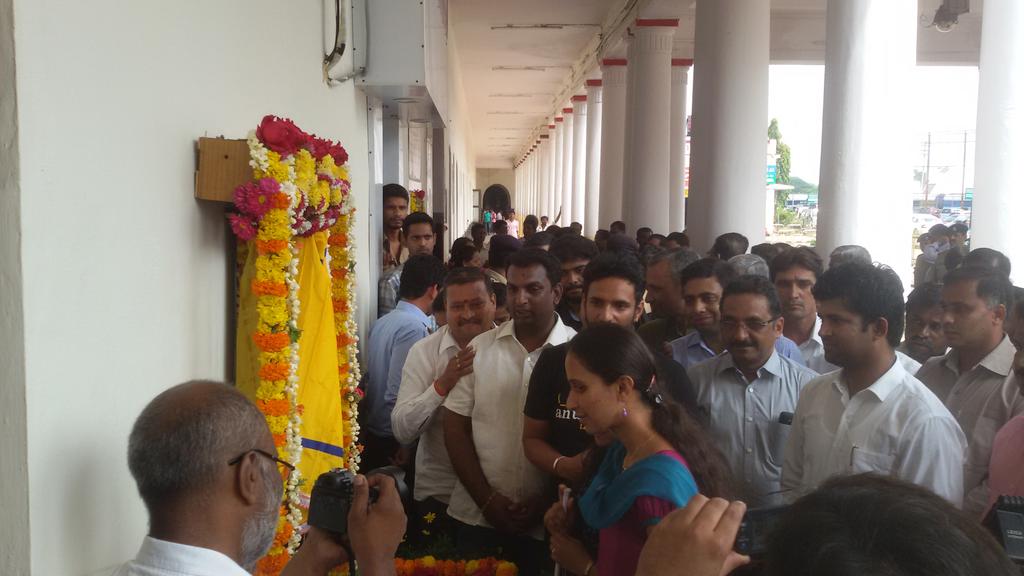
Mysore Gets India’s First Visually -Handicapped Friendly Railway Station …

Mysuru Railway Station has become the first railway station in India to be visually impaired friendly.

With the aim of helping visually impaired passengers travel independently, features like tactile maps and train schedules in Braille were unveiled at the station.

mysuru1

Source: Twitter

Anuprayaas, a non-government organization working for the welfare of visually challenged persons, along with south-western railway officials, started working on this project about a month ago. The first phase was inaugurated on November 3, and two more phases are being planned. The installations at the station include the following:

  • Tactile maps to give people an idea about the physical layout of the station. It is basically a map with raised surfaces that describes the distance and location of the entrance, platforms, counters, washrooms etc. The map informs people where they are, which side to turn and how many steps to take to reach a help desk.
  • Train itinerary sign board that provides train names their schedules in Braille. These are fixed signboards and do not provide real time information like electronic boards.
  • 400 metallic Braille signs have been installed at about ten places on each platform. Placed along the railing of the staircase leading to various platforms, they provide directions and platform information.
  • Restaurants, canteens and food plazas in the railways station will not have Braille menu cards too.

27-year-old Pancham Cajla is the founder of Anuprayaas, and he started working on this project along with five of his friends. Mysuru MP, Pratap Simha, inaugurated the facility.

“As a part of the railway department, I went to organizations and met blind people. We asked them about what they would expect from a blind-friendly railway station,” Arun Kumar Singh, Telecom engineer with the South-Western Railways who helped in the execution of the project, told The News Minute.

During the testing period, the NGO brought many visually impaired people to check the features. Until people became aware of this facility, volunteers from the NGO will help the passengers. Anuprayaas is planning to go digital, improve the tactile maps, and introduce more disabled friendly battery cars in the second phase.

Embedded image permalink

Sowmya visually challenged girl inaugurating tactile map of mysuru station with all utilities & train time table

https://twitter.com/DrmMys

Source…. Tanaya Singh ….www.the better india .com

Natarajan

This Kerala Man Built an Aircraft. He Now Wants a Job….

This Kerala Man Built an Aircraft. He Now Wants a Job

Saji Thomas has studied only till class 7 and has always been hooked on to electrical gadgets and their repairs

THIRUVANANTHAPURAM:  After five years of painstaking efforts, Saji Thomas has built a small aircraft – all on his own – but now this 45-year-old from Kerala, who is speech and hearing challenged, yearns for a full-time job.

His wife Maria said that they have been married for 14 years and since then, all that she saw was her husband busy tinkering with small motors and machines she didn’t have a clue about.

“Initially I tried my best to dissuade him to get work as an electrician, but when I found all my efforts were in vain, I decided to support him in all his endeavours. Today the entire village (near Thodupuzha in Idukki district) is steadfastly behind him as he built a twin-seater ultralight aircraft, which has been filmed by the Discovery Channel,” Maria told IANS.

Mr Saji has studied only till class 7 and has always been hooked on to electrical gadgets and their repairs.

“The first thing he built was the frame of an helicopter. He got in touch with (former prime minister) Rajiv Gandhi, seeking money to buy an engine for it. It did not materialise because Rajiv Gandhi was assassinated (In May 1991). Then his interest shifted to building an aircraft and after five years of hard work, he fitted the small aircraft with the engine of a two-wheeler. Later it was given to a college nearby and they still use it to teach their students,” the proud wife said.

She said he then began work on this now successful two-seater and sourced all the materials from Bangalore.

“After a marathon five years of work, last year in April, it was taken to a private airline academy in Ambasamudram near Madurai. Since this aircraft has no licence nor does Saji have a licence to fly aircraft, he could fly it for a few minutes there. Later the chief instructor, a retired air force officer, also flew it for a few minutes. The aircraft flew only at a height of 20 feet as the rules are very strict,” added Maria.

Today the couple, who has a 13-year-old son Joshua, is still hoping for the government support.

“We see the present programme of Discovery Channel which has filmed his efforts as an eye-opener and it is expected to be aired soon. Our only wish is my husband gets a stable monthly job as by now he has sold a portion of our land to complete this aircraft. We live in a small two-room home built with the help of the local village council in 2001,” Maria said.

In all, Saji has spent Rs.25 lakh for his expensive hobby in the past more than 15 years.

Source….www.ndtv.com
Natarajan

THAT TIME A COMMERCIAL AIRCRAFT RAN OUT OF FUEL MID-FLIGHT- THE GIMLI GLIDER….

On July 23, 1983, in the small town of Gimli, Manitoba, Captain Robert Pearson and Co-Pilot Maurice Quintal expertly glided a 100-ton Boeing 767 carrying 69 people to a safe landing without engines, air brakes or flaps, and minimal control of the aircraft.

Bad Math

The flight plan for Canada 143 that day began with a short jaunt from Montreal, Quebec to Ottawa, Ontario. Right from the beginning, the crew realized the plane had a faulty fuel control: “A computer known as the Fuel Quantity Information System Process manages the entire fuel loading process. . . . But the FQIS was not working properly on Flight 143.”

With FQIS out-of-order, the ground maintenance crew had to calculate the amount of fuel needed, in a process called “dipping the tanks.”

Wisely taking all precautions, the flight crew also checked the maintenance crew’s fuel calculations, three times in fact, and each time, the calculations matched.

After reaching Ottawa, and preparing for the 2,800 kilometer trip to Edmonton, Alberta, Pearson apparently sensed something was off and asked that the plane be “re-dipped.”  The ground refuelers stated that the tanks had 11,430 liters of fuel.  When Pearson and Quintal crunched the numbers, they came up with approximately 20,400 kilos of fuel on board, which all seemed correct.  The truth is, though, they only had about 9,144 kilos.

The problem was that the original ground crew, and the flight crew (twice!), had forgotten that the new airliner used the metric system (as Canada was in the process of switching to the metric system, so the new planes purchased by Air Canada were being calibrated in metric units); as a result, they had all erroneously used the figure 1.77 lbs/liter for their specific gravity factor in the calculations, but what they should have used was 0.8 kg/liter.

Bottom line, this meant that the plane was filled with only about half of the fuel it needed to make the trip.

Oh No!

Shortly after dinner:

The first warning light came on. Flight 143 was . . . at 41,000 feet and 469 knots at the time . . . . ‘At that point . . . We believed we had a failed fuel pump in the left wing, and switched it off. . . . . When a second fuel pressure warning light came on, Pearson felt it was too much of a coincidence and made a decision to divert to Winnipeg.


Just minutes later, another pressure gauge “lit up,” and they lost their left engine. Two minutes after that: “The EICAS issued a sharp bong – indicating the complete and total loss of both engines. . . . ‘It’s a sound that Bob and I had never heard before.’ . . . . Starved of fuel, both . . . engines had flamed out. Pearson’s response, recorded on the cockpit voice recorder, was ‘Oh fuck.’”

After a quick perusal of the manuals, which had no procedures for a loss of both engines, the pilots quickly realized their only hope was to somehow glide the plane to a safe landing. Luckily for the passengers aboard, while he’d never tried gliding a Boeing 767, Pearson was an extremely experienced glider pilot.

Of course, while a Boeing 767 is perfectly capable of gliding to some extent, even fully loaded, many of the systems within the plane were not designed to run without the engines. Thus, a byproduct of the engines dying was the loss of many of the systems and instruments on the plane due to lack of electricity, leaving them with only basic instruments.

One of the many key things that shut off was the radar transponder, meaning that traffic controllers on the ground at Winnipeg’s airport had to use a ruler placed on the radar screen to determine the distance traveled by the aircraft in a given time, which could then be combined with the rate of descent to figure out how far the plane could go.

If the loss of many of the instruments wasn’t bad enough, most critical of all was the loss of hydraulic pressure. Without it, the pilots would have no control at all.  Because of this, the Boeing 767 is equipped with a “ram air turbine” which is automatically deployed in cases like this, providing a very small amount of hydraulic pressure- the faster the plane is going, the better this hydraulic pump would work as the turbine spun faster.  Of course, as the plane slows for a landing, hydraulic pressure drops, and so does the pilot’s ability to control the plane.  But that’s a problem for later.

At this point, the plane was losing altitude at a rate of approximately 2,000 feet/minute, but at least the pilots could still control it.

Because of the sink rate, the pilots and controllers after crunching the numbers all agreed the plane would never make it to Winnipeg, but:

An abandoned Royal Canadian Air Force Base . . . was 12 miles away . . . Quintal was familiar with it because he’d been stationed there in the service. Unknown to him and the controllers . . . Runway 32L . . . had become inactive and . . . a steel guard rail had been installed down most of the southeastern portion. . . . This was the runway Pearson would ultimately try and land on…

A Forward Slip

Upon approaching the runway at the old Gimli base, Pearson and Quintal realized they were too high. They then performed a common maneuver in small aircraft called a forward slip, which is to bank into the wind, then apply opposite rudder to keep the plane flying straight, rather than turning; this results in the plane descending more rapidly without increasing airspeed. While commonly done in personal aircraft, this is a very rare maneuver for commercial craft.

Although somewhat risky, this was the pilots’ only option since the flaps and dive-brakes required power from the now-inoperable engines. While all pilots are well familiar with this maneuver (in fact it’s generally required before you can go on your first solo flight in personal aircraft), Pearson had a wealth of experienceperforming the forward slip maneuver, thanks to not only frequently piloting gliders, but also years of experience towing them: “After releasing the glider, I would have this long tow line hanging under the plane, and I had to be careful not to snag it on the farmer’s fence as I approached the runway. So I would stay high until I cleared the fence, and then did a steep slip to make the runway.”

The Landing

The lack of hydraulic pressure had another downside, they couldn’t control the landing gear.  Thus, they performed another atypical procedure of a “gravity drop” of the wheels.  As a result, as the nose gear was dropping into the wind, it didn’t lock in place.

Another problem was that, unknown to the pilots, the abandoned runway had been converted to a recreational center, including auto and go-cart racing. In one of the many weird coincidence of the day, July 23, 1983, was the “Family Day” for the Winnipeg Sports Car Club: “Go-cart races were being held on one portion of runway 32L and just past the dragstrip another portion of the runway served as the final straightaway for a road course. Around the edges of the straightaway were cars, campers, kids and families in abundance…”

In what must have been a surreal moment for all of them: “Trees and golfers were visible out the starboard side passengers’ windows as the 767 hurtled toward the threshold at 180 knots, 30-50 knots faster than normal . . . . A passenger reportedly said, ‘Christ, I can almost see what clubs they are using…’”

Quintal did not realize the people were present on the runway until the point of no return, so he didn’t say anything. Pearson simply hadn’t noticed.  Pearson’s obliviousness to the potential human tragedy wasn’t negligence on his part, rather, in order to land the plane: “His attention was totally concentrated on the airspeed indicator [and operating the plane. In fact,] he never even saw 32R, focusing instead on airspeed, attitude, and his plane’s relationship to the threshold of 32L.”

The plane had also become increasingly difficult to control as its speed decreased and the turbine providing the hydraulic pressure slowed its spinning.

Nevertheless, they managed to glide in safely and as the plane touched down: “Spectators, racers, and kids on bicycles fled the runway. The gigantic Boeing was about to become a 132 ton, silver bulldozer. One member of the . . . Club reportedly was walking down the dragstrip, five gallon can full of hi-octane fuel in hand, when he looked up and saw the 767 headed right for him.”

Pearson laid heavily on the wheel brakes directly after touching down and: “Two tires blew out. The nose gear . . . collapsed . . . the nose . . . slammed against the tarmac, bounced [and threw a] three hundred foot shower of sparks. The right engine nacelle struck the ground . . . . The 767 came to a stop . . . less than a hundred feet from spectators, barbecues and campers…”

Although some people were hurt exiting the plane, due to the now contorted angle of its emergency exits, none of the 61 passengers, 8 flight crew or people on the ground suffered any serious injury.

Source….www.today i foundout.com

Natarajan

WHY STANDING IN ONE PLACE MAKES YOUR LEGS MORE SORE THAN WALKING…?

Why does standing in one place for a long time make my legs and feet sorer than walking the same amount of time?

Working retail, waiting tables, standing in line at the amusement park or just shopping with mom, anyone who’s ever been stuck on their feet for a long time more or less standing still knows that it’s much more tiring than walking the equivalent amount of time.  But why?

First, when you stand, your legs aren’t resting, even beyond just supporting your weight. Instead, your body sways very slightly. To keep you upright, a few muscles, particularly those in your calves, are constantly working, making very small adjustments that you probably aren’t consciously aware of. On the other hand, when you walk, the burden is distributed across more muscle groups. Muscles swinging the arms help propel them, core muscles keep you stable, butt muscles complete your stride, and the legs of both the calves and the thighs are employed.

Second, when you’re standing still, each foot and leg supports about half of the body’s weight, but neither ever gets a rest. On the other hand, when walking, each time a foot is raised the muscles formerly helping to balance you get a little break as does the bottom of your foot. While only a small break each instance, this totals to about half the time being in more or less a resting state other than the muscles required to lift your foot off the ground.

Walking

Third, when you stand, the blood and lymph fluids pool in your feet, calves and ankles, because your heart cannot efficiently pump the blood all the way up from your feet by itself. This is why if you stand in one place for long periods, you might notice that your feet and lower legs swell a little.

Because the heart isn’t up to performing this task efficiently, it relies in part on muscle contractions that occur when you walk and move about. As David J Tibbs in Varicose Veins and Related Disorders, states,

Only the peripheral pumping mechanism (musculovenous pumping) can cause full venous flow against gravity. This forceful pumping action is brought about when multiple veins are compressed by contraction of surrounding skeletal muscle. The valves direct the blood heartwards and prevent it from falling back again. Thus, by this simple arrangement, the harder the muscles work, the more vigorously is the massive flow of blood generated by this activity returned towards the heart.

Thus, when you stand in one place, your muscles are receiving less oxygen and other such things they need to operate at peak efficiency compared to when you walk around.


Fourth, when you stand, the entire load of your body rests on the same place – the underside of your feet, and particularly on the balls and heels. Beyond one side getting the aforementioned break about half the time, when you walk, different parts of your feet bear the load at different times.

Fifth, standing is sometimes much more boring than walking, particularly if you are at work with nothing mentally engaging to do (or watching your mom shop…). With nothing to occupy your mind, it can wander to how tired you are and how much your feet hurt. On the other hand, when walking, your brain will be more occupied since you must constantly assess the situation and avoid obstacles. Thus, standing may also seem even more tiring because you are just more aware of how your legs and feet are feeling.

Sixth, if you walk fast enough (or jog), your body will release neurochemicals that make you feel better, including adrenaline that pumps the heart faster, providing more oxygen to the muscles and brain, as well as endorphins that improve mood.

Bonus Facts:

  • In addition to those muscles mentioned, walking also works out the muscles around the pelvis, including the external abductors and internal adductors, belly muscles in the front and spinal muscles in the rear.
  • As with standing, anytime a person remains upright, venous pooling will occur; in some situations, such as when a construction worker remains suspended in a “fall harness” (the device that saves his life after a fall) but is unable to move his legs significantly, the pooling of blood can reach a critical level. As more blood pools in the legs (which aren’t moving enough to send it back up to the heart), the heart rate increases at first, and then will slow significantly. Without sufficient blood to bring fresh oxygen to the brain, the victim first loses consciousness, and if left in that condition, renal failure and even death can occur. (See: Suspension Trauma)
  • The average U.S. adult walks about 5,900 steps each day. Health experts recommend this be raised to at least 7,000 – the amount the average Japanese person gets in a day.
  • Interestingly, in a 2004 study of American Amish, it was shown that women got in more than 14,000 steps each day, and men more than 18,000. If only they had Fitbits to have the data to brag with;-)
  • Australians average almost 9,700 steps each day, and the Swiss get just a bit less than that.
  • The idea that “10,000 steps each day” is required for optimum health comes from an early Japanese pedometer from the 1960s called manpo-kei (“10,000 steps meter”). That said, the Centers for Disease Control does not recommend any particular number of steps, and instead suggests adults get 150 minutes of moderate activity each week.

Source….www.today i foundout.com

Natarajan