Worlds Safest Airlines …Top 20….” Qantas is in Top of the list for the 3rd Year ” …

qantasjessrqst

Nervous flyer?  Just want to know you’re traveling with a reliable airline? Find out who are the world’s safest airlines.

AirlineRatings.com, the world’s only safety and product rating website, which was launched in June 2013, has announced its top twenty safest airlines and top ten safest low cost airlines for 2016 from the 407 it monitors.

Top of the list for the third year is Australia’s Qantas, which has a fatality free record in the jet era – an extraordinary record. Making up the remainder of the top twenty in alphabetical order are: Air New Zealand, Alaska Airlines, All Nippon Airlines, American Airlines, Cathay Pacific Airways, Emirates, Etihad Airways, EVA Air, Finnair, Hawaiian Airlines, Japan Airlines, KLM, Lufthansa, Scandinavian Airline System, Singapore Airlines, Swiss, United Airlines, Virgin Atlantic and Virgin Australia.

AirlineRatings.com’s rating system takes into account a range of factors related to audits from aviation’s governing bodies and lead associations as well as government audits and the airline’s fatality record. AirlineRating.com’s editorial team, one of the world’s most awarded and experienced, also examined each airline’s operational history, incident records and operational excellence to arrive at its top twenty safest airlines.

The AirlineRatings.com top twenty have always been at the forefront of safety innovation and launching of new aircraft and these airlines have become a byword for excellence. Responding to public interest, the AirlineRatings.com editors also identified their top ten safest low cost airlines.

They are in alphabetical order: Aer Lingus, Flybe, HK Express, Jetblue, Jetstar AustraliaThomas Cook, TUI Fly, Virgin AmericaVolaris and Westjet.

Unlike a number of low cost carriers, these airlines have all passed the stringent International Air Transport Association Operational Safety Audit (IOSA) and have excellent safety records.
Of the 407 airlines surveyed, 148 have the top seven-star safety ranking but almost 50 have just three stars or less. There are 10 airlines with only one star and these airlines are from Indonesia, Nepal and Surinam.

In selecting Qantas as the world’s safest airline AirlineRatings.com editors noted that over its 95-year history the world’s oldest continuously operating airline has amassed an extraordinary record of firsts in operations and safety and is now accepted as the industry’s most experienced carrier.

The Australian airline has been a leader in: the development of the Future Air Navigation System; the Flight Data Recorder to monitor plane and later crew performance; automatic landings using Global Navigation Satellite System as well as precision approaches around mountains in cloud using RNP. Qantas was the lead airline with real time monitoring of its engines across its fleet using satellite communications, which has enabled the airline to detect problems before they become a major safety issue.

Last year was a disturbing year for airline safety with some tragic and bizarre accidents such as the high profile GermanWings and Metrojet disasters. However according to Aviation-Safety.net data, the 16 accidents in 2015 with 560 fatalities were below the 10-year average of 31 accidents and 714 fatalities. Last year was also a significant improvement over 2014 when there were 21 fatal accidents with 986 fatalities.

Balancing these numbers the world’s airlines carried a record 3.6 billion passengers on 34 million flights in 2015.

Flashback 50 years and there were a staggering 87 crashes killing 1,597 when airlines carried only 141 million passengers – 5 per cent of today’s number.

– See more at: http://www.airlineratings.com/news/630/who-are-the-worlds-safest-airlines-for-2016#sthash.d2MKORhu.dpuf

Source….www.airlineratings.com

Natarajan

Image of the Day… Lunar shadow across Earth..

Lunar shadow moves across Earth

This is way cool. Watch the moon’s shadow move across Earth during the March 9 total solar eclipse. A first ever animation from deep space.

March 9, 2016. Image credit: NASA

A camera aboard the DSCOVR satellite captured a unique view of this week’s solar eclipse. On March 9, 2016, residents of the Western Pacific looked up in the early morning hours to observe the only total solar eclipse of 2016, while DSCOVR looked down from a million miles away and captured the shadow of the moon crossing the planet.

In the animation above, the shadow of the new moon starts crossing the Indian Ocean and marches past Indonesia and Australia into the open waters and islands of Oceania (Melanesia, Micronesia, and Polynesia) and the Pacific Ocean. Note how the shadow moves in the same direction as Earth rotates. The bright spot in the center of each disk is sunglint — the reflection of sunlight directly back at the satellite’s camera.

NOAA’s DSCOVR satellite is the Nation’s first operational satellite in deep space. DSCOVR hovers between the sun and Earth at all times, maintaining a constant view of the sun and sun-lit side of Earth.

Adam Szabo is NASA’s project scientist for DSCOVR. He said:

What is unique for us is that being near the sun-Earth line, we follow the complete passage of the lunar shadow from one edge of the Earth to the other. A geosynchronous satellite would have to be lucky to have the middle of an eclipse at noon local time for it. I am not aware of anybody ever capturing the full eclipse in one set of images or video.

The animation above was assembled from 13 images acquired on March 9, 2016, by NASA’s Earth Polychromatic Imaging Camera (EPIC), a four-megapixel charge-coupled device (CCD) and Cassegrain telescope on the DSCOVR satellite.

Japan’s Himawari-8 satellite also captured a series of images showing the procession of the shadow during this eclipse, which you can view here.

Bottom line: On March 9, 2016, a camera aboard the DSCOVR satellite captured the shadow of the moon crossing Earth from a million miles away during the only total solar eclipse of 2016.

Source…..www.earthsky.org

Natarajan

That Time an Olympic Rower Stopped to Let Some Ducks Swim By and Still Won the Gold Medal…

Born in Sydney Australia in 1905, Henry Robert Pearce, better known as Bobby Pearce, dominated the world of competitive rowing throughout the 1920s and 1930s and was extremely popular with fans of the sport due to a combination of the ease with which he seemed to best opponents and his affable personality. Perhaps the greatest example of both of these things in action was the time Pearce stopped mid-race to allow a duck and her ducklings to pass in front of him and still won.

This particular anecdote from Pearce’s life occurred at the 1928 Summer Olympics in Amsterdam during the quarter final of the single sculls event in the Sloten canal. For anyone unfamiliar, the single sculls is essentially a race between individual opponents along a body of water and it has been a staple of the Olympic program since 1896.

Prior to taking part in the quarter final event at the 1928 Olympics, Pearce had already made quite a splash with locals by beating his previous two opponents by nearly 30 seconds each, winning his first event with such a comfortable lead that, according to a contemporary report from the Sydney Morning Herald, he pulled up before the finish line to wait for his opponent to catch up a little.

Pearce’s opponent on the fateful duck match quarter final was a Frenchman called Vincent Saurin, a powerful rower who during his career would win nine national titles and medal at three European championships. Despite his opponent’s pedigree, Pearce was able to effortlessly pull away and secure himself a near half-minute lead before the half way mark of the 2000 metre race.

In an interview with historian Henry Roxborough in 1976, Pearce recounted what happened next.

“I heard wild roars from the crowd along the bank of the canal. I could see some spectators vigorously pointing to something behind me, in my path. I peeked over one shoulder and saw something I didn’t like, for a family of ducks in single file was swimming slowly from shore to shore. It’s funny now, but it wasn’t at the time for I had to lean on my oars and wait for a clear course…”

“Had to lean on my oars…” isn’t quite accurate.  He could have simply plowed through them, but chose to pull up. While all this was happening, Saurin made up the lead Pearce had secured and, showing far less concern for the welfare of the ducks than Pearce had, capitalised on his opponents’ unlikely stint as a duck crossing guard and blew past him, stealing himself a five length lead before Pearce started rowing again.

Remarkably, in the final 1,000 metres of the race, not only did Pearce catch up to the Frenchman, but he was able to once again get far enough ahead to secure an almost 30 second lead by the finish line. In the end, Pearce finished the race with a time of 7:42.8 vs. Saurin’s 8:11.8.

This, in of itself would be impressive, but it should also be noted that not only was Pearce able to beat Saurin by nearly half a minute after coming to a complete stop in the middle of the race, but in that race he also finished with the fastest time of any of the eight competitors that round.

We should also probably mention that this was during the elimination portion of the competition meaning Pearce had risked his chance of winning an Olympic medal for his country in his first Olympics to let the ducks pass.

Unsurprisingly, Pearce ultimately won the gold medal for that event, beating out the previously undefeated American Kenneth Myers with a new world record for the 2,000 metre event with a time of 7:11.0. This record stood for an astounding 44 years, finally beaten in 1972 by Yuri Malishev of the Soviet Union.

As for the formerly undefeated Myers, his time in that face-off was a nearly equally remarkable 7:20.8, which would have been a new world record, beating the old by almost 15 seconds, if not for Pearce’s time.

(For reference, today the world record is currently held by Mahé Drysdale of New Zealand with a time of 6:33.35, which he set in Poland in 2009.  As for the Olympic record, it was recently set in 2012 in London by Tim Maeyens of Belgium with a time of 6:42.52 in the first heat. However, the gold medal in that Olympics went to Drysdale with a time of 6:57.82 seconds in the final.)

Despite his incredible talent, as Pearce was barred from competing for money if he wished to continue competing in the Olympics, he struggled to make ends meet for much of his early life, even being unemployed during the early 1930s, scraping a living by collecting scrap paper at the Sydney Showgrounds. His fortunes turned around, however, when he met Scottish whisky magnate Lord Dewar, who happily offered Pearce a job selling his whisky as his official Canadian representative, prompting Pearce to move to Canada, where he lived the rest of his life.

Despite the move, Pearce continued to compete for Australia in the 1932 Olympics, in which he defended his title, winning the gold by narrowly beating out American William Miller by a mere 1.1 seconds in the final.  While that was a close finish, it should be noted that the nearest competitors behind those two finished a whopping 30 seconds back.

Shortly after the 1932 Olympics concluded, Pearce decided to turn pro, barring him from future Olympics, but at least allowing him to earn some money at his greatest skill while his body was still up to it.

Pearce’s professional career was decidedly uneventful… by which we mean he won every event he took part in and none of his races involved ducks. He eventually retired undefeated as an adult in 1938. That same year, he even managed to win a title defense race in Toronto just a few days after his wife unexpectedly died. In fact, while we know he must have lost several matches before his first competitive victory at 14 years old, the only definitive record we could find of Pearce ever losing a sculling match was his first one when he was six years old, which was a 16 year old and under youth competition.  He finished second in that race.
After retiring from the sport, Pearce tried his hand at being a professional wrestler before joining the Canadian war effort during WW2 as part of the Naval reserves. He served in the navy until 1956, retiring as a lieutenant commander. He subsequently spent the rest of his life selling whisky on behalf of Lord Dewar in Canada, later dying of a heart attack at the age of 70 in 1976

Source………..www.today i foundout.com

Natarajan

India Exports the First Six ‘Made in India’ Metro Coaches to Australia…

Six metro coaches made in the Bombardier Transportation Plant located in Savli, Vadodara, were shipped to Australia from Mumbai port on Friday. According to plan, 450 such coaches will be exported to Australia over a period of two and a half years.

Each coach is 75 feet long and weighs 46 tonnes. This is the first-of-its-kind export from India since the launch of the ‘Make in India’ campaign.

railcoach

Picture for representation only. Source: Wikimedia

According to a statement by Ministry of Shipping, loading these coached for export requires high degree of precision. “The entire stevedoring operation (loading into ship) of these prestigious over-sized metro coaches has been done in-house by Mumbai Port Trust unlike any other port in India where private operators carry out such operations,” the statement said.

The total value of the contract signed for the project with the Canadian firm, Bombardier Transportation, is approximately USD 4.1 billion. And Bombardier’s share is valued at approximately USD 2.7 billion. The project will be executed in the company’s Vadodara facility, which has been developed for export-oriented activities.

Source…….Tanaya Singh in http://www.the betterindia.com

Natarajan

Australian Farmer Fights Soil Erosion With Land Art……

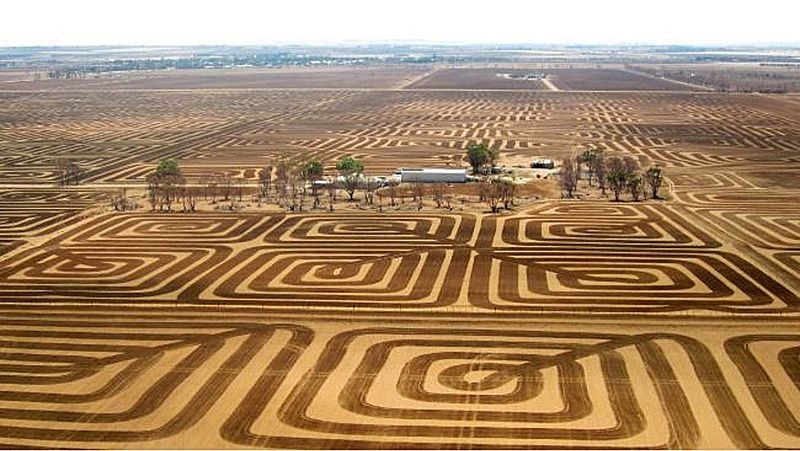
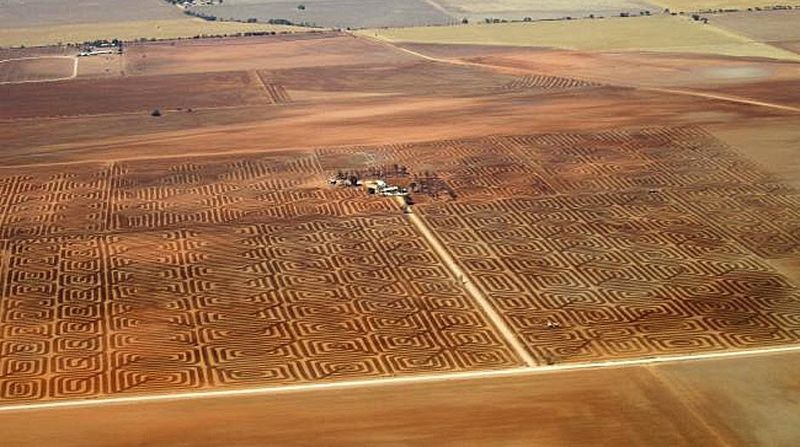
After a recent bushfire consumed all vegetation on his land, a South Australian farmer Brian Fischer decided to etch a gigantic geometric pattern on the bare ground in a bid to fight soil erosion. Without vegetation, the topsoil was vulnerable to erosion by gusting winds. So Fischer ploughed his land in a patchwork of spirals creating long furrows in the topsoil. Now no matter which direction the wind blows there will always be a furrow to catch the soil. Fischer says the pattern cost him a few days to make, but he expects to save 15 cm of topsoil that would have otherwise been lost, until the fields are green again.

The clever erosion-fighting technique came from his dad, who used it on the farm as early as 1944 during one of the worst droughts South Australia experienced. More than one million hectares of land were destroyed by a raging bushfire in Victoria, prompting some farmers to come up with this unique solution.

brian-fischer-1

Photo credit: Brian Fischer

brian-fischer-2

Photo credit: Brian Fischer

via The Guardian

Source….www.amusingplanet.com

Natarajan

image of the Day….” Sun Behind a Storm…”!

Sun behind a storm, in Australia

Beautiful light!

View larger. | Photo by Murray Fox Photography.  Visit him on Facebook.

View larger. | Photo by Murray Fox Photography. Visit him on Facebook.

Murray Fox of Ipswich – a city in southeast Queensland, Australia – posted this photo at EarthSky Facebook this weekend. He captured it on January 10, 2016. He wrote:

Amazing light as the sun was behind this storm this afternoon.

Source……..www.earthsky.org

Natarajan

9 of the Most Remote Inhabited Islands in the World…!!!

I can’t get my head around how far away the inhabitants of these islands live from civilization! They are hundreds, if not thousands, of miles from the nearest continental land mass – it’s truly astonishing to think they’re even inhabited at all. Would you dare to visit somewhere so remote? These are 9 of the world’s most remote inhabited islands:
Saint Helena 

The Most Remoted Inhabited Islands in the World

Image Source

Distance from Civilization: 1,200 miles from Angolan coast


Saint Helena is widely believed to have been discovered by the Portuguese at the turn of the 15th Century. Various European powers staked different claims to the island during the 17th Century. It’s probably most well-known as the place that Napoleon Bonaparte was exiled to, following his defeat by the British. It is home to 4,255 people.

Ascension Island

The Most Remoted Inhabited Islands in the World

Distance from Civilization: 1,000 miles from African coast


Located in the South Atlantic Ocean, Ascension Island is home to approximately 880 people. It is not thought to have had an indigenous population, and it was first settled in 1815. Prior to that, it was sporadically used as an open prison. Its principle settlement and capital city is Georgetown.

Easter Island

The Most Remoted Inhabited Islands in the World

Distance from Civilization: 2,000 miles from Chilean coast


Easter Island is instantly recognizable due to the Moai, or giant statues, which dot the island. They were carved by the native Rapa Nui people between the 13th and 16th Centuries. In the present day, the island is populated by a little over 6,000 people. It’s said to overwhelm first-time visitors with the sheer sense of isolation they feel upon arrival.

Tristan da Cunha

The Most Remoted Inhabited Islands in the World

Image Source

Distance from Civilization: 1,750 miles from South African coast


Lying all alone in the middle of the South Atlantic Ocean, Tristan da Cunha was first inhabited in 1816. Its main settlement, Edinburgh of the Seven Seas, is widely considered to be the most remote permanent settlement on earth.

Pitcairn Island

The Most Remoted Inhabited Islands in the World

Image Source

Distance from Civilization: 1,800 miles from New Zealand


Most of the 56 people that currently live on Pitcairn Island descended from the Bounty mutineers and the Tahitians that accompanied them. The island is the least populous natural jurisdiction in the world.

South Keeling/Cocos Islands

The Most Remoted Inhabited Islands in the World

Distance from Civilization: 620 miles from Java, Indonesia


This island chain consists of two atolls and 27 coral islands. Just two of the latter are inhabited. West Island is home to approximately 120 people, while Home Island is home to about 500 people. The islands are a territory of Australia.

Floreana

The Most Remoted Inhabited Islands in the World

Distance from Civilization: 620 miles from Ecuador


Taking its name from the first president of Ecuador, Floreana is part of the Galapagos Islands. While it’s true that there are some 26,000 people living throughout this archipelago in the present day, Floreana is the most remote island within it. It’s home to just 100 people.

Niue

Image Source

Distance from Civilization: 1,500 miles from New Zealand


Although Niue is an independent island country, it is in free association with New Zealand, which conducts diplomatic affairs on its behalf. It was the first nation in the world to provide free WiFi to all of its 1,600 citizens.

St. George’s Island

The Most Remoted Inhabited Islands in the World

Distance from Civilization: Approx. 500 miles from Alaska

Located in the frigid Bering Sea between Russia to the west and Alaska to the east, St. George’s Island features one settlement that encompasses the entire 35 square miles of the island. Just 100 people live on the island.

Written by: Jake Schembri

Source……www.ba-bamail.com

Natarajan

The Wedding Cake Rock, Australia…

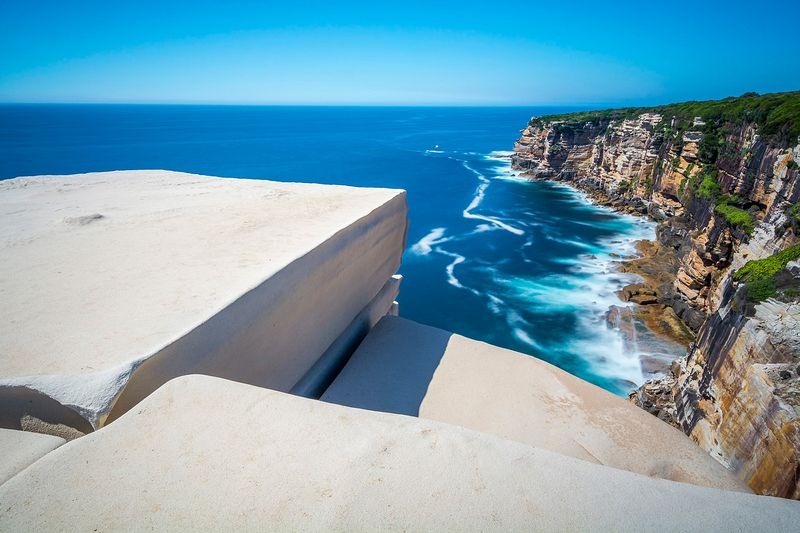
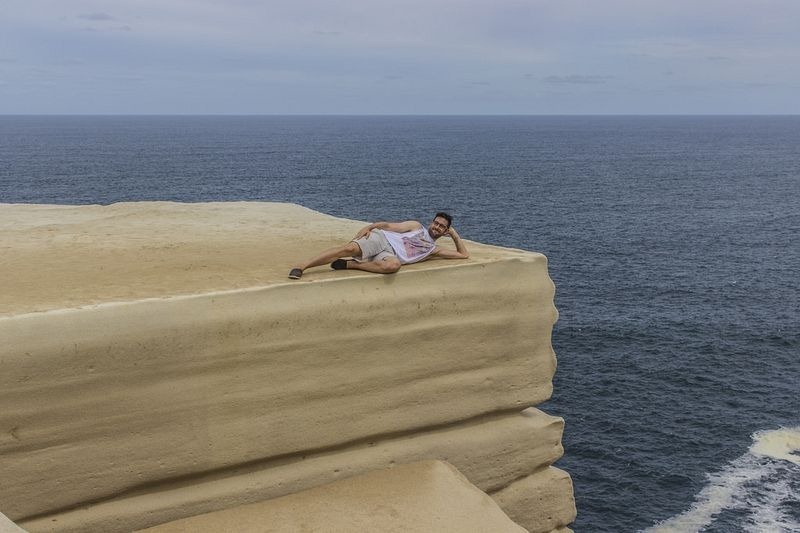
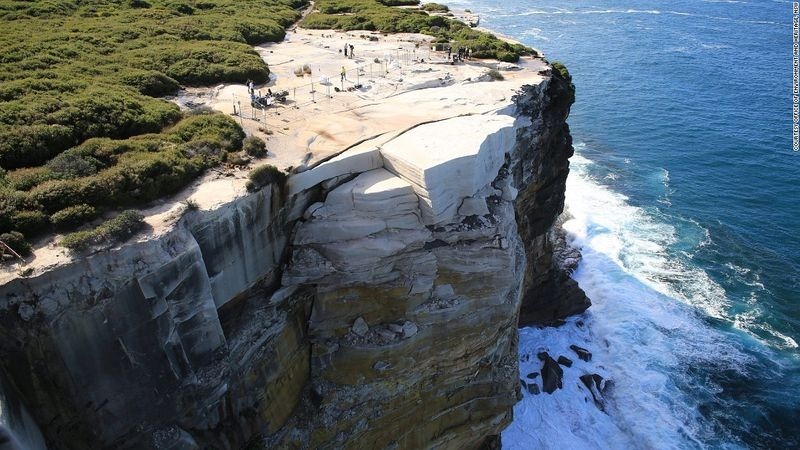
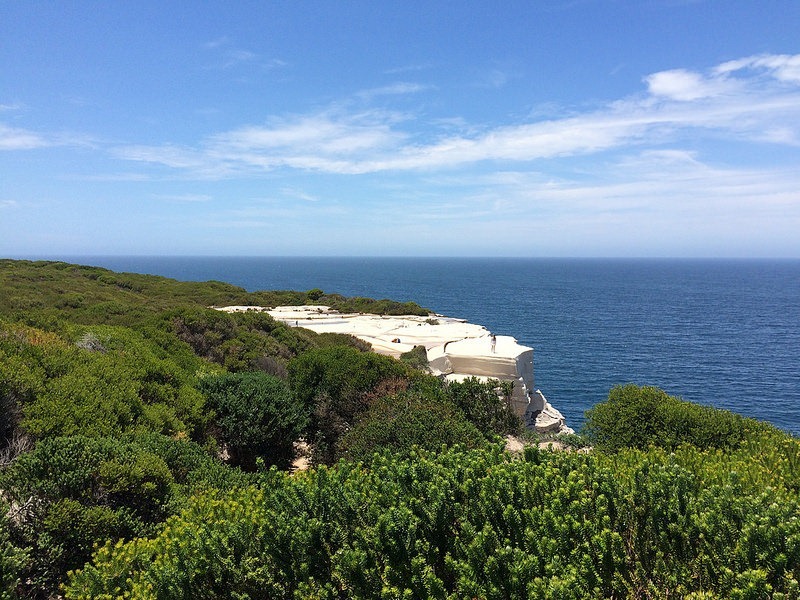
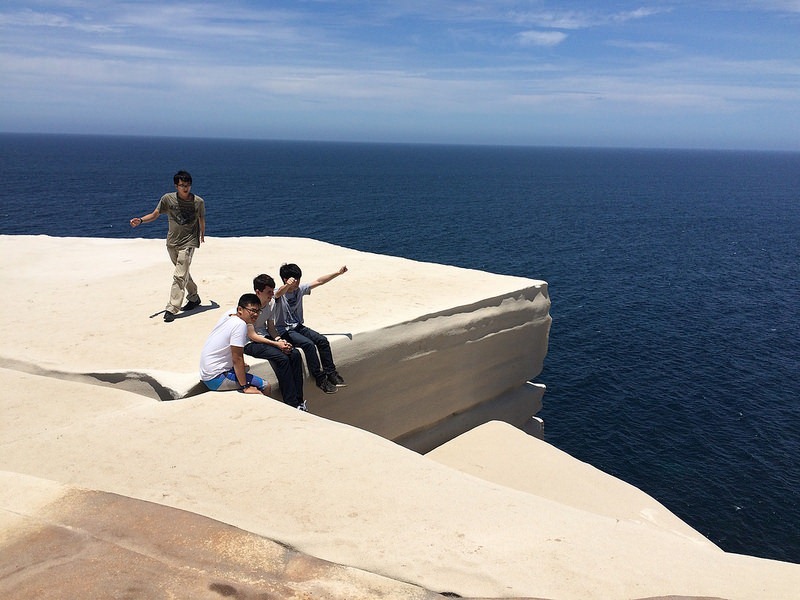
The Wedding Cake Rock is an unusual geological formation located just north of Marley Beach near Bundeena within the Royal National Park, in New South Wales. The dazzling white sandstone rock has a perfect 90° corner and a flat top, as if it has been curved by a knife. Some say, it resembles a sliced wedding cake. Others see a block of tofu or cheese.

The Wedding Cake Rock is one of many limestone formations along the Royal Coastal Walk track —a 26km long track along the cliffs of the Royal National Park from Bundeena to Otford. The landscape consist of steep valleys, ridges and rocky outcrops with panoramic views of the ocean stretching for miles around. Along the way you’ll encounter streams, waterfalls and pools. Wedding Cake Rock is situated 5.1 kilometers from the start of the trail at Bundeena.

wedding-cake-rock-1

Photo credit: photographyhotspots.com.au


In early 2015, Wedding Cake Rock saw a sharp increase in popularity. The New South Wales National Parks and Wildlife Service reported that the number of visitors per month on the Royal National Park Coast Track rose from the average of 2,000 per month to over 10,000. This turned out not to be good thing. These visitors had come after they saw pictures of the rock on the social media site Instagram. They sat on the rock or dangled from it, and took selfies while performing dangerous stunts. And worse — some vandals wrote over the perfectly white formation with chalk.

Park officials became concerned, not only for the safety of the visitors, but for the safety of the rock itself. They feared that the weight of 30 or 40 people standing on the rock might damage it or tip the rock to one side. The site was eventually closed off in May 2015. A subsequent evaluation of the rock revealed, to the Park’s surprise, that the formation was not only unstable, but was certain to collapse at anytime within the next ten years. The study found that the entire structure was precariously balancing on the edge of the cliff, and severely undercut. The rock is now permanently cordoned off to the public.

wedding-cake-rock-2

Photo credit: Danijel James/Flickr

wedding-cake-rock-4

Photo credit: CNN

wedding-cake-rock-5

Photo credit: Philip Terry Graham/Flickr

wedding-cake-rock-6

Photo credit: Philip Terry Graham/Flickr

Sources: Wikipedia / Weekend Notes

Source….www.amusingplanet.com

natarajan

“Periva’s Miracles- Always race with the time-Living example “

Periva’s Miracles- Always race with the time-Living example 

I wish to inform to the members of Periva forum, devotees of Maha Periva and readers of my post that my son, who is at Australia with his family, has reached Chennai after floods on 10th of this month. (December 2015). This is his annual visit to Chennai to take care of us every year.

After a couple of days, my only son Mr.Bharath and his wife Sow. Lakshmi wanted to go out for lunch to some good hotel along with me and my wife. I should make special mention about my small family members and their unmatched character and attitude in a short statement.

 My only son Mr.Bharath, who Exemplify the relation-ship between parents and children and we are fortunate enough to have a son like Bharath.

 My only daughter in law Sow. Lakshmi not only Lakshmi by name but Goddess Lakshmi in real sense to our sweet home.

 We are also blessed with a granddaughter by name Kriti who equals all aishwaryam to our sweet home.

Thanks to Periva’s Grace. 

We all started, on 13th December 2015 (Sunday) after noon at 12.00 Noon and reached a well reputed and posh star hotel. We all had nice time and very good lunch. The occasion was like a get together of our family after two years. All possible selfee were taken and we could reach home at 4.00 P.M. As everyone was tired, we all retired for sleep at 9.00 P.M.

Next day morning, my son got up from sleep and he was not comfortable. He was complaining of nausea and vomiting along with stomach pain. The excruciating pain was escalating every second and he said that that the pain was unbearable and he did not feel like having his Tiffin.

The pain was too much at 8.45 A.M. Myself and my wife were mentally disturbed and we did not know what to do. I am also a paralytic stoke patient and could not go out to reach any doctor. I immediately went to Maha Periva and prayed for my son’s sufferings. I prayed and took some “Vibhuti” from Maha Periva and put some Vibhuthi in my son’s mouth and applied little on his forehead also.

He slept for 10 minitues and exactly at 9.00 A.M. he came to kitchen and asked me to prepare doshas for him. I enquired about his stomach pain and he said that he is relieved of all sufferings including stomach pain. Absolutely, no traces of pain or any sufferings from 9.00 A.M, thanks to Maha Periva for HIS instant reply to my prayer.


I am sure that the experience of mine in my son’s case is a living example for the devotees of Maha Periva. Our faith on Periva never let us down in problems and crisis. Still HE is living among us and take care of devotees at all times.

What a way Maha Periva gave relief to my son. The treatment of Maha Periva is always very much clinical in nature. Even medicines may take some time to give relief or cure a disorder But Maha Periva’s blessings out beat even time.

Periva’s blessings are always  
Racing with the time, 
In serving the devotees needs. 

Read more: http://periva.proboards.com/thread/10884/periva-miracles-race-living-example#ixzz3wZkSJ99X

Source..

Gayathri Rajagopal in http://www.periva.proboards.com

Natarajan


The Alphabets From Space…!!!

In July 2012, while working on a story about wildfires, NASA’s science writer and social media manager Adam P. Voiland spotted a V-shaped plume of smoke caused by a wildfire in the Caribou Mountains in northern Alberta, Canada. That image made him wonder if there are other alphabets hidden among the millions of photos of earth’s surface taken by NASA’s satellites. It was a mammoth task, so he enlisted the internet in the ambitious project.  With the help of readers and colleagues, Voiland started collecting images of ephemeral features like clouds, phytoplankton blooms, and dust clouds that formed shapes reminiscent of letters. Now, over three years later, his search is completed and the results are exceedingly beautiful and educational.

space-alphabets

Some letters, like O and C, were easy to find,” said Voiland. “Others—A, B, and R—were maddeningly difficult.”

After he had tracked down all the letters, he wrote playful captions for each photos inspired by Dr. Seuss which he was reading to his son.

Here is a selection of alphabets from the gallery.

b_hollabend

Bonjour B, what begins with B? Biomass and boreal forests. Beirut, Barcelona, and Brasília. A bunch of babbling birds bunched up along Holla Bend.

On August 4, 2014, the Operational Land Imager (OLI) on Landsat 8 acquired this image of the Arkansas River and the Holla Bend Wildlife Refuge. In the winter, it is common for the refuge to host 100,000 ducks and geese at once.

c-space-alphabet

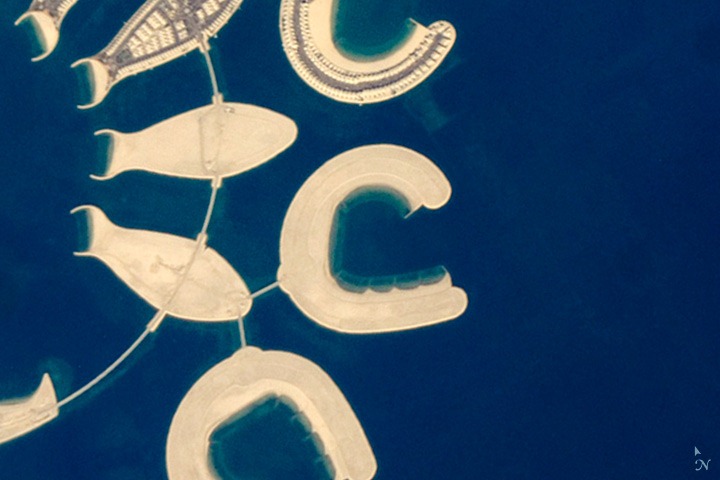
Big C, little C, what begins with C? This curving crescent of carbonate and quartz clinging to the coast. There is CloudSat and CALIPSO. Contrails from jets cruising over cumulus clouds. The Corolis force, chlorofluorocarbons, and crafty coccolithophores!

An astronaut captured this photograph of an artificial island at the southern end of Bahrain Island on January 23, 2011. The beach sand on tropical islands is mostly made up of calcium carbonate from the shells and skeletons of marine organisms.

e_newzealand

What begins with E? Earth, of course. Evaporation and the exosphere. Egypt and Eyjafjallajökull. Eskers, erratics, El Niño, and EO-1. This ephemeral entourage of algae off the east coast of an island where English is spoken!

On October 25, 2009, the Moderate Resolution Imaging Spectroradiometer (MODIS) on NASA’s Aqua satellite captured this image of a phytoplankton bloom off the coast of New Zealand.

f_tibet

Big F, little f. What begins with F? Firn-filled fjords and frozen forms on folded, fossil-filled facies of rock! Fog, fossil fuels, and faults. France, Fort Collins, and don’t forget Fiji.

The Operational Land Imager (OLI) on Landsat 8 acquired this false-color image of valleys and snow-covered mountain ranges in southeastern Tibet on August 4, 2014. Firn is a granular type of snow often found on the surface of a glacier before it has been compressed into ice

i_andamans

What begins with I? In situ measurements and infrared radiation. Ice sheets and isthmuses. Istanbul and Ilopango. This intriguing image of India’s Andaman Island after an intimidating incident involving an earthquake.

On February 10, 2007, the Moderate Resolution Imaging Spectroradiometer (MODIS) on NASA’s Terra satellite captured this image of the Andaman Islands. The thin, bright rings surrounding several of the islands are coral reefs that were lifted up by a massive earthquake near Sumatra in 2004

j_townsville

What begins with J? Jason-1 and the jet stream. Jerusalem, Jakarta, and Johnson Space Center. This jade-colored coral reef juxtaposed against the jumble of the sea.

On July 17, 2015, the Operational Land Imager on Landsat 8 captured this image of the Trunk Reef near Townsville, Australia

m_tienshan

What begins with M? The meandering Mississippi. MODIS and MISR. Mumbai, Miami, and Moscow. These medial moraines merging muck and minerals for millennia!

On August 14, 2015, the Operational Land Imager (OLI) on Landsat 8 captured this image of glaciers in the Tian Shan mountains in northeastern Kyrgyzstan. The trail of brown sediment in the middle of the uppermost glacier is a medial moraine, a term glaciologists use to describe sediment that accumulates in the middle of merging glaciers

n_northpacific

What begins with N? Numerous cloud condensation nuclei in the North Pacific! Nefarious nitrogen dioxide and NOx. The near infrared and NDVI and the Nimbus satellite. Nor’easters and the Nile at night.

On March 4, 2009, the Moderate Resolution Imaging Spectroradiometer (MODIS) on the Terra satellite captured this image of ship tracks over the Pacific. Ship emissions contain small particles that cause the clouds to form

t_liwa

What begins with T? Taal and Tolbachik. Taiga, typhoons, tornadoes, and thunderstorms. The trove of trees and towns tucked into this terrain in the United Arab Emirates.

On March 9, 2015, the Operational Land Imager (OLI) on Landsat 8 captured this image of development along two roads in the United Arab Emirates

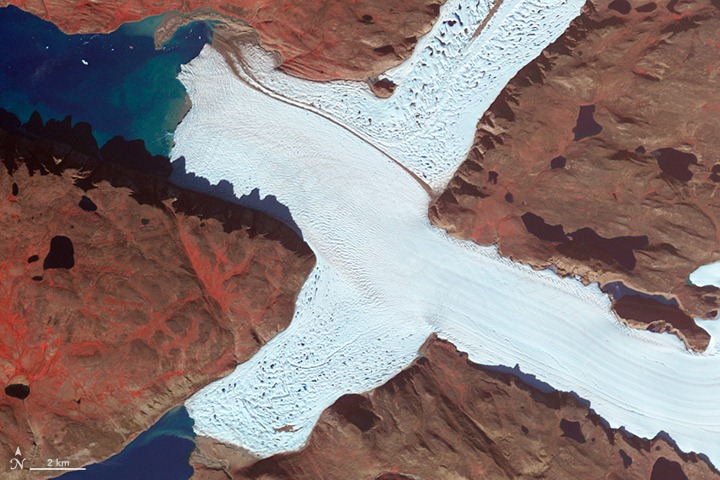
x_leidyglacier

What begins with X? There are xenoliths, the xylem in xeric woodlands, and the cities of Xian and Xalapa. Not much else begins with X, so relaX and enjoy this eXcellent icy X!

On August 7, 2012, the Advanced Spaceborne Thermal Emission and Reflection Radiometer (ASTER) on NASA’s Terra satellite captured this false-color image of the northwest corner of Leidy Glacier in Greenland.

z_canada

Z, what begins with Z? Zambia and Zimbabwe. Zenith and zooplankton. Zillions of smoke particles zipping, zooming, and zigzagging above Canada!

On July 11, 2012, the Moderate Resolution Imaging Spectroradiometer (MODIS) on NASA’s Aqua satellite captured this image of wildfire smoke over Canada.

See more of the gallery on NASA’s website.

Source…..www.amusingplanet.com

Natarajan