Source….www.livemint.com
Natarajan
A humble son of a farmer who studied in local government run schools, in Tamil medium, is the new head of India’s premier space agency.
Dr K Sivan was born in Sarakkalvilai in Kanyakumari district in 1957. His father was a farmer, and Dr Sivan is the first graduate in the family.
By all accounts, his is an unusual story.
A young Sivan studied in government schools in his native village till the 5th standard, and completed his schooling in neighbouring Valankumaravilai, all in Tamil medium. Later, he graduated from the S T Hindu College in Nagercoil.
He then graduated from the Madras Institute of Technology in aeronautical engineering in 1980 and completed his master’s in aerospace engineering from the Indian Institute of Science, Bangalore, in 1982.
That year he joined ISRO on its Polar Satellite Launch Vehicle project, towards which he contributed in mission planning, design, integration and analysis. He has held various responsibilities during his stint in ISRO, finally going on to head India’s space agency.
At ISRO, he completed his PhD in aerospace engineering from IIT-Bombay, in 2006.
Dr Sivan, who takes over from Dr A S Kiran Kumar on Monday, January 15, for a three-year term, is only the second rocket scientist after G Madhavan Nair to head ISRO.

MAGE: Dr Sivan’s family home in Sarakkalvilai village. He comes here regularly to attend family functions and for the Bhadrakali Amman puja. Photograph: A Ganesh Nadar/Rediff.com
Sarakkalvilai falls on the outskirts of Nagercoil, which is the headquarters of Kanyakumari district, Tamil Nadu. All of a sudden this small village has become the centre of attraction for people near and far, thanks to its famous son.
“Take the next right and it is at the end of the road,” says a villager, and as you reach the house you realise it is as unpretentious as the man who grew up there.
Dr Sivan’s sister-in-law Saraswathi lives in the family house with her daughter. “My eldest daughter got married five months ago and Sivan had come for the function,” she says, her eyes glowing with happiness.
Since the announcement about his appointment, people have been coming in droves to congratulate her, and her face beams with pride.
“I was married 30 years ago into this family and at that time he was already working for ISRO in Thiruvananthapuram. He used to live in a lodge then. He comes home for festivals and family functions,” says Saraswathi.
The conversation is interrupted when former Tamil Nadu Congress president Kumari Ananthan lands up with a dozen supporters to congratulate her.
One of the men who comes along with Ananthan hands her a book with the message, “Please give it to him when he comes next.” Another hands her a monthly magazine.
“He comes here every year for the Badrakali Amman puja which takes place in April-May,” adds his sister-in-law.
“He comes with his family, offers prayers and leaves the same day. He always comes for all family functions. When he is with the family he is always smiling and joking. He never calls, but his wife calls regularly and keeps in touch with us,” Sarawathi says.
“He was a class topper from school to college,” says Dr Sivan’s uncle who lives in the house opposite.
“He was a brilliant student and never went for tuitions or private classes. His father used to pluck mangoes and young Sivan used to go to the market to sell it. He was a helpful child,” the uncle adds.
The school Dr Sivan studied at is also opposite the family house. The retired PT master there recalls him clearly. “He was five years my junior in school, I remember him as a very quiet boy.”

“I too was five years his junior,” another villager pipes in. “You know the final exams used to come during harvest time. His father used to be in the field while Sivan sat on the lower branch of a tree with his books, studying, keeping one eye on the harvest, and run if his father called. He was always studying.”
“When Sivan and I were in school we had a very good headmaster,” the villager adds. “That headmaster planted many trees in the school compound and made every class in charge of a few trees. In the morning, when we came to school, the first thing we did was to water the trees and only after that did we attend school.”
“Kanyakumari is basically an agricultural district,” an elderly villager points out. “Apart from coir, there was no industry here. We all survived on farming. It’s rich fertile soil and there is plenty of water. Paddy, bananas, coconuts, mangoes, rubber is grown here.”
“Sivan was exceptional,” the elderly gent adds, “while he helped his father in the field he continued studying every free moment.”
“As there was only a primary school here we went to nearby Valankumaravilai for our SSC (Class 10). Those days there was no 12th standard. As there was no bus facility we walked.”
A colleague from ISRO, who retired a decade ago and did not want to be named for this feature, recalls, “He (Sivan) would go home only to sleep. He is extremely hard-working and totally focused on his work. He was not only the first graduate from his family, he was also the first graduate from his village.”

“He is a disciplined taskmaster,” says D Karthikesan, former director of the ISRO Propulsion Complex in Mahindragiri, Tamil Nadu.
“He likes to keep everything on schedule and works with a deadline,” adds Karthikesan. “If he thinks there is a problem somewhere he will go and talk to the people actually working on the project, and never limit himself to seniors in the organisation.”
“Though he is a hard taskmaster,” the former ISRO scientist points out, “he is also extremely generous and always looks after the welfare of the people working under him. So people work hard for him.”
“He is a bold decision-maker,” says Karthikesan. “Where others may hesitate wondering if it would work or not, he will say it will work and will do it.”
“Though he followed the schedule strictly,” adds Karthikesan, “he also made sure that all parameters are met at every stage. Whether it is quality or safety, he made sure every parameter was up to the mark before proceeding, and yet kept a tight schedule.”
Dr Sivan has two sons. The elder one has finished his BTech, the younger son is in college.
The school Dr Sivan studied in was built over 60 years ago. “We need to pull it down and build another,” says a villager. A government-run school, the land was given free by Dr Sivan’s uncle.
The village still does not have a bus service, a fact the villagers highlighted to Kumari Ananthan, the Congress politician. Nor does it have a middle, high or higher secondary school.
K Sivan’s ascent bears an uncanny resemblance to another ISRO scientist who was born in a fishing village in Ramanathapuram, also in Tamil Nadu.
That scientist, of course, went on to become the most beloved President this Republic has had.
Source….A.Ganesh Nadar in http://www.rediff.com
Natarajan
A typist is required to be fast and accurate, and while he proved to be precisely that, Bhide was much more too. Throw in artistic to those set of skills, and you have Chandrakant Bhide.
“Sachin Tendulkar’s curls gave me the most trouble!”
Chandrakant Bhide is a typist by profession. In 1967 he joined the Union Bank of India and worked there for 3 decades.
A rather implausible scenario for Tendulkar’s curls to give him grief, right?
A typist is required to be fast and accurate, and Bhinde proved he was precisely that but more too.
Throw in artistic to those set of skills, and you have Chandrakant Bhide.
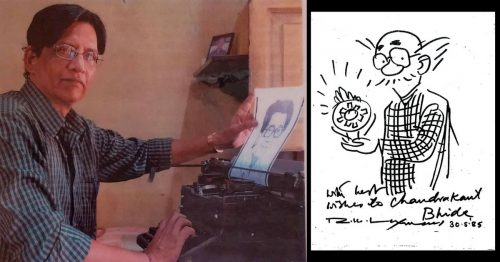
“Art helped me meet important people. How else does a modest typist like me get to meet and be appreciated by people like R. K. Laxman and Mario Miranda,” questions Mr Chandrakant Bhide?
Mr Bhide is anything but ‘just a typist’. His art is indicative of his sheer talent and why the likes of the above-mentioned greats were his fans.
Growing up, he always wanted to join an art school – specifically the Sir J.J. School of Art in Mumbai.
But financial constraints forced him to take a more secure job.
“One day I was asked to type out a list of phone numbers, instead of typing a regular list, I made one in the shape of a telephone instrument,” he remembers. That was the beginning of many more artistic endeavours to come.
“I typed out Lord Ganesha using the ‘x’ key and it was published in the Maharashtra Times newspaper in 1975. I slowly started improvising and started using other keys like ‘_’, ‘=’, ‘@’, ‘-’, ‘,’ in my sketches,” recalls Bhide.
His father’s words inspired him to be better and do better. Each sketch takes him about 5-6 hours to complete.
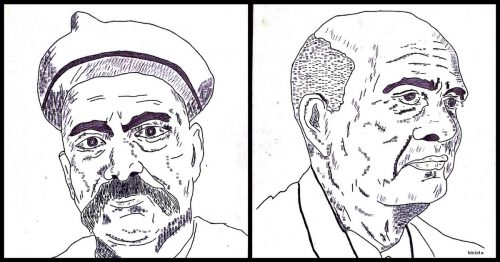
“I hold the paper with my left hand and use the fingers on my right hand to type out the symbols. The different shades in a sketch are added by using a light or a hard touch on the keys. My hands start aching after 10-15 minutes, and so I need constant breaks,” he adds.
One day, Mr Bhide sketched RK Laxman’s, Common Man. It was a time when Xerox machines had just made their appearance. His friend helped him get copies and requested to keep the original.
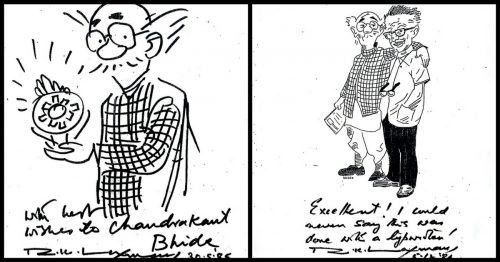
“I wanted to show the sketch to R.K. Laxman sir. I went to his office without an appointment and showed it to the cartoonist. Laxman sir was so thrilled with it that he said the result could not have been better with a pen and brush. We spent 1.30 hours talking, and I even mentioned my lost dream of studying in Sir J.J. School of Art, and he said, you can be an artist anyway!” he recalls.
Bhide continued to keep in touch with the famed cartoonist and takes great pride in having several original ‘Common Man’ sketches.
Over the years, Mr Bhide has created almost 150 sketches including several of people he admires including Amitabh Bachchan, Dilip Kumar, Sunil Gavaskar, Dr Ambedkar, Lata Mangeshkar and more.
But it was Sachin Tendulkar’s curls that frustrated the master typer! “I finally used the ‘@’ symbol to get it right,” he recalls.
One of his fondest memories was meeting up with renowned cartoonist and illustrator Mario De Miranda via a common friend, the famous Behram Contractor also known as the Busy Bee. “I was nervous when I rang the bell to Mario’s home, but he soon put me to ease. Once he saw some of my sketches based on his famous characters (Ms Fonseca, Godbole and Boss), he autographed one of my sketches with the words – ‘I wish I could draw like you type.’ That was my biggest compliment,” says Mr Bhide.
Mario De Miranda encouraged and inaugurated Mr Bhide’s first exhibition. He went on to hold several more, including ones in festivals like IIT Mumbai’s Mood Indigo and IIT-Kanpur’s Antaragini.
Mr Chandrakant Bhide retired from the Union Bank of India in 1996. He approached the administration department with a request to buy his beloved companion, his typewriter but was denied it as it was against policy. But on the day of his farewell, the chairman of the Bank allowed him to buy it for just Rs. 1.
Today, the typewriter still holds a place of pride in his household. “It has been with me for fifty years now, I understand it, it understands me,” he chuckles.
Source….Uma Iyer in http://www.the betterindia.com
Natarajan
As part of the custom, the idols along with temple elephants are taken to Shangumugam beach for the ritualistic bath.
For two days in a year, the Thiruvananthapuram International Airport halts its flight operations for five hours on the basis of a ‘Notice to Airmen’ (NOTAM).
Respecting a centuries old temple tradition, the airport runway makes way for a grand procession.
Saturday is one of the two days in a year that sees members of the Travancore royal family, temple priests, police, and even elephants walk down the runway, as part of the temple procession. Hundreds of people also escorted the idols past the 3400-metre runway.
Flights have been halted between 4pm and 9pm at Thiruvananthapuram on Saturday.
The ‘Arat’ procession marks the conclusion of the Painkuni festival and the Alpassi festival. Painkuni and Alpassi are references to Tamil months. While Painkuni is in April, Alpassi is in October.
Arat is the ritualistic bath procession of temple idols at Sree Padmanabha Swami temple in Thiruvananthapuram. The procession, which began at 5pm, crossed the runway at 6.30 pm.
As part of the custom, the idols along with temple elephants are taken to Shangumugam beach for the ritualistic bath. The procession sees royal family members wearing traditional attire and carrying swords. All priests along with royal family members take a dip into the sea three times. The idols are also given a ritualistic bath.
The procession returns to the temple on the same route, accompanied by people carrying traditional fire lamps.
They have to, however, ensure that they clear the runway by 8.45pm.
“The ritual was started centuries ago when the Travancore royal family ruled here. Even after the airport was established, the procession continued to pass through the runway. When the airport was established in 1932, it was under the Royal Flying Club. Since then, the runway was open for these processions. Even after it was converted into an international airport in 1991, the practice continued as the tradition is very important to this place,” an airport official told TNM.
Since the runway is part of traditional arat procession route, the Airport Authority of India issues passes to those who participate in it. Only those who have a pass can enter the route and cross the runway to head to the beach.
“There are strict restrictions inside the airport area. CISF officials guarding the area allow only people with passes. We issue the pass only to people in the list given by temple authorities,” he added.
NOTAM is issued a week before these two dates in the year, so that all the international flights can change their schedule. NOTAM is a notice issued to pilots or airline operators before flights, alerting them of the circumstances or changes in aeronautical facilities or about local procedures that affect safety.

Source….Haritha John in http://www.the newsminute.com
Natarajan



 Take off with Natarajan