Dashrath Manjhi Aka Mountain Man’s Story Is The Most Inspiring Thing You’ll Read Today…

Manjhi

Dashrath Manjhi, a poor landless labor moved a mountain in his lifetime, quiet literally! It took him 22 years but Manjhi shortened the travel between the Atri and Wazirganj of Gaya town from 55 km to 15 km. Not many are aware of this man’s greatness but thanks to Bollywood for converting his life story into a film. The film by Ketan Mehta is called Manjhi- The Mountain Man and is slated to release this Friday starring ace actors like Nawazuddin Siddiqui and Radhika Apte in lead roles. The story of a brave man who took the challenge of gifting accessibility to his remote village will inspire you beyond limit.

If you still haven’t heard of the man who fought with a mountain for more than two decades, his real story will move you!

1. Gehlour Ganj, Atri: A 300-foot tall mountain loomed between Atri block of Gaya, Bihar civilization in Wazirganj made commuting a difficult task for the locals

Dashrath Manjhi 1

2. Manjhi, a landless labourer worked in the fields on the other side of the mountain and lived with his wife, Falguni.

Manjhi 2

Manjhi belonged to a cast which was regarded the lowest of the low in a caste-ridden society. They were kept aloof from basic necessities like- water supply, electricity, a school and a medical centre.

3. Like everyday, Manjhi eagerly waited for his beloved wife Falguni who would bring lunch for him.  She did come to him that one eventful day, but her body had bruises and blood all over.

3

The treacherous trek up and around the mountain took hours. This led to frequent accidents and death of locals who lost their lives purely because reaching for medical facilities took hours. The nearest doctor was at Wazirganj, which was more than 70 kilometers over the mountain. Locals of the area cursed the inaccessibility but no one ever bothered to do anything about it. However, one man could wait no longer but that too alerted him after a tragedy. However, one day, Falguni tripped on loose rock, shattering her water pot. Not only she slid down several feet, she injured her leg. Manjhi could not save his wife and then he took a pledge.

4. “Jab Tak todenge nahi, tab tak chodenge nahi”- After losing his wife in 1959, Manjhi took up a challenge against the mountain and sold his goats to buy a hammer, chisel and crowbar.

Manjhi Story

“That mountain had shattered so many pots; claimed lives. I could not bear that it hurt my wife. If it took all my life now, I would carve us a road through the mountain.”- He said.

5. People called him a ‘lunatic’ but that did not deter him from his journey. After a struggle of 22 years (1960-1982), a tiny cleft across a rock wall opened up one day!

Mountain Man

He then went on to widen the cleft. Some several years later, he managed to carve out a passage 360 feet long and 30 feet wide.

Even though he lost his battle of life to cancer in 2007, thanks to Bollywood for converting his life into a film. Even when he was alive, people were totally awed by his will power and determination. Chief Minister Nitish Kumar agreed that once he had stood up and vacated his chair when Manjhi visited him in Janata Durbar in Patna.

Source…..Isha  Sharma… http://www.indiatimes.com

Natarajan

” These Chennai Scientists Are Trying To Solve An Impending Agricultural Crisis…”

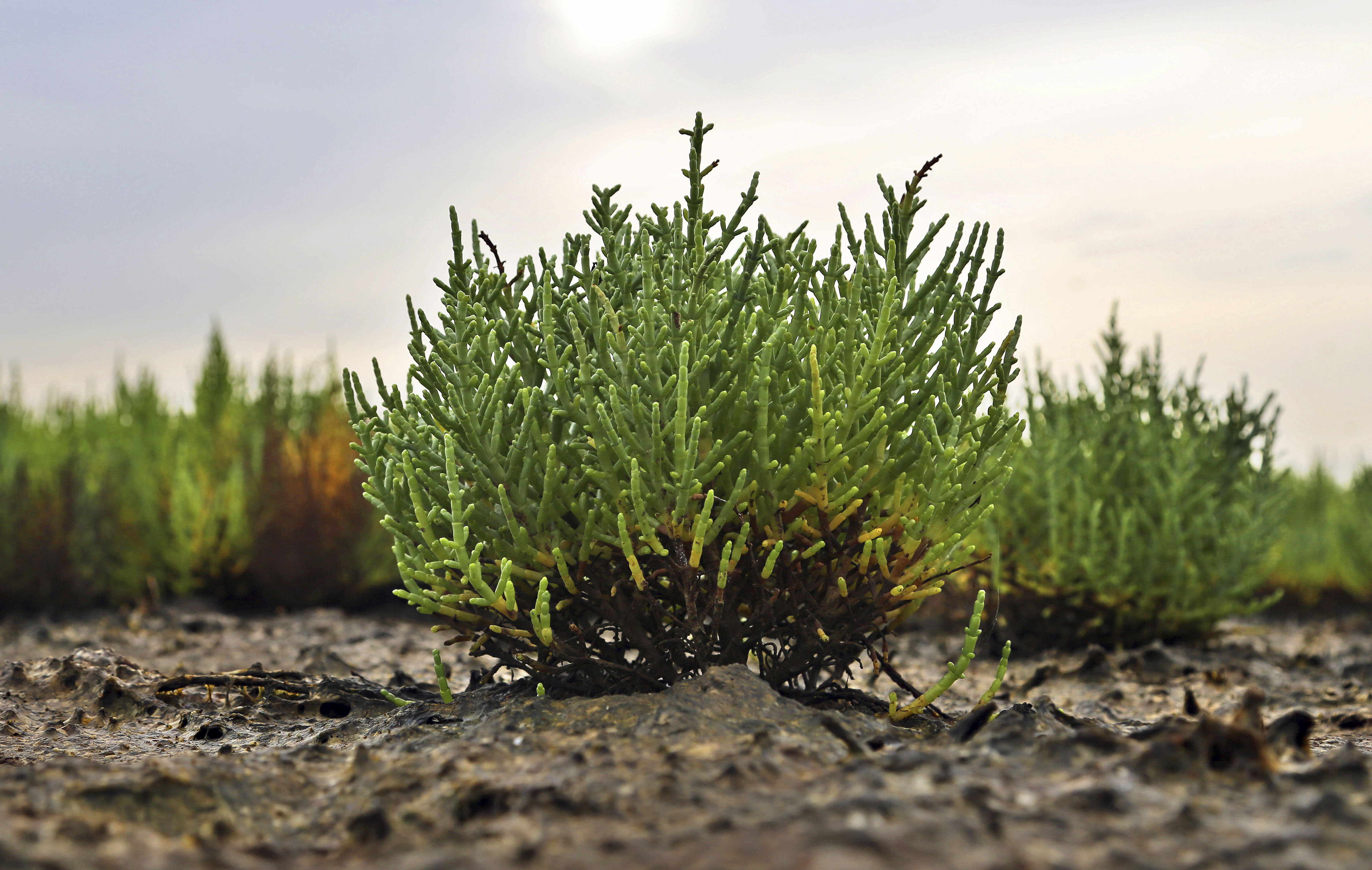
SALICORNIA BRACHIATA

VEDARANYAM, Tamil Nadu — On a sun-scorched wasteland near India’s southern tip, an unlikely garden filled with spiky shrubs and spindly greens is growing, seemingly against all odds.

The plants are living on saltwater, coping with drought and possibly offering viable farming alternatives for a future in which rising seas have inundated countless coastal farmlands.

Sea rise, one of the consequences of climate change, now threatens millions of poor subsistence farmers across Asia. As ocean water swamps low-lying plots, experts say many could be forced to flee inland.

“It’s hard to imagine how farmers will live,” said Tapas Paul, who as a World Bank official helped channel about $100,000 to help build the small garden a decade ago in a swampy, seaside town dominated by salt flats in southern Tamil Nadu state. “In the places subject to inundation and sea level rise, there are few options.”

A team of Indian scientists is searching for solutions to what they describe as a fast-approaching agricultural crisis. Their neatly plotted rows of naturally salt-tolerant plants, known as halophytes, could be a part of the answer. The scientists from the M.S. Swaminathan Research Foundation are also trying other approaches: tweaking genes and cross-breeding plants by conventional means to discover which might grow and even flourish.

“Sea level rise is inevitable, and we are not prepared,” said Swaminathan, who pioneered high-yield wheat and rice varieties for India in the 1960s. “The biggest problem in India is just the very large population. We can say people can relocate, but where could we even accommodate all those who need to move inland?”

Saltwater for a farmer long meant certain crop failure. Wartime foes sowed enemy fields with salt to ensure social collapse. Natural disasters such as the 2004 Asian tsunami left countless plots unproductive for years.

Asia’s coastal farmers, including millions impoverished in India, now face such problems. Climate change will bring stronger storms and warmer temperatures that expand ocean waters and melt ice caps and glaciers. As a result, seas are set to rise up to 1 meter (3.2 feet) in this century, according to the latest scientific forecasts.

Chellammal, a graceful, 65-year-old farming housewife in the Tamil Nadu village of Tetakudi, knows the nightmare of farming on salt-contaminated land too well.

“I struggled so long to get things to grow, but nothing worked,” said Chellammal, who goes by one name. “Every year just got worse until there was nothing left,” she said, crouched in a bright pink sari by her fields.

The land her family had saved for decades to buy went completely barren about five years ago, after a neighboring village took up shrimp farming when flooding from a nearby ocean canal salted their lands. The shrimp ponds were never lined properly, so their saltwater seeped into surrounding soils.

The farmland lost by Tetakudi’s 200 households now supports little more than a vast expanse of salt-tolerant shrubs called Suaeda maritime along with succulents called Salicornia brachiata, known to locals as “chicken feet.”

To the villagers, the bright green bushes are no better than weeds. Already, 12 families have boarded up their homes and left.

But scientists say suaeda is good for firewood. And salicornia species, which can tolerate nearly twice the salinity of seawater, have enormous potential as a biofuel crop, with seeds containing high concentrations of oil.

The problem, however, lies in realizing profits. For any crop to work on a large scale, inexpensive methods and machinery for harvesting will have to be developed. Then processing plants, production lines and markets would need to be built. As of now, none of that exists.

Chellammal is dubious, but interested.

“If we can make money from what we grow, we’ll try it. Why not?” she said. “Maybe all is not lost.”


salicornia brachiata

In this June 16, 2015 photo, a wild-growing Salicornia brachiata, a halophyte known to locals as ‘€chicken feet’, thrives on fields tainted by saltwater from a neighbouring shrimp farm near Velankanni, India.

The timing for an agricultural crisis due to sea rise couldn’t be worse. India’s poor farmers already struggle with frequent flooding, drought and soils degraded by agrochemical overuse. Those on the coast are also hit by storms, with at least 27 of the 35 deadliest cyclones in history barreling through the Bay of Bengal before slamming into either India or Bangladesh.

India’s freshwater sources are also in peril, with over-tapped groundwater reserves so low the country is expected to have only half the water it needs by 2030. Grain production, meanwhile, has stalled around 260 million tons in recent years, despite global pressure for India to boost yields, eliminate waste and eradicate widespread poverty and malnutrition.

To feed its growing 1.26 billion population, India must increase food production 45 percent by 2050, for which experts say it may need to cultivate more land. Instead, about 1.2 million hectares (3 million acres) of its coastal farmland has been degraded by salt, according to India’s Central Soil Salinity Research Institute.

Inland, India has lost another 5.5 million hectares of arable farmland, out of its nationwide total of 163 million hectares, though India’s soil salinity troubles are exacerbated by industrial salt flats, a growing number of shrimp farms and the depletion of groundwater reserves. The trend will only continue as seawater creeps onto low-lying lands along the 7,500-kilometer (4,700-mile) coast that outlines the country along the Bay of Bengal, Indian Ocean and Arabian Sea.

“Saltwater agriculture is considered a futuristic area. But it really shouldn’t be,” said marine biologist V. Selvam, the M.S. Swaminathan foundation’s mustachioed director of coastal research. “Very soon there won’t be enough land and water to meet our needs.”

And India is not alone. Countries including Egypt, Bangladesh and much of Southeast Asia also face heavy saltwater intrusion and loss of farmland. Already, 62 million hectares, or 20 percent, of the world’s total 300 million hectares of irrigated farmland has been salinized to some extent. Another 50 centimeters (1.6 feet) of sea rise, which is just half of what’s expected by 2100, would swamp up to 1.9 million more hectares, the Intergovernmental Panel on Climate Change has said.

That will undermine the world’s ability to find the additional 120 million hectares of farmland it needs for a staggering 70 percent increase in food production to feed the world by 2050, according to the U.N. Food and Agricultural Organization.

Experts say there will be little choice but to grow some non-food crops along the coasts.

The world’s irrigated acreage could be increased by about 50 percent by reusing saline water and salinized crop fields for halophytes, said University of Arizona environmental sciences professor Edward Glenn.

“As with aquaculture replacing wild fisheries, it is inevitable that halophytes will have their day,” he said.

Sesuvium portulacastrum. Paspalum vaginatum. Prosopis juliflora.

These are just a few of the 350 known species of salt-tolerant plants that are candidates to become crops for the future. Saltwater plants are unlikely to become staple foods, because while often high in nutrients they’re also very salty and so should be eaten in moderation.

Species such as Salicornia europaea, also known as glasswort or samphire, are already sold in European markets as a fancy salad addition or side dish. The bright purple-and-white blossoms of Limonium are a florist’s delight, while another species called Atriplex or saltbush is eaten by sheep.

Supporters note a host of potential uses to make harvests profitable, including firewood, decorative flowers, kitty litter, nutritional supplements, cooking oil and biofuel. Cattle fodder is another possibility, and Indian herders already graze their cattle on thorny shrubbery by the sea.

Despite the potential, saltwater agriculture is still seen as a fringe topic, even after decades of research by universities worldwide along with studies and pilot projects in countries including Mexico, Pakistan, Jordan and Eritrea. The aviation company Boeing is also researching biofuels from saltwater plants.

India’s scientists aren’t waiting for markets to develop. Nor are they relying on just the halophyte garden to offer up new options.

They’re scouring coasts for wild grain species that might naturally tolerate some salinity, and using arduous breeding methods to create new salt-tolerant strains.


The foundation has also developed genetically modified rice using genes from mangrove trees. It says the resulting plant can tolerate salt concentrations of 12-15 grams per liter. Seawater is typically two to three times saltier, but that’s still a major improvement from currently cultivated rice varieties, which can handle only up to 3 grams per liter.

Genetic modification is considered the most difficult approach, because salt tolerance is a trait that involves numerous genes. But the molecular biologist leading the development of GM halophytic rice believes it’s essential.

“Conventional breeding just takes too long, and this problem is urgent,” said Ajay Parida, the foundation’s executive director. His work stalled in 2007 under an effective moratorium on field testing GMOs, but the Indian government is considering shifting its GM testing policy and Parida now expects his trials to start soon.

“We could eventually be cultivating wastelands and places considered entirely unsuitable,” he said. “But it’s only after crisis hits that people realize the magnitude of the problem and start pushing for an answer.”

Source….  |  Katy Daigle….www.huffingtonpost.com

Natarajn


How to handle criticism at work….

Feedback is essential for the growth of any professional. But are you equipped to handle it well?

How to handle criticism at work

Dealing with criticism in a positive manner is extremely important.

At some point in your professional life you will be criticised.

It may seem unfair and difficult. But you can use it in a positive manner — as a means to better yourself, or in a negative manner — causing yourself stress, anger and lowered self-esteem.

Below are the ways in which one must handle criticism:

Is it really criticism?

Most people get their defence up the minute they feel somebody is giving them an opinion not necessarily aligned with their own.

It is important to understand if the opinion is criticism or constructive feedback.

Instead of being extra sensitive, it is essential to absorb the person’s outlook and analyse whether it can be incorporated in anyway.

Do not reject any idea by labelling it as criticism.

It might be a stepping stone to bettering yourself.

What is the intent?

You need to evaluate why are you being criticised.

Is it for the betterment of your task quality, behaviour, productivity, or is it simply done to ridicule you?

In case the feedback is in your best interest, utilise the opportunity to learn and outperform your previous efforts.

However, if the person’s intent is to simply pick on you, you must be assertive and stand up for yourself.

Accept that you are not perfect.

‘Nobody is perfect; neither are you.

If you are good, there is scope to become great.

If you are great, there still is scope to become outstanding.

Take feedback with a pinch of salt and do not get offended. Look at it as an opportunity to stretch your boundaries and explore further into your potential.

Do not get offended easily.

Do you find yourself getting hurt, crying at the drop of a hat or stressing out the minute anybody criticises your work?

The solution is not to cut the critics out of your life but to toughen up.

Do not be over sensitive. Listen intently to what the person is saying.

Weigh the significance before dismissing the person.

Is the feedback accurate?

Be completely objective and unbiased in assessing feedback.

Just because it is different from your line of thought, doesn’t necessarily mean that it is wrong.

Think of every piece of feedback/criticism as a means of improving your knowledge, skills, attitude and efficiency.

If it doesn’t help on any of these parameters, brainstorm your ideas with the person before putting your foot down and rejecting it.

Stop making excuses.

Do you display strong displeasure whenever someone is pointing out something to you?

This will lead to conflicting situations with the person or discourage the person from walking up to you and sharing his/her honest and possibly valid feedback next time.

Either way, your relationship will suffer, along with any future probability of getting fresh perspective on self-improvement.

Is the criticism destructive?

If you are sure that the intention behind the criticism is destructive, try to find the hidden motive and communicate with the person.

An open communication serves the purpose majority of the time. Be assertive and yet empathetic when you do so.

Trust yourself and be confident of what you bring on the table. Let the critics not succeed in pulling your morale down.

Remember: If you have received criticism that was delivered in a warm manner only to bring a positive shift in you, take the effort to display your gratitude and appreciation to the person.

Thanking people who give you honest criticism is a sign of maturity.

Lead image used for representational purposes only. Credit: Diego Rodriguez-Vila/Creative Commons

The author is co-founder and head of business development at Work Better Training.

Source….Ruchira Karnik…www.rediff.com

Natarajan

Message for the Day…” Time Wasted is Life Wasted…”

Sathya Sai Baba

You are wasting a lot of time in meaningless pursuits. Time wasted is life wasted. Our ancients never wasted even a minute. They considered God as the embodiment of time and extolled Him thus: Kalaya Namah, Kala Kalaaya Namah, Kalaateetaya Namah, Kalaniyamitaya Namah(Salutations to the Embodiment of Time, to the One who conquered time, to the One who transcends time and to the One who ordains time). Why have you forgotten the truth that time is verily God? You eagerly await a Sunday thinking that you can relax and enjoy. In fact, you should feel sad that you are wasting time without doing any work on a Sunday. You have to utilise your time in a proper way. If you do not have any work, undertake social service. Help your fellowmen. Life becomes meaningful only when you make proper use of time.

First Digital Map of World Ocean Floor….

This is a still shot of the world's first digital map of the seafloor's geology. Image credit: EarthByte Group, School of Geosciences, University of Sydney, Sydney, NSW 2006, Australia National ICT Australia (NICTA), Australian Technology Park, Eveleigh, NSW 2015, Australia

This is a still shot of the world’s first digital map of the seafloor’s geology. Image credit: EarthByte Group, School of Geosciences, University of Sydney, Sydney, NSW 2006, Australia National ICT Australia (NICTA), Australian Technology Park, Eveleigh, NSW 2015, Australia

Map key.

Map key.

Scientists have created a digital map of the global seafloor’s geology. It’s the first time the composition of our planet’s seafloor has been mapped in 40 years; the most recent map was hand drawn in the 1970s.

Published in the latest edition of Geology, the map will help scientists better understand how our oceans have responded, and will respond, to environmental change. It also reveals the deep ocean basins to be much more complex than previously thought. Adriana Dutkiewicz from the University of Sydney is the lead researcher. She said:

In order to understand environmental change in the oceans we need to better understand what is preserved in the geological record in the seabed.

The deep ocean floor is a graveyard with much of it made up of the remains of microscopic sea creatures called phytoplankton, which thrive in sunlit surface waters. The composition of these remains can help decipher how oceans have responded in the past to climate change.

A special group of phytoplankton called diatoms produce about a quarter of the oxygen we breathe and make a bigger contribution to fighting global warming than most plants on land. Their dead remains sink to the bottom of the ocean, locking away their carbon.

The new seafloor geology map demonstrates that diatom accumulations on the seafloor are nearly entirely independent of diatom blooms in surface waters in the Southern Ocean. Professor Dietmar Muller from the University of Sydney, is a study co-author. Muller said:

This disconnect demonstrates that we understand the carbon source, but not the sink.

Some of the most significant changes to the seafloor map are in the oceans surrounding Australia. Dutkiewicz said:

The old map suggests much of the Southern Ocean around Australia is mainly covered by clay blown off the continent, whereas our map shows this area is actually a complex patchwork of microfossil remains. Life in the Southern Ocean is much richer than previously thought.

The scientists analyzed and categorized around 15,000 seafloor samples – taken over half a century on research cruise ships to generate the data for the map. They teamed with the National ICT Australia (NICTA) big data experts to find the best way to use algorithms to turn this multitude of point observations into a continuous digital map. Simon O’Callaghan from NICTA is a study co-author. He said:

Recent images of Pluto’s icy plains are spectacular, but the process of unveiling the hidden geological secrets of the abyssal plains of our own planet was equally full of surprises!

Bottom line: Scientists have created a new digital map of the geology of Earth’s seafloor.

Source….www.earthsky.org

Natarajan

India’s Mars Orbiter sends back stunning 3-D images of the largest known canyon in the solar system

While the rest of India was tasting patriotic waters on the account of the 69th Independence Day, India’s Mars Orbiter Mission, Mangalyaan, sent us pictures which made us proud yet another time.

The Mars Orbiter Mission sent some beautiful images of the largest known canyon from the Red planet – Mars.

These are the images of Valles Marineris,  a largest known canyon complex in the solar system. This picture was taken from a height of nearly 2000 km from Mars colored camera.

A 62 km wide valley named Opir Chasma can be seen bordered by high cliffs.

Mangalyaan reached Mars on September 2014. It was an ecstatic moment for the whole country as ISRO was successful in its maiden attempt. Many countries like the USA, Russia, and Europe have accomplished successful Mars missions.

And what’s more, this is not the first time that an image has been sent. Earlier, they sent images of Martian landmarks – Aurorae Chaos.

It’s a long terrain with irregular blocks.

What this image proved?
It showed signs of fluvial activity which means showing signs of water or similar substances which could have flowed there sometime in the past.

You can see more pictures taken by Mangalyaan here.

Well, there is no doubt that this image proved the mettle of Mangalyaan another time, but it also proved to be a perfect Independence Day present for everyone especially because many studies have been undertaken to know about any signs of life on Mars. May many more pictures come our way!
Built at the cost of just Rs 450 crores, the orbiter still has 39 kilograms of fuel it still has left in the tanks – which could mean a few more years of breathtaking pictures, among other things.

Well done!

News Source: Aparajita Mishra in Hindustan Times…. http://www.storypick.com and  www.scroll.in

Natarajan


Message for the Day…” In all the Worldly Activities , You should be Careful not to offend the Propriety…”

Sathya Sai Baba  Whoever subdues egoism, conquers selfish desires, destroy one’s bestial feelings and impulses, and gives up the natural tendency to regard the body as the Self, is surely on the path of Dharma; they know that the goal of Dharma is the merging of the wave in the sea! In all worldly activities, you should be careful not to offend propriety, or the canons of good nature; you should not play false to the promptings of the Inner Voice, you should be prepared at all times to respect the appropriate dictates of conscience; you should watch your steps to see whether you are in someone else’s way; you must be ever vigilant to discover the Truth behind all this scintillating variety. This is your duty, your Dharma. The blazing fire of Jnana, which convinces you that all this is Brahman (Sarvam Khalvidam Brahma) will consume into ashes all traces of your egoism, and worldly attachment.


The Doctor Who Makes the Difference… Meet Dr. M.R. Rajagopal Kerala…

On August 10, the Human Rights Watch, an international non-governmental organisation that conducts research and advocacy on human rights, announced that Dr M R Rajagopal was one of the recipients of the prestigious Alison Des Forges Award for Extraordinary Activism (external link).

Announcing the award, the NGO said that Dr M R Rajagopal was being honoured for ‘his efforts to defend the rights of patients with severe pain to live and die with dignity’.

On this occasion, Rediff.com digs into its archives, tracking down Dr M R Rajagopal’s sincere efforts of changing lives and changing the way India looks at palliative care.


‘Even if there is only one day left for a person, I find it very satisfying to have made a difference. That is because I believe life matters. If I can bring a smile to the face of a person who has seen only pain and suffering, I feel satisfied.”

Rediff.com’s Shobha Warrier meets Dr M R Rajagopal who has made such a difference to the lives of the terminally ill.

Dr M R Rajagopal attends to a terminally ill patient. Photograph: Shobha Warrier/Rediff.com

“I haven’t slept for months. I can’t lie down in any position. The pain is killing me. I want to sleep for just one day without the pain bothering me. Please do something, doctor,” Sasidharan Nair breaks down. He has very advanced cancer in the spinal cord and many other bones.

“No, you need not suffer any pain. You have every right to feel better,” says Dr M R Rajagopal, prescribing morphine.

A few days ago, I travelled with Dr Rajagopal and the Pallium India team on home visits to some of the remotest areas outside Thiruvananthapuram; places where no vehicle could go. We climbed hills and walked through rubber plantations to visit terminally ill cancer patients.

The doctor was patience personified, listening keenly to all the complaints the patients had, and consoling them with compassionate words. The visits continued until late in the evening, but Dr Rajagopal’s energy and commitment didn’t wane in the slightest. The nurses on his team changed diapers and catheters, and dispensed the medicines prescribed by the doctor for free.

If you are one of those who has faced the frustration of dealing with doctors in corporate hospitals, who have no time to even talk to you, you will find Dr Rajagopal an aberration.

He picks up his phone when you call, calls you back if he can’t, and listens to all of your concerned questions, answering them honestly and patiently. You don’t find doctors like him anymore.

Pallium India wants to take care of those in terrible pain and isolation due to cancer, AIDS, paralysis, or other prolonged, debilitating, diseases. ‘No one,’ the organisation believes, ‘should be left to face all of this without support and proper medical care.’

A Pallium India van sets out to reach out to terminally ill patients. Photograph: Shobha Warrier/Rediff.com

Dr Rajagopal set up the country’s first palliative care unit, the Institute of Palliative Medicine, in Kozhikode, Kerala, in 1993, at a time when few in India had heard of palliative care.

The World Health Organisation only passed a resolution integrating palliative care as a part of healthcare on January 23, 2014.

“I was then working in the KozhikodeMedicalCollege as an anaesthetist,” recalls Dr Rajagopal, “I was also treating patients in pain, mainly cancer patients. It was a 42-year-old college professor with two small children who taught me a lesson. He had cancer of the tongue spreading to his cheeks. I gave him a nerve block, and the next day, he told me he was pain free.”

“I was very happy. He asked me then, ‘When should I come again?’ I said, ‘You don’t have to come back unless you are in pain’.”

That night, the young professor committed suicide.

“I found out that his oncologist had never discussed the prognosis with him,” remembers Dr Rajagopal. “So, he was expecting a cure. When I told him that he didn’t have to come back again, he understood for the first time that his disease was incurable.”

“I never bothered to find out what his emotions were and how he felt; I just relieved him of his physical pain. That was a turning point in my life. He gave up his life to teach me that a man is not made of just a few nerves and organs.”

Dr M R Rajagopal: You don’t find doctors like him anymore, says Shobha Warrier. Photograph: Shobha Warrier/Rediff.com

After the professor’s death, Dr Rajagopal understood that he had to look at disease-related suffering as a whole; the physical, the psychological, social, and spiritual.

Dr Rajagopal came across a book on palliative care by Dr Robert Twycross. He also attended a lecture by a British nurse, Gilly Burn, who travelled around India teaching palliative care, and invited her to his centre in Kozhikode.

After spending half an hour at the centre, she asked him whether he was interested in going to Oxford to take a course in palliative care. The 10-week course served as the doctor’s formal introduction to the precepts of palliative medicine.

When he came back, with a capital of Rs 1,500, he formed a non governmental organisation with six friends, each of whom contributed Rs 250.

At this point, he was sure of one thing — that he was going to offer the treatment for free, as most of the patients who came to the Kozhikode Medical College were very poor.

When he discovered that his patients did not buy the medicines he prescribed, he started dispensing the medication for free, a practice he continues to this day.

“This is possible due to many kind-hearted people,” he says. “There are many such people around us, contrary to our belief.”

The small unit he started in Kozhikode in 1993 became Pallium India in 2006, aiming to care for all terminally ill people in the country.

Pallium India has palliative care facilities in 11 states, mostly in the north and north-east. The Thiruvananthapuram unit, a WHO collaborating centre for four years, is a demonstration project that works with 12 link centres in the interiors of the Kerala capital.

Eighty two per cent of the patients Pallium India sees are from the poorest sections of society. People like Sasidharan Nair, Yunus, Shiji and Esther.

Dr Rajagopal and his team walk down the hill to Shiji’s home. Photograph: Shobha Warrier/Rediff.com

Yunus, who suffers from lung cancer, is angry.

“We went to the TrivandrumMedicalCollege for treatment and we were asked to take a CT scan at a private centre. We went to the centre with all the money we had. We had just Rs 1,900, and they wanted Rs 10,000. Where are we supposed to find Rs 10,000?” he asks angrily.

He was the family’s only earner till he fell ill two years ago. His family is now dependent on his 18-year-old son.

A narrow path through a rubber plantation leads us to a small unfinished house, where 20-year-old Shiji lives. He lies on the bed, paralysed from the waist down.

From the time the sun comes out, he lies on his bed, staring at the huge trees and the blue sky, thinking of the days he and his father had built the house brick by brick.

The house was not finished when Shiji was diagnosed with cancer two years ago. Today, his world is confined to the tiny room he built.

Hope is what makes this young man smile. He believes he will get better one day and go out. Raveendran, his father, has hopes for his only son, and it is that which has driven him to pledge the house and borrow money from wherever he could.

His debt has now run up to Rs 50 lakh (Rs 5 million), but he is hopeful that Shiji will get better and the two of them will work hard and pay off all the debts.

Raveendran has borrowed money again to take Shiji to the VelloreMedicalCollege. “I feel my son will get better…” he says.

As we walk back to the car, Dr Rajagopal speaks of a healthcare system that ignores the psycho-social aspect of suffering.

“It is this kind of unnecessary treatment and lack of information that has resulted in people like Raveendran building up huge debt burdens from which he may never escape,” he says.

“This kind of destruction of families in the name of healthcare is cruel and almost criminal. The so-called healthcare industry is exploiting the ignorance of people for financial gain. Palliative care is making a difference to such people, and it will transform healthcare.”

Dr M R Rajagopal interacts with his patient, Sasidharan Nair. Photograph: Shobha Warrier/Rediff.com

“It is sad that people have to go through years of treatment without psycho-social support just because they are undergoing curative treatment,” says Dr Rajagopal, stressing that palliative care should start at the time of diagnosis and go hand in hand with curative treatment.

Pallium India doesn’t just take care of the terminally ill, though up to half of all its patients suffer from terminal cancers.

“It is very worthwhile working with even the terminally ill, because even if there is only one day left for a person, I find it very satisfying to have made a difference. That is because I believe life matters. If I can bring a smile to the face of a person who has seen only pain and suffering, I feel satisfied.”

Dr Rajagopal can be described as a crusader in making morphine-based medicines, one of the cheapest and the most effective treatment for chronic pain, available to every patient in pain.

The 15th Lok Sabha recently passed an amendment to the Narcotic Drugs and Psychotropic Substances Act in its last sitting only because of Dr Rajagopal’s efforts.

“It was the culmination of frustrating moments waiting outside government offices and being insulted. But I also saw a lot of goodness in many people.”

Once the amended Act is implemented, the licensing procedure for obtaining and storing morphine becomes very simple.

The amendment essentially scraps the long list of licences, which currently varies from state to state, that drug makers and hospitals are required to obtain in order to produce and store morphine sulphate.

Under the new Act, there will be a uniform regulation across states for issuing licences to manufacture morphine-based drugs.

Similarly, each medical institution that previously needed four to five different licences from different government agencies to store morphine will now have to approach just the state Food and Drug Administration.

Does that mean the amendment to the NDPS Act will transform pain relief?

“No. It needs harder struggle,” says Dr Rajagopal. “But we can consider it a new beginning. Regulatory barriers are not the only barriers to access to pain relief. I would say attitudes and lack of knowledge among medical professionals is the biggest barrier.”

“To make this a success, drug availability, education and strategy are equally important. We now have a government strategy for palliative care; but this is not full-fledged or fully funded.”

“Drug availability can improve with the amendment provided we work with each state government,” Dr Rajagopal adds, “and make sure that the Act is implemented without additional complications.”

“Government hospitals should have doctors and nurses with basic education in pain management and the hospitals should have morphine and other essential narcotic drugs. Then again, pain management is not enough on its own, there also has to be psycho-social support.”

Dr M R Rajagopal and his team walk up an unpaved path to a patient’s home. Photograph: Shobha Warrier/Rediff.com

Dr Katherine Irene Pettus of the International Association for Hospice and Palliative Care, who accompanies us on the home visits, is a strong advocate of using morphine to relieve pain.

She became a hospice volunteer after having watched, as a 19-year-old, her mother die in pain in the United States.

Today, she works from Vienna to educate physicians, politicians and lawyers on the purpose of morphine in palliative care. “My work involves educating people on the need to make morphine-based medicines available instead of controlling them. They only care about control, which doesn’t work anyway,” Dr Pettus says. “We have drug addicts, illegal use, and de-addiction centres everywhere, but yet, 80 per cent of the world has no access to morphine.”

Kerala follows a model of palliative care that other Indian states would do well to emulate.

Dr Rajagopal has shaped the Kerala government’s palliative care policy. “Palliative care,” he says, “has to be fully integrated into the healthcare system.”

“For example, when I fall ill, the doctors and nurses treating me will consider me a human being — and not only look at my coronary arteries — but try to understand what I feel. I hope they will care for my family too.”

“I hope that when I go, I will not be shut up in an intensive care unit, but instead have someone who cares for me sitting beside me, and maybe holding my hand. It would be the ultimate cruelty if I have to die in an intensive care unit with tubes in every orifice and masked creatures working around me.”

“If I were to get disoriented and delirious, my hands and feet may be tied up. I am looking for a world where this kind of intensive cruelty does not happen anymore. I hope for a world where healthcare is delivered with compassion and empathy.”


Source…….Shobha Warrier / Rediff.com

Natarajan

World”s 10 Safest Airlines ….

A Lion Air plane is seen in the water after it missed the runway in Denpasar, Bali in April 13, 2013. Photographs: Reuters

Five decades ago, 87 plane crashes took away the lives of 1,597 people.

This was when airlines carried only 141 million passengers, which is 5 per cent of today’s number, says Safety and product rating website AirlineRatings.com.

In 2014, though the number of fatal accidents fell to 21 (one for every 1.3 million flights), Malaysia Airlines’ two planes – MH370 and MH17 – met a fatal end that claimed 537 lives.

December 2014 saw the tragic end of 162 people from Surabaya who were flying to Indonesia when the AirAsia flight crashed due to bad weather.

Safety and product rating website AirlineRatings.com has listed world’s ten safest airlines.

Of 449 airlines which were included in the study, 149 achieved the website’s seven-star safety ranking and almost 50 had just three stars or less.
Take a look at the world’s 10 safest airlines…

A Qantas A380 arrives at its gate at Kingsford Smith International airport in Sydney. Photograph: Daniel Munoz/Reuters

Qantas

Topping the list is Qantas, which has a fatality free record in the jet era, says the report.

Qantas is Australia’s national airline with an impeccable record. AirlineRatings.com editors noted that over its 94-year history, “Qantas has amassed an extraordinary record of firsts in safety and operations and is now accepted as the world’s most experienced airline.”

: An Air New Zealand Boeing 777-300ER featuring livery advertising the film The Hobbit: An Unexpected Journey. Photograph: Neil Hall/ Reuters

Air New Zealand

Air New Zealand ranks second in safety.

Based in Auckland, New Zealand’s national airline operates scheduled passenger flights to 25 domestic and 26 international destinations in 15 countries.

British Airways. Photograph: Reuters

British Airways

Ranked third in safety, British Airways is the UK’s largest airline on fleet size, international flights and destinations.

Photograph: Alex Domanski/Reuters

Cathay Pacific Airways

Cathay Pacific, based in Hong Kong also ranks high on safety.

The airline operates flights across 168 destinations in 42 countries.

Flight attendants serve journalists during a flight tour organized by Emirates airline. Photograph: Reuters

Emirates

Emirates is the largest airline in the Middle East with over 3,500 flights per week.

It operates in 142 cities across 78 countries.

Photograph: Reuters

Etihad Airways

Etihad Airways operates more than 1,000 flights per week to 96 destinations.

Etihad Airways is the fourth largest airline in the Middle East and the second largest airline in the UAE.

An Airbus A330-300 aircraft of Taiwan’s Eva Airlines, decorated with Hello Kitty motifs. Photograph: Reuters

EVA Air

Taiwan-based EVA Airways Corporation operates flights across 40 international destinations in Asia, Australia, Europe, and North America.

Photograph: Reuters

Finnair

Finnair is the fifth oldest airline in the world.

It has also been ranked one of the safest airlines in the world with no accidents since 1963.

Image: A Lufthansa Boeing 747-8 taxis after landing at Dulles International Airport. Photograph: Larry Downing/Reuters

Lufthansa 

Lufthansa operates services to 197 international destinations in 78 countries.

It has one of the largest passenger airline fleet in the world.

Image: Singapore Airlines Ltd stewardesses pose next to a business class seat at Changi Airport. Photograph: Edgar Su/ Reuters

Singapore Airlines

Singapore Airlines ranks amongst the top 10 in terms of international passengers.

It was the first airline to fly the Airbus A380.

Source….www.rediff.com

Natarajan

World”s 10 Longest Non-Stop Flights….

The world’s 10 longest non-stop flights criss-cross the world, cutting down travel time and making journeys easier and comfortable.

: Emirates to fly the longest non-stop trip. Photograph, courtesy: Emirates

While the longest non-stop flight in the world will take over 17 hours, the longest domestic flight in India — from Kochi to New Delhi — takes three hours.

The top 10 non-stop flights cover a distance of 82,702 miles, connecting big cities across the world.

Take a look at the world’s 10 longest non-stop flights…

Emirates

Rank: 1

Route: Dubai to Panama City

Distance: 8,588 miles

Duration: 17 hours and 35 minutes

Image: Emirates’ flight from Dubai to Panama city, to launch in February 2016, will be the world’s longest non-stop flight. Photograph, courtesy: Emirates

One of the world’s biggest airlines, Emirates plans to launch services to Panama City from February 2016, making it the longest non-stop flight in the world.

The service to Panama City will start with a daily flight operated by a Boeing 777-200LR aircraft.

Currently, it operates four longest non-stop commercial flights.

Qantas ranks 2nd in the list. Photograph: Reuters

According to a report in The Daily Telegraph, these airlines operate the longest non stop flights… 

Qantas

Rank: 2

Route: Dallas to Sydney

Distance: 8,578 miles

Duration: 16 hours and 55 minutes

Qantas is Australia’s national airline and has the record of being the safest airline as well.

Founded in 1920, the third oldest airline in the world flies to 20 domestic destinations and 21 international destinations in 14 countries. Qantas also owns the low-cost airline, Jetstar.

Saudia flies from Jeddah to Los Angeles. Photograph: Reuters

Saudia

Rank: 3

Route: Jeddah to Los Angeles

Distance: 8,332 miles

Duration: 16 hours and 55 minutes

Founded in 1945, Saudi Arabia’s flagship airline flies to over 120 destinations in the Middle East, Africa, Asia, Europe and North America.

The airline is the third largest in the Middle East in terms of revenue, after Emirates and Qatar Airways

Delta’s longest flight takes 16 hours and 40 minutes. Photograph, courtesy: Delta

Delta Airlines

Rank: 4

Route: Johannesburg to Atlanta

Distance: 8,439 miles

Duration: 16 hours and 40 minutes

The oldest airline operating in the United States, started off as Huff Daland Dusters in 1924.

The airline and its subsidiaries operate over 5,400 flights daily across 334 destinations in 64 countries.

Emirates

Rank: 5

Route: Dubai to Los Angeles

Distance: 8,339 miles

Duration: 16 hours and 35 minutes

The largest airline in the Middle East, Emirates operates services to 147 destinations in 81 countries in Europe, North America, South America, the Middle East, Africa, South Asia and Far East and Australasia.

Since its launch in 1985, Emirates Airline has received more than 500 international awards

Etihad is the second-largest airline in United Arab Emirates.
Photograph, courtesy: Etihad

Etihad

Rank: 6

Route: Abu Dhabi to Los Angeles

Distance: 8,390 miles

Duration: 16 hours and 25 minutes

Founded in 2003, Etihad is the second-largest airline in United Arab Emirates.

The airline operates more than 1,000 flights per week to over 120 destinations in the Middle East, Africa, Europe, Asia, Australia and the United States.


Emirates operates four of the longest non-stop commercial flights. Photograph, courtesy: Emirates

Emirates

Rank: 7

Route: Dubai to Houston

Distance: 8,168 miles

Duration: 16 hours and 20 minutes

Emirates is the seventh largest airline in the world in terms of revenue and the fourth-largest airline in the world in terms of international passengers carried.

The airline has a record for being profitable for the last 27 consecutive years.

American Airlines is the world’s largest airline. Photograph, courtesy: American Airlines

American Airlines

Rank: 8

Route: Dallas to Hong Kong

Distance: 8,123 miles

Duration: 16 hours and 20 minutes

American Airlines, which started operations in 1934, is the world’s largest airline in terms of passengers flown, fleet size and revenue.

The airline established itself by merging 82 small airlines through acquisitions in 1930.

Etihad is ranked among the world’s best airlines. Photograph, courtesy: Etihad

Etihad 

Rank: 9

Route: Abu Dhabi to San Francisco

Distance: 8,158 miles

Duration: 16 hours and 15 minutes

Etihad Airways was ranked 9th among the world’s top 10 airlines by Skytrax in 2014.

Image: Cathay Pacific flies to 200 destinations. Photograph, courtesy: Cathay Pacific

Cathay Pacific

Rank: 10

Route: New York to Hong Kong

Distance: 8,072 miles

Duration: 16 hours

Cathay Pacific. founded in 1946, flies to 200 destinations in 52 countries across the world.

The airline has been ranked as ‘World’s Best Airline’ four times.

It subsidiary, Dragonair, operates to 44 destinations in the Asia-Pacific region from its base in Hong Kong.

Source….www.rediff.com

Natarajan