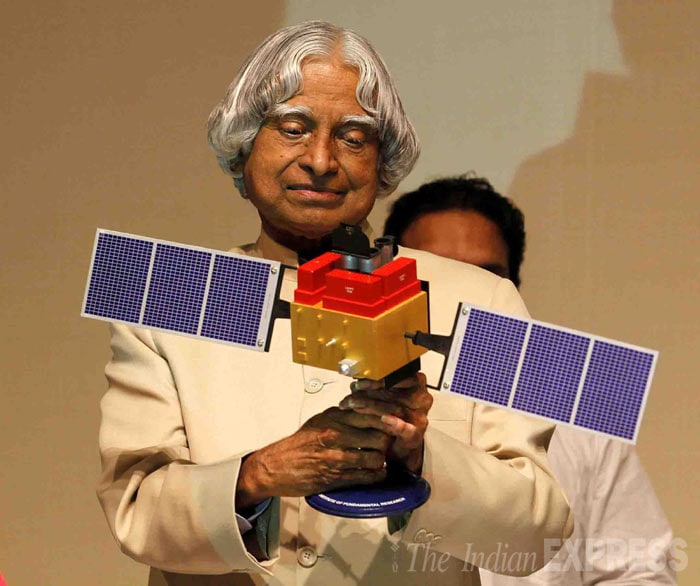
Rare Photographs of Dr. Abdul Kalam ….From The Archives of Indian Express…

abdul kalam, abdul kalam rare photos, abdul kalam photos, photos abdul kalam, apj abdul kalam, apj abdul kalam photos, photos abdul kalam, abdul kalam photo, photos kalam, kalam photos, latest photos, photos 27 July abdul kalam

The journey of A P J Abdul Kalam as a space scientist began in early 1960s at Thumba, a coastal village near here, which housed India’s first rocket launcher, Thumba Equatorial Rocket Launcher.

I K Gujral congratulating former President Dr. APJ Abdul Kalam after he was conferred with the Bharat Ratna at Rashtrapati Bhawan in New Delhi. (Source: Express photo by Virendra Singh) –


abdul kalam, abdul kalam rare photos, abdul kalam photos, photos abdul kalam, apj abdul kalam, apj abdul kalam photos, photos abdul kalam, abdul kalam photo, photos kalam, kalam photos, latest photos, photos 27 July abdul kalam

One of the little known facts about former President A P J Abdul Kalam is that he has a medical invention to his name — a coronary stent built with missile composites that dramatically brought down the cost of heart stents from Rs 55,000 to Rs 10,000 in the mid-1990s.

Former president Dr APJ Kalam deliver lecture on Homi Bhabha Birth Centenary Commemoration TIFR Foundation Day at Colaba. (Source: Express Photo by Ganesh Shirsekar) –


abdul kalam, abdul kalam rare photos, abdul kalam photos, photos abdul kalam, apj abdul kalam, apj abdul kalam photos, photos abdul kalam, abdul kalam photo, photos kalam, kalam photos, latest photos, photos 27 July abdul kalam

Dr. Abdul Kalam, who received several prestigious awards including Bharat Ratna, played a crucial role when India tested its nuclear weapons at Pokhran in 1998 when the Vajpayee government was in power.

Former prime minister Atal Bihari Vajpayee, George Fernandes, Pramod Mahajan, Bhairon singh Shekhawat and other senior sceintist and army officals at the site of 1998 Pokharan nuclear missile launch. (Source: Express photo by Ravi Batra) –

abdul kalam, abdul kalam rare photos, abdul kalam photos, photos abdul kalam, apj abdul kalam, apj abdul kalam photos, photos abdul kalam, abdul kalam photo, photos kalam, kalam photos, latest photos, photos 27 July abdul kalam

Dr. APJ Abdul Kalam felicitated 100-year-old body builder from Kolkata Manohar Aich during the celebration of Shanmukhananda Hall Diamond Jubilee. (Source: Express photo by Prashant Nadka) –

abdul kalam, abdul kalam rare photos, abdul kalam photos, photos abdul kalam, apj abdul kalam, apj abdul kalam photos, photos abdul kalam, abdul kalam photo, photos kalam, kalam photos, latest photos, photos 27 July abdul kalam

“At Rashtrapati Bhawan I found a letter from our first President, Rajendra Prasad to Nobel laureate Sir C V Raman in 1954 asking him to come to Rashtrapati Bhawan to accept the Bharat Ratna. Anyone would have jumped at the offer. Then I read Sir CV Raman’s reply to the invitation. It said, “Dear Mr President, I thank you for giving me such a great honour, but I have a problem. I am guiding a scholar and he is submitting his thesis in December-January. I have to sign the thesis and won’t be able to accept the invitation, ” Dr. Kalam said at Idea Exchange. (Source: Express archive) –

abdul kalam, abdul kalam rare photos, abdul kalam photos, photos abdul kalam, apj abdul kalam, apj abdul kalam photos, photos abdul kalam, abdul kalam photo, photos kalam, kalam photos, latest photos, photos 27 July abdul kalam

Dr. APJ Abdul Kalam being sworn-in as the 11th President of India by the then Chief Justice of India B N Kirpal at the central hall of Parliament in New Delhi. (Source: PTI file photo) –


abdul kalam, abdul kalam rare photos, abdul kalam photos, photos abdul kalam, apj abdul kalam, apj abdul kalam photos, photos abdul kalam, abdul kalam photo, photos kalam, kalam photos, latest photos, photos 27 July abdul kalam

Former President A P J Abdul Kalam intervenes in the debate after presenting the second Ramnath Goenka Excellence in Journalism awards on Monday night. On stage (from left): moderators Rajdeep Sardesai of CNN-IBN and Barkha Dutt of NDTV; panelists Shobhana Bhartia of The Hindustan Times, N Ram of The Hindu, Ravi Dhariwal of Bennett, Coleman (publishers of The Times of India), Pankaj Pachauri of NDTV India and Shekhar Gupta of The Indian Express. (Source: Express archive) –

abdul kalam, abdul kalam rare photos, abdul kalam photos, photos abdul kalam, apj abdul kalam, apj abdul kalam photos, photos abdul kalam, abdul kalam photo, photos kalam, kalam photos, latest photos, photos 27 July abdul kalam

During the Ramnath Goenka Awards, Dr. Kalam had broken protocol and sat on the dais to interact with the journalists present at the ceremony. (Source: Express archive) –

abdul kalam, abdul kalam rare photos, abdul kalam photos, photos abdul kalam, apj abdul kalam, apj abdul kalam photos, photos abdul kalam, abdul kalam photo, photos kalam, kalam photos, latest photos, photos 27 July abdul kalam

Dr. APJ Abdul Kalam in Sukhoi-30 MKI. (Source: Express photo by Ravindra Joshi)

APJ Abdul Kalam's rare photos from Indian Express archive

Dr. Abdul Kalam at his residence at 10 Rajaji Marg in New Delhi. (Source: Express photo by Oinam Anand) –

See more at: http://indianexpress.com/photos/photo-archives/apj-abdul-kalams-rare-photos-from-indian-express-archive/15/#sthash.0VnQg57H.dpuf


Source….www.indianexpress.com

Natarajan

” When a Problem Arises , Become the Captain of the Problem and Defeat it…” Dr. A P J Abdul Kalam

From the Archives of Rediff.com …. This   Article dates back to 6 NOV 2014….

Once, during his Presidency, President A P J Abdul Kalam received a letter from a student shocked with his class 12th mark-sheet.

He had secured 10 per cent in Maths and Physics, whereas throughout his school career, he had always scored 90 per cent and above.

In utter dismay, he wrote to the President of India, asking for his help.

President Kalam referred his case to the authorities and two weeks later got a reply that indeed there was a mistake in the evaluation and a rectification had been done.

APJ Abdul Kalam

In the last 15 years, President Kalam — arguably India’s most popular President and among the founders of the country’s space programme — has interacted with 18 million young Indians, face-to-face, through e-mail and over Facebook.

He receives 300 e-mails everyday.

Some of these letters have been turned into his latest book Forge Your Future, which provides an insight into the issues which concern and engage the minds of young Indians today. President Kalam’s replies are based on his personal experiences, his reading and his interactions with political and spiritual leaders.

The title of the book was selected after an online public vote.

In his quiet bungalow in Lutyens’ Delhi, President Kalam speaks to Archana Masih/Rediff.com about India becoming a developed country by 2020-2022, the heroes he admires, how 90 per cent of India’s space programme is intended for the people and the individual’s potential to become unique.

Photographs: Rajesh Karkera/Rediff.com

Dr Kalam, please can you tell me a little about your daily schedule? What’s it like 

The garden here has a 107-year old tree. Edwin Lutyens himself built and stayed in this house — so he maybe somewhere here (laughs).

His relatives had come to see this building.

The 107-year-old tree is beautiful. Parrots and various other birds live at the top and at the bottom live peacocks. Every year there are baby peacocks. I have a very bioactive tree.

I walk for 1 hour and 15 minutes every day. I spend time in my library.

In a month, I spend 15 days travelling in India. For ten days in a year, I go abroad. I am an honorary professor at the University of Beijing.

Every month, I meet a minimum of 100,000 young people. A million people in a year. So far I have met 18 million young people below the age of 25 in my country.

You get 300 e-mails everyday and spend two hours answering them. When did this process begin? When did you start actively engaging with young people?

It all started when I wrote Wings of Fire, in which I conveyed my life, how I had lived it, how I got myself educated, how I started meeting youth…

I was also teaching at Anna University at that time. After my work as scientific advisor, then projector director SLV 3, programme director AGNI — after all that I went in 2001 to Anna University as a professor.

I also get some handwritten letters. I consider them very important and I love to reply to them because they come from people from the grassroots who do not have access to the Internet. They come with unique questions and I have to give unique answers.

APJ Abdul Kalam

You mention what President Mandela told you about courage in your book — who are some of the most inspiring world leaders you have met?

Two world leaders exclusively come to my mind — Mahatma Gandhi and his unique life. Similarly, Nelson Mandela. I went to the prison where Mandela lived.

Where there is righteousness in the heart, there is beauty in the character. That’s the example of Mahatma Gandhi throughout his life.

In 2006, I travelled in the same kind of train with a steam engine from Durban to Pietermaritzburg. I could imagine the courage which Gandhiji showed in that cold winter.

Ahimsa dharma came after the battle of Kalinga. It transformed King Ashoka. The second time ahimsa dharma was put into action was by Mahatma Gandhi at Pietermaritzburg.

This book gives three messages. First: You can become a unique personality. Mahatma Gandhi and Nelson Mandela were unique.

The other important thing about this book is about continuously acquiring knowledge. Thirdly, when the problem arises — become the captain of the problem and defeat it.

You envisioned a growth plan for India called Vision 2020. How close are we to achieving that vision, in view of that deadline being six years away?

Actually India 2020 is a vision for an economically developed India by 2020. Up to 2008 our GDP was 8 to 9 per cent. Then there was a problem across the Atlantic Ocean, and our GDP crashed to 6 to 7 per cent, then to 5.5 and then to 5 per cent.

So in the 2008-2014 period, we had a slack in our development programme.

Six years is a long period in a nation like India with 600 million youth, nowhere in the democratic world there exists this strength.

We also have a natural way of life. Our agriculture is doing well. We have 250 to 260 million tons of food. Our IT, small scale and pharma industries are doing very well.

Of course, we have to do lots in the development of the rural area. We have 600,000 villages where 700 million people live. We have to Provide Urban Amenities to Rural Areas (PURA). Seven thousand PURAS are needed to lift 600,000 villages.

Even now it is not too late. Fortunately, I understand the present government is taking a priority for PURAS. If they push it along with small scale industry and smart waterways, then definitely 2020 — plus or minus 2 years — we can get there.

So you are confident by 2022, that we may be able to do it?

We can do it, provided we have a national vision.

Do we have that national vision?

From 1930 to 1947, we wanted Freedom. Our caste system vanished, our religions vanished, our differences vanished and we were fighting only for Independence. I call that the first mission that India had.

The second vision: Economic development. If you work like that and declare that mission in Parliament and people and government work for it, irrespective of whichever party they belong to, it is possible. Because our resources are youth power and our natural resources.

The Book Cover

Image: President Kalam’s latest book Forge Your Future

In your book, you say ‘The orientation must turn from the past to the future and focus on how India can become a developed nation. The real issue is that we are not to see ourselves as a nation and because of that there is no national vision.’

Why do you think we have not been able to see ourselves as a nation?

When we see the types of conflicts all around — religious conflict, caste system, language problems — any big nation will have such types of problems but the nation can be united for a big cause.

Independence was a big cause that united us. That’s why I am pushing this idea that the tool for India Vision 2020 is Providing Urban Amenities to Rural Areas. This way we can enhance village development. I have talked about all this in my book.

Independence was a common goal that united people, but some would say that India today is more divided than what it was then.

Any nation goes through a number of problems in various decades, but India has the experience of bringing together people on a big cause.

I am a believer.

The second great movement that India needs is India 2020 Vision and this will make people come together. Plus if the economic programme grows, the poverty level will come down.

Only a national vision can lift 300 million — that’s one third of the population — below the poverty line out of poverty.

As one of the co-founders of India’s space programme, you must be very proud of our Mars achievement. But at the same time when you say that we have to lift the large masses that remain poor, should not basic needs like healthcare, education, infrastructure precede loftier goals or at least go hand in hand?

The space programme is targeted at uplifting the people. In geosynchronised orbit, more than 200 transponders are communicating to the Indian earth station.

These transponders transmit communication, weather reports, 24 hour TV broadcast, the path of cyclones.

All the recent major cyclones have been forecast by various satellites. 90 per cent of the space programme is for remote sensing and communication. You can remote sense what is the kind of wealth we have on earth like water, minerals etc — so it is intended for the people. 90 per cent of the space programme is intended for the people. It is a people’s programme.

You asked about the Moon and Mars programme. We are spending less than 10 per cent of our space programme for finding and research on Moon and Mars so that we are partners in the research and no one can claim that it belongs to them. I don’t want to see Moon and Mars as the property of some other nation. It should be international property.

Ours is the lowest cost of going to the Moon or Mars and we found trace of water also on the moon. From Mars we don’t know… some revolutionary ideas will come from our Mars programme.

What kind of a leader was Vikram Sarabhai, the founder of India’s Space programme?

When you read this book Forge Your Future, you will know how to become a unique person. It contains the experience of great thinkers and doers. Dr Vikram Sarabhai was a unique personality.

He was a visionary. In 1970 he gave a report about what the nation’s space programme should be for the next 20 years.

What according to you are India’s greatest strengths?

One is our farmer community. Whatever weather condition, whatever shortfall — they will give us 200 million tones of food.

Hats off to our farmers and our agriculture scientists!

Second is youth power. No other democratic nation has 600 million youth. The ignited mind of the youth is the most powerful resource — on the earth, above the earth, under the earth — and we have that.

Third, just like every family asks the government for an economically developed nation; every family has the responsibility to give a great citizen to the nation.

We have 200 million families. Parents have the responsibility to make their children righteous — where there is righteousness in the heart, there is beauty in the character.

Only three people can give a good citizen before s/he turns 17. Father, mother, the spiritual environment and the primary school teacher.

You mention women like Marie Curie and Sister Antonia as role models. Who are some contemporary Indian women role models you admire?

I have great respect for Dr V Shanta, for her contribution towards cancer diagnosis, treatment and teaching how to avoid cancer. I admire the mission of Ela Bhatt, founder of the Self-Employed Women’s Association of India and, of course my favourite, whom I respect because I like Carnatic music — M S Subbulakshmi. I love her music.

When she was alive, I used to go to her music festival.

President A P J Abdul Kalam

You say in the book that India needs to cast off its inferiority complex vis-a-vis China and work towards coming together to become a master civilisation because together they constitute 37% of the world’s population.

How can this be achieved in the background of the tension, hostility and border incursions?

I remember in April 2007, I addressed the European Parliament. There were around 800 parliament members from 23 nations.

I told them when I see you all — for hundreds of years you were fighting each other and you generated two World Wars, so a billion Indian people congratulate you. Forgetting all your wars, forgetting the difference of society, you formed a European Union for prosperity and peace.

This should be an example. I had composed a poem and recited it there. They gave a standing ovation.

That is not the issue, the issue is that such nations that created World War I and II, when they came together, we — China and India — are a people of great civilisation, in spite of all the differences, there are some great philosophy that is common.

Buddha and Confucius are common to us.

I believe we have to have a great mission. I suggested when the Chinese president came here that we have a World Knowledge Platform. I teach at the University of Beijing, I told them the time has come that both nations should combine our core competence, our 60 billion dollar business, should become 250 billion dollars.

The border issue we should sort out once for all. People of the European Union fought for hundreds of years, a people who generated two World Wars and Hitler and lost millions of people are a union today for economic growth and peace and it happened in front of our eyes.

So for me the differences between nations can be solved by mutual discussions.

Both sides should decide what we can give and what we cannot. It should be an intensive one month discussion with experts and we should sort it out. I hope the present governments in India and China will do that.

What are your thoughts on the present government?

We are getting into politics, next question!

I just asked your thoughts…

Any elected government will perform in five years. We have to give time.

You believe social media affected the results in 30 to 40 per cent Lok Sabha constituencies. How will social media and the Internet affect future elections?

Social media and the type of information flow should have credibility. It reaches fast. It connects people. It is one of the important mediums for putting forth ideas, thoughts and discussing problems.

In India, we also need contact on the ground, but in the future I see that you can sit in your home with a biometric signature and security approved and you can vote. That way you will have 100 per cent voting. It is a long way off, but I visualise it.

Selection of the candidates will also follow an electronic process — to determine if s/he is a good or bad candidate, how many cases s/he has etc. This will happen, it is only a question of time.

Archana Masih/Rediff.com in New Delhi 

Source….From The Archives of  www.rediff.com

Natarajan

Epsom Salt….A Miracle Worker For Your Home Garden…!!!!

Epsom Salts Help Your Garden Grow


epsom salt gardeningNot only are epsom salt something you should keep in your kitchen, they are also a miracle worker for gardening enthusiasts. Adding epsom salt to your garden can enrich your soil with additional nutrients (like magnesium), increase your vegetable output, and speed up your plant growth. There are so many benefits to adding this salt to your gardening routine.
1. Enrich your roses – Roses benefit from epsom salt immensely. It provides them with magnesium, which is vital for chlorophyll production and seed germination. By adding this salt, the rose bush produces more vibrant blooms with richer colors and darker foliage, and the plant grows stronger. The plant’s inflow of sulfur, nitrogen and phosphorus improves too.

What to do: When planting a rose bush, soak the roots in a ½ cup salt diluted in one gallon water beforehand. Sprinkle a tablespoon of salt in the hole in the ground and cover this with a thin layer of soil. During the growing season, you can sprinkle a tablespoon of salt per foot of plant height to the base of the plant once a month before watering.

2. Grow healthier tomatoes and peppers – Both these plants use up a lot of magnesium while growing, so adding epsom salt – which are easily absorbed into the plant – offers gardeners a cheap source of magnesium for their crops. The Epsom salt helps in other ways too: The plants are stronger, produce more fruit, with less blossom rot, deeper color, and more flavorful vegetables. Gardeners also report sweeter and healthy-sized vegetables.

What to do: When planting a new tomato or pepper plant, dig a hole, place one tablespoon of salt in the hole and then cover with a thin layer of soil. You can position the plant on top of this. During the growing season, you can give the plants a liquid treatment every two weeks: Mix 1 tablespoon in a gallon of water and water the plants with this mix. Using warm water can make it easier to dissolve the salt.

3. Cultivate better flowers and stronger blooms – Experienced gardeners swear that adding epsom salt to their flower gardens benefits the plants. They cite that the added nutrients make their plants healthier, grow stronger flowers and feature blossoms with improved color and texture. Start by adding the Epsom salt to the soil when planting new flower-bearing plants, and after that treat the plants with a liquid solution (same method mentioned in #3) every two to three weeks.

flowers

4. Nurture better azaleas and rhododendron – Add some Epsom salt to help these flowering plants produce more buds. The supplement of sulfate from the Epsom salt also helps prevent the plants from turning yellow. Every two to four weeks you can apply 1 tablespoon per 9 square feet, making sure to cover the root zone.

4. Nurture better azaleas and rhododendron – Add some Epsom salt to help these flowering plants produce more buds. The supplement of sulfate from the Epsom salt also helps prevent the plants from turning yellow. Every two to four weeks you can apply 1 tablespoon per 9 square feet, making sure to cover the root zone.

5. Grow greener grass – Adding epsom salt to your lawn can supplement the grass with minerals that make the grass healthier, greener and grow stronger, enabling the plant to withstand any harsh environmental factors. Adding this salt can help with the germination process and the seed growth in the early stages. What to do: Use a spreader, or dilute the salt in water and apply with a sprayer. It’s recommended that three pounds be applied per every 1250 square feet.

plant6. Help fruit trees flourish – It is a long process for a tree to bear fruit, but adding the salt to its soil helps the plant reap better-tasting, nutritious and more attractive fruit. It can also help improve photosynthesis, and make the tree more weather and disease resistant. You can treat the trees three times a year with 2 tablespoons per 9 square feet, applied over the root zone.

Magnesium deficiency problems

7. Prevent palm trees from getting “frizzle top” Frizzle top is what gardeners call the palm trees with yellow or light green leaves at the top. It looks as if the plant is having a bad hair day, hence the name. You can remedy this by applying epsom salt at the base and then spraying the leaves and crown with a liquid mixture (1 tablespoon mixed in a gallon of water).

8. Stop leaves from curling – Another problem plants incur due to a lack of magnesium is that their leaves begin to curl. If this is the case, you can drench the soil with a mixture of 1 tablespoon salt dissolved in 1 gallon of water, or just sprinkle salt into the soil before watering.

9. Avoid yellowing bougainvillea and gardenia leaves. These low maintenance plants are beautiful additions to a garden. However, due to their heavy flowering or if their soil pH is slightly off balance, they can suffer from low levels of magnesium, which results in yellowing blooms or foliage. You can fix this by sprinkling ½ cup of salt in the ground around the plant roots.

10. Put an end to yellowing leaves – When plants lack magnesium or sulfur, their foliage often turns yellow. Epsom salt’s technical name is magnesium sulfate, which makes it the perfect fix for this problem. Plants such as ferns, cycads, and elephant-ear plants benefit from richer foliage coloring with Epsom salt treatments. Add epsom salt to soil fertilizer once a month and, if you want to solve the problem more quickly, you can spray a solution of 1 tablespoon per gallon directly onto the plant leaves.

plant

11. Help with transplant shock – If you move a plant to a new location or from a pot to the ground, the roots can get damaged and shock can occur. Help the plant adapt more easily to its new environment by adding epsom salt, which facilitate chlorophyll production. Water after planting with a solution of one gallon water mixed with one tablespoon of epsom salt.

12. Keeps slugs away – epsom salt can offer a non-toxic way to rid your garden of unwanted pests. Sprinkling them will keep slugs and snails from nibbling on your plants leaves and fruit, making your garden safer for animals and children, because you didn’t add pesticides to the soil.

13. Easily remove tree stumps – epsom salt can help you drain a tree stump, so that it is easier to remove it. Drill holes in the top of the stump, with three to four inch gaps in between, and fill these with the salt. You can also pour it on any exposed roots to dry them out as well. Add water after filling the holes with the salt – it can take several tries to completely dry out the stump, but the salts speed up the process.

14. Help remove a splinter – It’s easy to get a splinter when working in the garden, even when wearing gloves. They can be irritating and painful, but epsom salt can help with this too. Soak the affected area with a mixture of 2 tablespoons of the salts dissolved in a cup of water. This solution will increase the skin’s osmotic pressure, and help draw the splinter out on its own.

15. Kill weeds – Create a homemade weed killer that can efficiently destroy weeds but won’t damage your growing plants. Mix 2 cups of epsom salt with 1 gallon of vinegar, and add a few squirts of liquid dish soap into the solution. Store this in a spray bottle and apply to any destructive weeds.

Source….www.ba-bamail.com

Natarajan


Message for the Day…” Dedicate Your Body To the Divine…”

Sathya Sai Baba

Turn the love that arises in you towards God. Dedicate your body to the Divine. This is the true mark of devotion. There are three constituents in every human being: the mind, the power of speech and the body. These three are called Trikaranas – the three active agents. It is when all three are used for sacred purposes, your life is sanctified. All need devotion. Every person must cultivate this spirit, irrespective of one’s beliefs. It is only spirituality that can purify the heart and mind of human beings. The second requirement is morality. Morality helps to purify speech (Vaak).The third is called Dharmikam. All righteous deeds done by the body or hands sanctify you. It is through spirituality, morality and righteousness that the three instruments get purified. Only the one who has achieved this triple purity can realise the Divine. If any of these instruments are impure, you will not be able to realise the Divine.

Most Beautiful Front Doors Around the World….!!!

Generally doors are sadly boring, but they don’t need to be; they might as well work as thoughtful designs of gateways between worlds or between diverse elements of our existences.

The front door is normally the sole component of a building’s outer part that everyone will interact most regularly with, so if you wish a building to look awesome, there’s likely no nicer way to do it than by designing a gorgeous door.

1. Toronto, Ontario, Canada

most-beautiful-doors-in-the-world-5

Source: mandalaybus

2. Garden Door

most-beautiful-doors-in-the-world-2

Source: wallpapersinhq.com

3. Santa Fe, New Mexico, USA

cool-door-designs-5

Source: Ken Piorkowski

4. Northumberland, UK

colorful-doors-4

Source: Maree Turner

colorful-doors-2

Source: Rig

6. Funchal, Madeira, Portugal


beautiful-door-designs-5

Source: Natalie AE

7. Fes, Morocco

beautiful-door-designs-4

Source: David K. Edwards

8. Valparaiso, Chile

amazing-doors-5

Source: Byron Ellis

9. Pollença, Balearic Islands, Spain


amazing-doors-2

Source: silverlarynx

10. Shanghai, China

amazing-doors-1

Source: Sean Maynard

11. Sardinia, Italy

amazing-doors-4

Source: Pia – Artemisia1975

12. Garden Door by Kazuyuki Ishihara in Japan

amazing-doors-3

Source: Anya Langmead

13. Burano, Italy

beautiful-door-designs-1

Source: John C. Hutchins

14. German Alps

beautiful-door-designs-3

ource: Dominic Walter

15. Chefchaouen, Morocco

beautiful-door-designs-2

Source: Olga Osipova

16. Funchal, Madeira, Portugal

colorful-doors-1

Source: Ahrabella Heabe Lewis

17. Germagno, Piedmont, Italy

colorful-doors-3

Source: Wozz

18. Jaipur, India

colorful-doors-5

Source: payal.jhaveri

19. Valloria, Italy

cool-door-designs-1

Source: socket974

20. Soho, New York, New York, USA

most-beautiful-doors-in-the-world-4

Source: Gary Burke

21. Sintra, Lisbon, Portugal

most-beautiful-doors-in-the-world-3

Source: Amaury Henderick

22. Miami, Florida, USA

most-beautiful-doors-in-the-world-1

Source: jaydkim 

23. Bali, Indonesia

cool-door-designs-4

Source: Corinna A. Carlson

24. Montmartre, Paris, France

cool-door-designs-3

Source: John Kroll

25. Copenhagen, Denmark

cool-door-designs-2

Source: Ingeborg van Leeuwen

Source…www.top13.net

Natarajan


World’s Best Home Garden ….?

Is this Britain’s most immaculate garden? Pensioner spends 30 HOURS A WEEK tending his lawn which is cut to exactly 5mm

  • ‘It’s my pride and joy’ reveals self-confessed ‘gardening geek’ Stuart Grindle
  • Lush lawn is cut twice-a-day three times a week says the green-fingered gardener
  • The award-winning 70-year-old has spent 30 years crafting the former veggie patch into a floral paradise
  • Gardening widow Anne says she is allowed to step on the hallowed turf but son was told ‘no ball games allowed’
  • Mr Grindle claims his garden is a full time job getting him up at the crack of dawn

Do you want a lawn like this? Well, it’s easy – in theory. You just need to spend 30 hours a week gardening and do it for 30 years!

That’s how long 70-year-old Stuart Grindle has spent turning a former vegetable plot into the picture of perfection it is today.

Mr Grindle mows his lawn six times a week and keeps the grass cut to an impressive 5mm. He was so determined to protect his precious grass that he even banned his son Jonathan from playing football on it when he was a boy.

Anne and Stuart Grindle stand on the hallowed turf, proudly showing off their immaculate garden at their home in Rotherham, Yorkshire

Anne and Stuart Grindle stand on the hallowed turf, proudly showing off their immaculate garden at their home in Rotherham, Yorkshire

Stunning blooms, neat borders and vibrant shrubs dot the stunning green lawn

Stunning blooms, neat borders and vibrant shrubs dot the stunning green lawn

Mr Grindle is a former winner of the Doncaster In Bloom Best Garden competition

Mr Grindle is a former winner of the Doncaster In Bloom Best Garden competition

Dedicated Stuart, who is a retired joiner and lives with his wife Anne, 69, said: ‘It is my pride and joy, most people probably only get out the lawnmower once a week but I cut my lawn twice-a-day, three days a week.

‘People think it’s astroturf because it’s cut to 5mm long and in such good condition. That’s down to watering it and cutting it often.

‘I suppose I am a bit of a golf and gardening geek. Anne is a bit of a golf and gardening widow.’
The 70-year-old has spent 30 hours a week for the last 30 years tending his magnificent blooms and bushes

The 70-year-old has spent 30 hours a week for the last 30 years tending his magnificent blooms and bushes

The self-confessed 'gardening geek' mows his lush green lawn SIX times a week to exactly 5 mm

The self-confessed ‘gardening geek’ mows his lush green lawn SIX times a week to exactly 5 mm

In an effort to encourage her husband from his haven, Mrs Grindle rings a bell to grab his attention.

Mr Grindle added: ‘She has a little bell she rings when she wants me to come in from the garden.

‘It’s not unknown for me to go out at 9am or even earlier. When I entered competitions and when I was preparing for the open garden day I was out there at 7am.

‘I’ve managed to play golf twice in the past week but you know there’s still work to be done when you get home – thankfully it’s light until nine o’clock at the moment.’

Anne Grindle has to catch her husband's attention by ringing a bell to summon him away from his haven

Anne Grindle has to catch her husband’s attention by ringing a bell to summon him away from his haven

Mr Grindle transformed the former vegetable plot into a floral paradise and threw open his garden gates to raise money for charity

Mr Grindle transformed the former vegetable plot into a floral paradise and threw open his garden gates to raise money for charity

Mr Grindle added: ‘I have spent 30 years getting it to this state and I can put in 30 hours a week. It’s a full-time job.’

Wife Anne confirmed that she was allowed to walk on the hallowed turf, but said Stuart had banned his son Jonathan from playing football there when he was a boy.

She said: ‘There were no ball games allowed, Stuart always said there was a cricket field and a football field up the road he could use instead.’

Stuart, a former winner of the Doncaster In Bloom Best Garden competition, said aside from the lawn, his large-leaved hostas were his most prized feature, because of the wonderful colours of the leaves.

Source….www.dailymail.co.uk

Natarajan

Sir Donald Bradman: Living in the shadow of The Don’s fame….

The effect of Sir Donald Bradman’s fame has filtered down through the family tree. Now, for the first time, members of the notoriously private family have spoken about how the spotlight has influenced their lives.

Throughout the world’s greatest Test batsman’s life, he shunned most media requests and denounced the hero-worshipping which came with his fame.

“Some people are fascinated by fame and it just draws people to be part of it, and there’s absolutely nobody who ever lived who could enjoy that process less than my dad,” his son John said.

This distaste for the public gaze is a characteristic that has trickled through subsequent generations.

John Bradman was deeply affected by the relentless attention paid to him as son of ‘The Don’.

“When people would come up to him as a child quite often the first question would be, ‘and are you going to be a sportsman like your dad when you grow up?’,” John’s daughter Greta Bradman said.

John decided the best way to cope with the associated fame was to change his name.

“[It wasn’t] to pretend I was somebody other than who I was but simply to say ‘people, please give me a break’,” John told Australian Story.

In his early 30s John Bradman became John Bradsen, a pun on the ‘son of Bradman’ with a nod to Norway, where he had spent some time as a young man.

“John felt he was not his own person, that people saw him as Don Bradman’s son, and it was crushing him,” John’s former wife and Greta’s mother Judith Bradsen said.

According to Ms Bradsen, it worked.

“People did not know. I did not ever, ever get a Bradman question all through the time I was teaching as Bradsen,” she said.

Even though he raised the possibility of a name change with his father when he was 18, John said it was a tough decision to make, as he knew Sir Donald would find it difficult.

“My father wrote some letters to a friend in which he expressed his anguish over my changing my name which reflected the fact that it must have been difficult for him,” he said.

Next generation steps into the limelight

Greta Bradman, The Don’s granddaughter and John’s daughter, is now a soprano singer and on the cusp of international stardom herself.

Greta told Australian Story her grandfather’s great love of classical music helped shape her interests as a child.

“My Grandpa was hugely into music. He composed music,” Greta said.

“He also had a very large record collection and he was really interested in certain soprano and certain conductors.

“He and I would sit and listen to his record collection and talk about it.”

In the past year Greta has been fostered by conductor Richard Bonynge.

“She should be singing in Covent Garden because I’ve heard many singers there who are not as good as she is,” Bonynge told Australian Story.

“She’s a one off as far as I’m concerned. She’s very special.”

But it is a path Greta has been reluctant to travel because of the shadow fame has cast over her family.

Bradman childhood and Sir Donald as a grandparent

Greta and her brother Tom Bradman’s childhood was a happy one.

They enjoyed a close relationship with their grandparents, going to their house every day after school and having dinner with them once a week.

“My grandparents were amazing after school carers,” said Tom Bradman.

Lady Jessie Bradman played a pivotal role in their upbringing.

She would bring crayfish for lunch every Saturday and play endless games with the children.

“My grandma had this long, long grey hair that she’d have usually tied up in buns and we’d play witches, she’d let her hair right down,” Tom said.

But even as a child Greta could see the toll fame took on her grandfather.

“Grandpa wouldn’t come to school concerts and things like that because he really just wasn’t comfortable with people staring at him,” she said.

“He didn’t want anything to be different for me.”

According to Greta, Lady Jessie helped him through many public appearances.

“She was so good at conversing with people and keeping the conversations sort of light and keeping grandpa feeling really comfortable because he, socially, I don’t think was quite as fluid in his conversation as she was.”

Full circle name change

As Tom and Greta grew older, Sir Don’s health was failing and John Bradman and his new partner Megan were about to give birth to their son Nicholas

It was then John began to think seriously about the possibility of changing his name back to Bradman.

Tom said for years they had enjoyed “the gift of anonymity” but that it was time to change back.

“When I told him [we were changing our name back to Bradman] he just smiled and said — you know, don’t do it for me,” John said.

“The period of its effectiveness had somehow come to a close,” Tom said.

“We were ready to assume our family name.”

“My grandpa was truly tickled pink,” Greta said.

Don Bradman being asked for an autograph

Don Bradman being asked for an autograph by nine-year-old Rick Scheeren in 1963.

source…..

By Belinda Hawkins and Wendy Page

http://www.abc.net.au

Natarajan

Natural Remedies for Arthritis ….

Effective Remedies Against Arthritis

Arthritis is a type of joint disorder that involves inflammation of a single joint or several joints. The disease plagues approximately 350 million people worldwide, with osteoarthritis being the most common type. Arthritis is the leading cause of disability in the United States, with over 20 million people affected by it.
Arthritis can be triggered by severe bouts of inflammation, which occurs when chemicals are released from the body into the bloodstream or damaged tissue areas. The chemical release eventually aggravates the nerves, which results in a great deal of pain. Rheumatoid arthritis can even cause disfiguration of the hands.
We’re going to discuss 13 various tips to help alleviate the discomfort and take preventative measures against the disease. Before we jump to the remedies department, it’s crucial to get better acquainted with the different types of classes and symptoms attributed to the painful joint disease.
Editor’s Note: The remedies listed here are NOT a substitution for medical treatment. Please consult with your doctor if you think you are experiencing symptoms.
Classes of Arthritis:
  • Osteoarthritis
  • Rheumatoid arthritis
  • Juvenile idiopathic arthritis
  • Septic arthritis
  • Ankylosing spondylitis
  • Gout and pseudo-gout
  • Still’s disease
Symptoms of Arthritis:
  • Redness
  • Joint stiffness
  • Loss of joint function
  • Joint swelling
  • Joint pain
  • Muscle stiffness
  • Fatigue/loss of energy
  • Fever
  • Chills
  • Headaches
  • Loss of appetite
Here Are 13 Natural Remedies to Prevent Against Arthritis:
1) Exercise – You must keep mobility in your joints by regularly exercising. Exercising will help control the excess pressure and strain that inflames the joint. It will also help strengthen the muscles that support the joint, and provides keeps your joints fully lubricated. Always warm up properly before performing any stretching exercises. It’s also a good idea to follow a healthy diet, and go for a walk every day.
2) Massage – There’s nothing quite as soothing for your aching joints and muscles like getting a massage. Massaging with mustard oil might seem a bit out of the ordinary, but it works. The oil helps to reduce joint pain and inflammation. You can prepare the homemade mustard oil mix as follows:
Directions:
  • Heat a little mustard oil until it becomes slightly warm. Onion juice may be added if there is swelling.
  • Rub the oil gently over the painful joint or joints, before covering it with plastic wrap.
  • Apply warm towels to the swelling joints, and repeat on a daily basis, or until swelling goes down.
3) Epsom Salt – Magnesium relaxes the muscles and nerve endings, which become aggravated with the inflammation. Dunking your hands in a bowl of water with Epsom salt, can help alleviate the discomfort. It’s also a great source of magnesium, which regulates the pH balance levels in the body. The salt keeps the pH levels low, to prevent inflammation. Here’s how to prepare an Epsom salt mixture:
Directions:
  • Fill a large bowl with warm water, and a half cup of Epsom salt. Make sure you stir the bowl.
  • Dunk your hands or affected joints into the bowl. Alternatively, you may want to fill a tub with warm water and add 2 cups of Epsom salt to allow more room for larger joints, such as the knees.
  • Keep your joints soaked for approximately 15 minutes. Perform daily.


4) Turmeric – Turmeric helps to reduce painful swelling and joint inflammation. The dark yellow spice promotes healthy functioning of the joints, keeps your immune system well-protected, and improves digestion. It’s also excellent for reducing pain among people who suffer from rheumatoid arthritis. The yellow powder can even be mixed together with green tea, and here’s the delicious recipe:
Directions:
  • 1/2 teaspoon ground turmeric
  • 1/2 teaspoon ground ginger
  • 2 cups of water
  • 1 teaspoon of honey for a little flavoring
5) Increase Your Magnesium Intake – Magnesium is essential to absorb calcium, which strengthens the bones. Magnesium supplements can relieve pain and rebuild bone tissue. Eat more foods that are high in magnesium, such as beans, nuts, whole grains, dark leafy greens, and fish. Magnesium oils and supplements can be purchased at any local health store. It’s important to maintain high bone density to thwart off the pains.
6) Extra Virgin Olive Oil – Extra virgin olive oil acts like a natural aspirin to help heal painful joints. The oil contains the inflammatory enzymes COX-1 and COX-2, which helps lubricate your joints, and provides you with instant pain relief. You can either rub a bit of the olive oil on the affected joints or consume 2-3 teaspoons of it.
7) Ginger – Ginger can reduce swelling and stiffness in joints due to the high anti-inflammatory components found inside. Eating raw ginger on a regular basis can help to alleviate pain by improving blood circulation. Ginger may be added to green tea to create a great healing solution. Here is an easy recipe you can make if you don’t enjoy the taste of raw ginger:
Directions:
  • Fill a bowl with 6 teaspoons of dried ginger, 6 teaspoons of caraway seeds, and 3 teaspoons of black pepper. Mix well.
  • Consume half a teaspoon of the mixture with a glass of water after each meal.
8) Fish Oil – The popular fish oil supplement is loaded with omega-3 fatty acids, EPA and DHA, which are used to combat arthritis. The fatty acids also boost your immune system, fighting off swelling or achy joints. Fish oil also improves your cardiovascular system, and helps to prevent blood clots. Cold water fish should be added your dietary plan, but if you don’t enjoy eating fish, a capsule of fish oil will suffice.
9) Cayenne  Ointment – The capsaicin of the cayenne pepper acts as a natural dopamine to block out pain signals from the neurological system. It disrupts the Substance P, which transmits pain signals to the brain. Cayenne ointment may be applied to the joints to relieve the pain. You can prepare your own treatment with these easy-to-follow instructions:
What You Will Need:
  • 3 tablespoons of cayenne powder
  • 1 cup of grapeseed oil (or any other oil like almond, olive, jojoba)
  • 1/2 cup of grated beeswax
  • A glass jar with a tightly fitting lid
  • A double boiler
Directions:
  • Mix 3 tablespoons of cayenne powder together with a cup of your oil of choice.
  • Heat the oily mixture in a double boiler for 5-10 minutes on a medium heat.
  • Stir in a half cup of grated beeswax until the substance has fully melted down, and that everything is blended together.
  • Keep the cayenne mixture chilled in the refrigerator for 10 minutes, and then whisk together. Repeat the step for an additional 10-15 minutes.
  • Pour into a glass jar with a tightly fitting lid in the refrigerator, and apply daily.

10) Cinnamon – The anti-microbial, anti-cancer, and antioxidant properties contained in cinnamon, helps repair damaged tissues and increases bone density. The powerful spice is an ideal wonder drug for people suffering from Osteoarthritis or rheumatoid arthritis. Cinnamon blends well with honey, and helps soothe the discomforting areas. Mix a half teaspoon of cinnamon powder with a tablespoon of honey, into a cup of warm water or add the combination to your tea. A honey cinnamon paste can be made, and massaged gently over the painful areas.
11) Peppermint Eucalyptus Oil Blend –Peppermint and eucalyptus oils, when combined, offer a soothing sensation to the achy arthritic joints. Here’s how to prepare the mixture:
What You Will Need:
  • 5-10 drops of Eucalyptus oil
  • 5-10 drops of Peppermint oil
  • 1-2 tablespoons of carrier oil (olive, almond, grape seed, etc.)
  • A small dark glass bottle
Directions:
  • Blend 5-10 drops of eucalyptus and peppermint oil together, and then add 1-2 tablespoons of carrier oil to the mixture.
  • Carrier oil dilutes the essential oil, to prevent skin irritation.
  • Keep the concoction stored in a dark glass bottle, far away from direct sunlight.
  • Rub the mixture gently onto the painful joints.


12) Cherries – Cherries are excellent resources for magnesium and potassium, both vital components for treating joint discomfort and pain. The potassium acts as a natural anti-inflammatory. Make sure you eat a handful of cherries per day to keep the inflammation away! You can prepare a homemade cherry syrup by boiling a few cherries in water for a couple of minutes. Once the water thoroughly boils, it will form into a sweet tasting syrup.
13) Juniper Berry Tea – Juniper berries are used to treat arthritic pain, nerve pain and gout. They contain the powerful anti-inflammatory compound known as terpinen-4-ol. Pregnant women should not drink the juniper tea because it can lead to miscarriages. Here’s how to prepare the juniper tea:
What You Will Need:
  • 1 tablespoon of dried juniper berries
  • 1 cup of fresh water
  • A Teaspoon of Honey
Directions:
  • Place a tablespoon of fresh juniper berries into a cup of boiled water. Add a teaspoon of honey to increase the flavor.
  • Pour the boiling water over the berries, and allow them steep for 20 minutes before straining.
    • Drink the tea twice per day.
    (H/T: everydayroots.com & top10homeremedies.com)

    Source….www.ba-bamail.com

    Natarajan


4 Ways to Increase Your Productivity at Work….

Prioritising tasks and effective time management is the key to success, says Pardeep Goyal.

How I increased my productivity

It may sound unpractical, but it’s true.

Earlier I’d work 12 hours a day, and my productivity was average.

Now I work for 8 hours a day, and my productivity is 1.5 times more than before.

I left my job last year to work full time on my start-up.

I worked harder than ever and dedicated all my time to building our product and marketing it online.

Sometimes, I would work continuously for 4 to 5 hours.

Slowly I realised that my productivity was not increasing proportionally to my increased working time.

I experimented a lot with my time in the last one year.

#1 Experiment: Pick up work and finish it

My first start-up was a total mess, and unorganised.

I was working on design, product architecture, and online marketing.

There was so much to learn about start-ups.

So I would pick the most terrifying, imposing task and subsequently spend hours and hours on it, until it was finished.

I remember that I finished product deployment on AWS (Amazon Web Services) in just three days, without any clue about cloud computing.

I spent about 12-14 hours daily in order to accomplish the AWS task.

This experiment looked like it was working, but it delayed other important tasks like design and marketing.

I realised that AWS deployment was not worth spending 36 to 40 hours on.

I don’t know how much time I spent actually working on AWS, considering I was worrying about design and marketing the whole time.

2 Experiment: Time segmentation for each task category

My next experiment was to allocate a time window for each category.

I divided my day into three segments, and decided to work on one type of task in each segment.

In the morning, I was a designer, spending 3 to 4 hours on creating User Interface/User Experience.

In the afternoon, I was a tech architect, learning and implementing technology, occasionally coding and fixing defects.

In the late evening, I was a digital marketer, promoting our product online.

This experiment improved my overall productivity and allocated equivalent bandwidth to all my work. But I was still spending 12 to 14 hours daily in front of the computer.

I found myself wasting time on unnecessary websites and phone calls. I had to optimise my sitting time.

#3 Experiment: Reduce computer screen time

I loved this experiment.

The idea was simple, do not sit in front of the computer if you don’t know what to do.

Put your system to sleep and plan what to do for the day.

Pick one task that needs the computer, complete the task and put your system back to sleep.

I reduced my time on social media, e-commerce websites, and unfocused reading.

I saved 2 to 3 hours each day, that I started utilising on offline activities like playing with my kid, household work and reading books.

I found myself more energetic and effective in doing online work.

#4 Experiment: Become early riser and short work sitting

I have never been an early riser in life.

Even in my school days, I’d do my work till late at night.

I never woke up early, not even on exam days.

I had continued working till late night, and that was having adverse effects on my health, sleep, and mind.

I was occasionally distracted by my family because I was working from home.

The solution was to wake up early and finish the most important work before my kid woke up.

At the same time, I shortened my sitting time to 90 minutes to 120 minutes.

I started taking breaks of 60 minute to 90 minutes in between each sitting.

This schedule increased my productivity significantly, and I reduced my working time.

Below is my working schedule for your reference.

6:00 am: Wake up

6:30 to 8:30: Focused work (Writing)

8:30 to 10:00: Yoga, Breakfast, Bath

10:00 to 11:30: Focused work

11:30 to 1:00: Break

1:00 to 2:30: Focused work

2:30 to 3:30: Break

3:30 to 5:30: Focused work

5:30 to 8:00: Family time and phone calls

8:00 to 10:00: Unallocated buffer time

10:00 pm: Sleep


My computer screen time is maximum 7 to 8 hours and family time is minimum three hours.

I am still experimenting with my time schedule. I feel there is still scope for improvement.

I would love to know how you are improving your productivity.

Lead image used for representational purposes only. Credit: hatalmas/Creative Commons

Pardeep Goyal   

Source…www.rediff.com

Natarajan

6 Tips for You to Stay Fit….

The keys for attaining good health and a fit body are quite simple. All of you have to do is take care of good nutrition, physical activity, sufficient sleep and rest, meditation and conscious breathing.


Constant travel for work coupled with never ending long and tiring commutes to the office, work pressure, unhealthy diets high in saturated fats, sugar, food with high sodium content and a sedentary lifestyle, all combined together pose serious health challenges like obesity. It can also play host to complications like hypertension, atherosclerosis, diabetes, osteoporosis, and more. In the long run, if this kind of lifestyle is not altered these will turn into life threatening and life shortening disorders!

But, the good news is that despite these challenges, one can maintain one’s weight and achieve a healthy and fit body by adhering to a sensible eating pattern with a variety of natural, wholesome foods and most of all by staying active, physically and mentally.

Diet and nutrition

The best insurance for healthy eating is maintaining a diet that has a balance of fruits, veggies, salads, millets, whole grains, nuts, pulses, sprouts, seeds, low fat milk, soy milk, tofu etc. These foods have detoxifying, healing and regenerative properties and are rich in antioxidants and elements needed to keep you nourished.

Exercise

Any physical activity like walks, swimming, yoga, gym workouts etc helps to keep one energised, well oxygenated and improves strength, stamina, flexibility, immunity and metabolism.

1. Avoid snacking on junk foods

Instead, make sure you eat a wholesome breakfast before hitting the road and carry a fruit that can be munched on in between. Choose steamed foods like idlis or toasted sandwiches and stay away from all fried foods, aerated drinks, milk shakes, fruit juices, desserts and any kind of sweets.

2. Keep dry fruits handy

These are nutritious and will keep hunger at bay. A few almonds, walnuts, cashew nuts, dates and figs are ideal.

3. Do neck rotations, shoulder shrugs, arm rotations etc. in between travelling

These can be done when you take a break from driving, between meetings and even in an aircraft. These exercises work wonders especially for long flights as they keep your blood flowing even when you’re sitting in one place for a long time. While sitting at a traffic signal or in the plane extend your legs, keep your toes pointed and rotate your ankles clockwise and anti-clockwise. Shoulder rotations are also recommended to ease away the muscle tension.

4. Walk a lot

A brisk walk daily is an effective way to do some cardio without hitting the gym and can be an invigorating experience as walking is an exercise that you can do anywhere, anytime.

Take a brisk walk everyday and you are sure to be on the way to better health and vitality. Walking also helps you enjoy the freshness of nature with the added benefit of relaxing your mind and simultaneously getting rid of stress.

Here’s a quick tip, whenever possible, use the stairs instead of elevators.

5. Exercise

Simple exercises like leg kicks, squats, lunges, chair dips, push ups, ab crunches and a few yoga stretches like suryanamaskar, bhujangasan, dhanurasan, sethubandhasan and naukasan are possible to do in your room.

These help to boost flexibility as well as stamina and strengthens the core and back muscles.

Pranayam or breathing exercises like chanting Om, kapalbhati and anulom-vilom should be done at regular intervals throughout the week. These revitalise your body and alleviate stress and tension after a long day.

6. Drink plenty of water

Keep yourself well hydrated. This can include water, herbal/green teas/coconut water (depending on their availability).

Health, wellness and fitness certainly do not require extreme or rigid measures. All they need is proper planning, consistency and regularity. These are the key factors for a healthy mind and a well toned body. Incorporate the above mentioned simple strategies to reinforce complete and total wellness and enjoy a healthy and stress free life.

Photograph: pexels.com

Source….www.ba-bamail.com

Natarajan