‘When we became a Rs 100 crore company in October, we celebrated in grand scale. We have grown from producing 10 packets a day in 2005, with just my cousin managing the kitchen, to 50,000 packets a day with 1,100 employees in 10 years.’
‘If you have the passion to start something, do it immediately. Don’t wait for tomorrow.’
Shobha Warrier/Rediff.com listens to P C Musthafa’s incredibly inspiring story.
This is the story of a 42-year-old man from a remote village in Wayanad, Kerala. His father was a coolie. His mother never went to school.
This is the story of a man who failed in Class 6, but went on to join the Regional Engineering College (now the National Institute of Technology), Calicut and the Indian Institute of Management-Bangalore.
This is the story of a man who decided to become an entrepreneur and employ people from rural India.
Today, fresh idli and dosa batter made by P C Mustafa’s company ID Fresh reaches homes in Bengaluru, Chennai, Pune, Mumbai, Delhi, Hyderabad, Mangaluru and even Dubai.
Childhood in Wayanad
I grew up in a small village called Chennalode near Kalpatta in Wayanad.
The village was so remote that we had only a primary school. It had no roads or electricity. We had to walk at least four kilometres to go to high school so most of the kids dropped out after primary school.
My father Ahmed stopped studying after Class 4 and worked as a coolie on a coffee plantation. My mother Fathima never went to school.
I am the eldest and I have three younger sisters.
Failing in Class 6
I was not interested in studies. After school every day, and on weekends, I preferred helping my father, a daily wage worker, instead of doing homework or studying.
There was no question of opening the books at night as there was no electricity at home, only kerosene lamps.
Though I was below average in all other subjects, I was good at mathematics. After I failed in Class 6 I lost interest in going to school.
A school master steps in
My father asked me to join him as a daily wage worker. My maths teacher, Mathew Sir, didn’t like my dropping out of school one bit. He spoke to my father who agreed to give me one more chance.
Mathew Sir asked me a question, ‘Do you want to be a coolie or a teacher?’ I looked at him and could see the difference between my father and my teacher. ‘Sir,’ I answered, ‘I want to be a teacher like you.’
When I went back to school, I had to sit with my juniors. All my friends were in a higher class. I felt so humiliated that I became attentive in class.
I was very weak in both English and Hindi. Seeing me struggle, Mathew Sir helped me after school.
From a failure to a topper
Sir’s help worked. I came first in the Class 7, surprising all the teachers. There was no looking back after that.
I stood first in the school in Class 10.
In those days, I had only one ambition: I wanted to be a maths teacher like Mathew Sir. He was my role model.
From a village to a city
Till I completed Class 10, I had not stepped out of Wayanad. For college (junior college was known as pre-degree those days), I had to go to Kozhikode (Calicut). My father didn’t have a problem but didn’t have any money to fund my education.
I got admission at the Farooq College in Kozhikode where my father’s friend, who had suggested I study further, arranged for a free meal scheme in the college charity hostel. I was one of the 15 students who were offered free stay and food, as we could not afford to pay.
There were four hostels in the college and we had to go to different hostels for breakfast, lunch and dinner as we were on charity.
Naturally, other students looked at us with disdain. That upset me. It was like we were eating somebody else’s food. Some students made fun of us. It was not a pleasant experience, but I had to swallow the humiliation for the sake of my education.
Looking back, I feel the college management did a great job by taking care of poor students like us.
Coming from a village, I was very weak in English. It was a big handicap in college where all the lectures were in English. A good friend of mine used to translate everything for my benefit. I also worked extremely hard and felt even more motivated when I scored good marks.
Engineering at REC, Calicut
I wrote the engineering entrance exam after my college and was ranked No 63 in the state. I got admission at the Regional Engineering College (now the National Institute of Technology).
When I look back, I feel three factors helped me.
I had the potential as I was good in Maths. I was a hard worker. And the third and most important reason was that God was with me.
I was very lucky to have secured such a good rank. I got the opportunity to study what I really liked — computer science. There was no one to guide me in those days except God Almighty.
Life was not that bad at REC. I got a scholarship and also took a student’s loan. I didn’t have to pay any tuition fees and only had to take care of the hostel fees. That was a big relief. Unlike other students, I had to be very careful about spending money, but that was okay.
I had no dreams to be an entrepreneur then. I wanted to be a well-known engineer. I worked hard and did well in studies. When I graduated in 1995, I got placed at Manhattan Associates, an Indian start-up in the US.
First flight
After a few days of working at the start-up in Bangalore, I got an offer from Motorola. It was a dream offer for a person from a remote village in Wayanad. After working for a short period in Bangalore, I was sent to Ireland.
As a young boy, I stepped out of Wayanad for the first time to study in a college. Now, for the first time in my life, I boarded a flight and went out of the country.
The flight took off at 6.30 pm. I looked down and saw Bangalore. I will never be able to forget the image: The aerial view of Bangalore.
Missing India
Though I loved Ireland and the Irish people, I missed my people and country a lot. I also missed Indian food, as there were no Indian restaurants there. I was used to praying five times a day, which I found difficult to do there.
After three months, I got a very good offer from CitiBank. I jumped at it and moved to Dubai. In 1996, a salary in lakhs was quite something. The first thing I did after I paid off my loan was to send Rs 1 lakh in cash to my father through a friend. I was told he cried seeing so much cash in a bag sent by his son.
He paid off his debts and started planning my sister’s wedding. One of my sisters had dropped out after school, but the others went to college. In 2000, I also got married.
A home for his parents
Soon, I built a house for my parents in our village. The people in my village, who had seen me as a small child, could not believe the change in my life. Many kids in my village now look up to me. They also dream of achieving something big in life.
From Dubai to India
In 2003, after having lived in Dubai for so long, I decided to return to India. There were three reasons for the decision.
I wanted to come back and spend time with my parents.
I wanted to study further. Though I had a very good GATE score, I couldn’t study after my engineering due to financial constraints. After working for a few years, I decided to study business administration.
The third reason was that I wanted to give something back to society.
There are so many smart youngsters in our villages who are not getting a good break in life. I wanted to give them that opportunity so that they too could come up in life. And the best way to help them, I thought, was by providing them with jobs. In order to do that, I had to be an entrepreneur.
Quitting a well paying job
It was one of the toughest decision I have ever made.
My father was horrified. So was my wife’s family. But one person supported me wholeheartedly, my cousin Nasser. As did my wife.
I am very close to my maternal cousins. We grew up together. They also came from very poor families. Unlike me, they didn’t go for higher studies.
Nasser ran away from home to Bangalore where he started a small kirana store. He gave me the courage to listen to my heart. He said, ‘If it does not work out, you can go back to work anytime. Quitting the job was the end of the world. But you shouldn’t feel that you didn’t try to do what you wanted to.’
The funny thing was I knew I wanted to do something but had no idea what it would be. I came to back to India with a savings of Rs 15 lakh (Rs 1.5 million).
Idlis and dosas
I met with my first objective by going to my village every weekend to be with my parents.
Instead of studying technology, I decided to do an MBA as I found management more interesting. I gave the CAT exam and got admission at IIM-Bangalore.
Even while studying at IIM-B, I would constantly discuss business plans with my cousins.
Shamsuddin, one of my cousins, had seen dosa batter being sold in plastic bags tied with a rubber band in nearby stores and suggested we make and supply dosa batter. That was an Aha! moment. I decided to invest Rs 25,000 and start a company immediately.
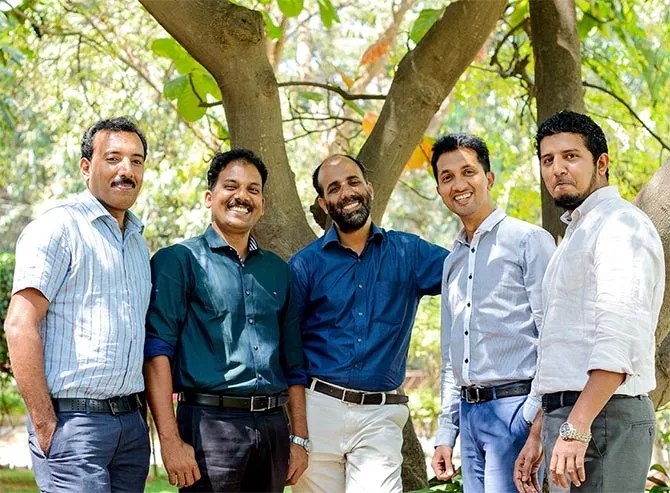
Five of us cousins — Nasser, Shamsu, Jaffer, Naushad and me — decided to join hands. The partnership was such that I had 50 per cent share in the company and the other 50 per cent was with the four of them.
We found a small place of around 550 square feet and started with two grinders, a mixer and a sealing machine.
ID is identity, not idli dosa
We were discussing names when a cousin suggested ID for idli dosa. We named the venture ID Fresh as we planned to supply fresh dosa and idli batter.
Our initial target were 20 stores in the neighbouring area. If we were able to sell 100 packets a day in six months, I would invest more and buy more machines.
We didn’t employ anyone; my cousin was in charge. We started very small with just 10 packets a day. Initially, the shopkeepers were not willing to keep a new brand. So we gave them a special offer — cash after sales.
When the customers asked for ID repeatedly, other stores also wanted to stock our product. But we stuck to the first 20 stores and waited to touch the 100 packet figure. By the ninth month, we were selling an average of 100 packets a day.
Making profits from day one
The best part of our venture was that we were making profits from day one. None of us took any salary initially. After paying the rent of Rs 500 and crossing off the expenditure of buying rice, dal, etc, our profit was Rs 400 in the first month.
Once we reached the target of 100 packets, I decided to invest Rs 6 lakh (Rs 600,000) and move to a bigger kitchen of 800 sq ft with 2,000 kg capacity, which is 2,000 packets with 15 wet grinders.
Nasser was handling the kitchen alone so we employed five people, all of whom were our relatives.
Joining as the CEO
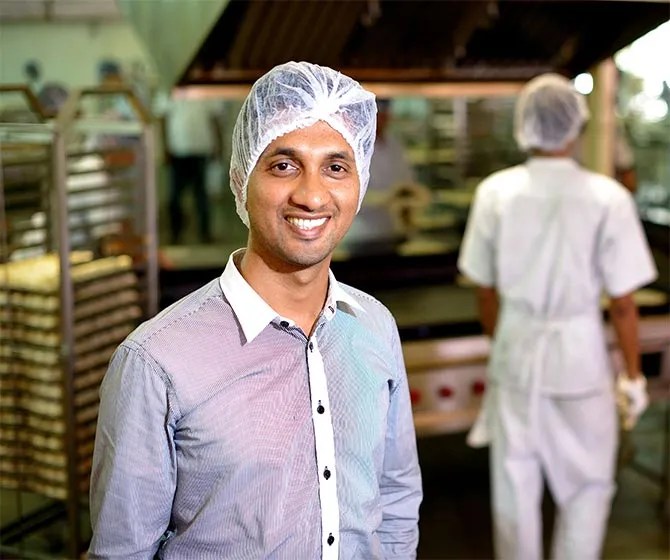
In 2007, I got my MBA and officially joined as the CEO in charge of marketing and finance. Till then, I was only remotely participating in the operation along with my cousins.
In two years, we increased the capacity to 3,500 kg a day. The number of stores we partnered with increased to 300, 400. We now had 30 employees working for us. We were operating our kitchen in a residential area till then.
As the demand increased, we decided to have a proper manufacturing plant in an industrial area. We were making a decent 10 to 12 per cent profit every month.
In 2008, I invested another Rs 40 lakh (Rs 4 million) and bought a 2,500 sq ft shed in the Hoskote Industrial Area. We imported five large wet grinders from America and customised them to fit our requirements.
In 2008, we added parathas to our list of products. We will soon introduce vada batter and also rava idli batter.
At ID Fresh, we only deal with natural fresh food. We do not add any preservatives to any of our products.
Expanding operations
In 2012, we expanded to other cities like Chennai, Mangaluru, Mumbai, Pune and Hyderabad. My friends and relatives joined me to take ID Fresh to the next level. We follow a partnership model in other cities, with a local manufacturing plant in each city. Each partner becomes a shareholder in the parent company.
In 2013, we started our operations in Dubai. We see the maximum demand for dosa batter in Dubai and are not able to match the demand.
Our experience in Bangalore helped us. We use the same raw materials, the same manufacturing process and the same business model everywhere. Expanding to other cities was a bit tough though, since we are not locally present there.
We are not looking at any other international market right now. India is such a huge market and we have so much to explore.
Rs 100 crore company
Today, we produce around 50,000 kg in our plant. The total investment must be around Rs 4 crore (Rs 40 million) and our revenue is Rs 100 crore (Rs 1 billion).
When we became a Rs 100 crore company in October 2015, we celebrated in grand scale. We have grown from producing 10 packets a day in 2005, with just my cousin managing the kitchen, to 50,000 packets a day with 1,100 employees in 10 years.
Employs only youngsters from rural areas
When I recruit someone, I ensure he is from a rural area. He has to be smart, honest and committed. Those who work in the plant make around Rs 40,000 a month.
Biggest challenge
The biggest challenge any start-up faces is getting the right people, the right team. I was lucky to have my cousins with me.
But balancing work and personal life is by far the toughest challenge.
Future plans
My aim is to make ID the most popular and trusted brand in the fresh food segment and make it Rs 1,000 crore (Rs 10 billion) company in the next five to six years.
By then, I am sure we will be able to employ at least 5,000 people.
Advice to aspiring entrepreneurs
If you have the passion to start something, do it immediately. Don’t wait for tomorrow. I had the passion to be an entrepreneur, but it took me a few years make that decision. I still regret the delay. I wish I had started five years earlier.
My words may sound like management jargon, but it is very important to maintain the quality of the product to be successful.
The three things that worked for us were that we were in the right city with the right product at the right time.
Photographs: Courtesy ID Fresh
Source…..Shobha Warrier in http://www.rediff.com
Natarajan


 \
\