Message for the Day….” The Trinity is Present in the form of Three ‘gunas’ in Every Human Heart…”

The true meaning of Guru is, ‘One who is beyond attributes and forms, the Supreme Self (Brahman)’. When this Self is within you, where is the need to search for a Guru? A teacher who teaches others has had a teacher himself. The one who has noGuru above him is the true Guru. The Sanskrit stanza which hails the Guru as Brahma, Vishnu and Maheshwara and asParabrahman is misinterpreted. The right approach is to consider Brahma, Vishnu and Maheshwara as the Guru. These three are symbolised by the three gunas or attributes: Brahma is Rajas, Vishnu is Satwa and Shiva represents Tamas. The whole cosmos is constituted by the three gunas and the gunasare present in you. The Trinity are present in the form of the three gunas in every human heart. Hence, you are your ownguru. You need not seek him elsewhere. You have to feel at all times your inherent divinity, which is also present in everyone. When you help or feed someone you must feel that the Divine in you is feeding the Divine in others.

Sathya Sai Baba

July 29…” Mohun Bagan Day”….Read this story to know the Reason…

Imagine India in 1911.

Lord Curzon had recently announced the partition of Bengal between East and West Bengal along Hindu and Muslim lines. When the whole country was fighting against the British and the movement was at its peak…

…THE SUCCESS OF MOHUN BAGAN in IFA SHIELD in 1911 is remembered as an eventful event in the social history of Indian sports.

Mohun Bagan’s barefooted Bengalis defeated the British Army’s East Yorkshire Regiment to win the Indian Football Association Shield. This IFA Shield victory of 1911 is one of the most commented upon events in Indian histories. This victory was much more than just the greatest day in the history of Indian football. It provided an inspiration to a movement which was gathering pace in India then.

1911-2

Mohun Bagan, considered the national club of India, became the first Asian football club when it was set up in 1889 in Calcutta. On 29th July 1911, Mohun Bagan was up against the East Yorkshire Regiment, a major British team. Over 80,000 Indians had gathered in and around the stadium to witness the real-life Lagaan moment.

After drubbing St. Xavier’s College 3-0 in the first round, they defeated Rangers Football Club in the second round. A 1-0 win over Rifle Brigade secured a semi-final berth for Mohun Bagan, under the leadership of inspirational Shibdas Bhaduri.

The final was as exciting as any game played today by players who cost their clubs millions. Perhaps more, because Mohun Bagan played that day with one thing on their mind – FREEDOM.

1911-1

Mohun Bagan captain Shibdas Bhaduri scored an equalizer after the British team drew first blood. Then with just two minutes to go from the final whistle, Abhilash Ghosh received a pass from the captain and scored the winner with a thunderous strike.

The ground erupted in celebration. It started to rain in shirts and shoes within the ground. Mohun Bagan became the first Indian team to lift the IFA Shield. Indian football was born on 29 July 1911, and at the same time it pumped the freedom movement with much-needed enthusiasm.

3

29th July came to be known as Mohun Bagan Day.

This victory was highly praised not only by the Indian media. The British media wrote,“What the Congress failed to achieve, Mohun Bagan has”.

This day is remembered, for the bare-footed warriors who gave direction to a freedom movement. Not only that, it also has a nationalist, social, cultural and economic significance in historical perspective.

Source….www.storypick,com

natarajan

Meet Siddharth Jayakumar Whose Life Changed after a Meeting with ” People’s President”…

Siddharth Jaykumar (left) says Dr Kalam "taught him to be a good human being"

Siddharth Jaykumar (left) says Dr Kalam “taught him to be a good human being”

Former Indian president APJ Abdul Kalam died on Monday at the age of 83. He was known for his humble and friendly nature and touched many lives during his illustrious career. BBC Monitoring’s Vikas Pandey speaks to Siddharth Jaykumar, whose life changed after meeting the former president.

Mr Jaykumar still remembers every detail of his first meeting with Dr Kalam on 2 December, 2005.

The president had written to him after reading his story of “grit and determination” in an article on web portal Rediff.com.

Mr Jayakumar has cerebral palsy, but he overcame the odds to get a degree in economics and become an executive in a private bank.

Dr Kalam, who was the president at the time, was impressed with his story and wanted to meet him.

Start of friendship

The banking executive vividly remembers how he was mesmerised with Dr Kalam’s humble nature when they met for the first time in the southern Indian city of Chennai (Madras).

“I did not feel even for a second that I was meeting the president of India. He told me he was proud of what I had achieved. He encouraged me to continue doing well in life,” Mr Jaykumar says.

That was the start of a “friendship” that lasted for more than a decade.

“I really don’t know what to say. All the memories of the times spent with him are coming back to my mind and heart,” he says.

The 35-year-old still remembers that he was surprised and amazed when Dr Kalam shared his story with the world in a speech on the International Day for Persons with Disabilities in December 2005.

The two interacted several times after their first meeting, but Mr Jaykumar fondly remembers one “unplanned encounter” three years ago.

“I had gone to listen to him at an event in Chennai. He recognised me from the stage and broke the protocol to come and meet me in the crowd,” he remembers.

He adds that the incident explains why people loved him so much, earning him the unofficial title of the “people’s president”.

‘Great human being’

He broke protocols to meet people, specially children, wherever he went and always wore his infectious smile.

This was in stark contrast with most Indian politicians who usually follow strict rules and stay behind layers of security.

He is also known as India’s “missile man” for his contributions to the country’s satellite programmes, guided and ballistic missile projects and nuclear weapons programme.

He loved sharing his experiences and knowledge with young minds through his books and speeches.

And that is what he did until his last moments. He suffered a cardiac arrest while giving a lecture at a management institute in Shillong, Meghalaya.

He inspired a generation of Indians and Mr Jaykumar feels proud that he knew him personally.

“He was a beautiful human being. He inspired me to share my experiences with the world,” he says.

Mr Jaykumar suffered great difficulties in his childhood. Doctors had “diagnosed him as mentally retarded”.

He also faced problems in getting admissions at schools and colleges. But he says he loves winning against difficult situations.

Dr Kalam too liked this quality and encouraged him to study further and inspire others.

Mr Jaykumar today is a well-known motivational speaker, but he never forgets to thank Dr Kalam.

Mr Jaykumar has given more than 130 motivational talks in different parts of the country

Mr Jaykumar has given more than 130 motivational talks in different parts of the country


“I always mention him and his stories in my talks. I became a better human being after meeting him. I also became more visible after he mentioned my story in his speech in 2005,” he says.

He adds that Dr Kalam taught him a valuable lesson in life that “no matter who you are, you must be a good human being above everything else”.

Mr Jaykumar says that he will now honour “his friend’s” wish and write a book.

“I think I will definitely write a motivational book in honour of a great president, a great scientist, but above all, a great human being and a friend,” he says.


The banking executive adds that he still takes refuge in Dr Kalam’s teaching whenever he faces difficult situations.

“He changed my life in so many ways. Professional success aside, I give him more than 100% credit for making me the person I am today. He taught me to dream,” he says.

Many agree that Dr Kalam’s legacy lies in the people he inspired and nurtured.

It’s hardly surprising that there are many like Mr Jaykumar who are feeling that “one of their own” has died.

Source…..www.bbc.com

Natarajan

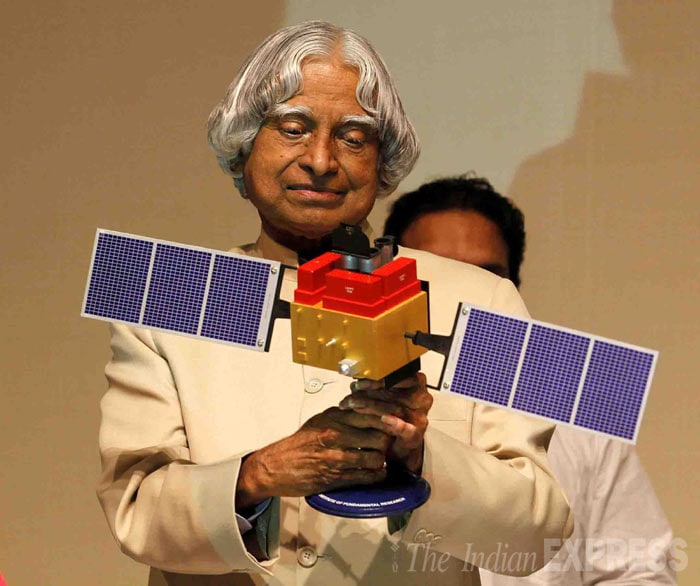
Rare Photographs of Dr. Abdul Kalam ….From The Archives of Indian Express…

abdul kalam, abdul kalam rare photos, abdul kalam photos, photos abdul kalam, apj abdul kalam, apj abdul kalam photos, photos abdul kalam, abdul kalam photo, photos kalam, kalam photos, latest photos, photos 27 July abdul kalam

The journey of A P J Abdul Kalam as a space scientist began in early 1960s at Thumba, a coastal village near here, which housed India’s first rocket launcher, Thumba Equatorial Rocket Launcher.

I K Gujral congratulating former President Dr. APJ Abdul Kalam after he was conferred with the Bharat Ratna at Rashtrapati Bhawan in New Delhi. (Source: Express photo by Virendra Singh) –


abdul kalam, abdul kalam rare photos, abdul kalam photos, photos abdul kalam, apj abdul kalam, apj abdul kalam photos, photos abdul kalam, abdul kalam photo, photos kalam, kalam photos, latest photos, photos 27 July abdul kalam

One of the little known facts about former President A P J Abdul Kalam is that he has a medical invention to his name — a coronary stent built with missile composites that dramatically brought down the cost of heart stents from Rs 55,000 to Rs 10,000 in the mid-1990s.

Former president Dr APJ Kalam deliver lecture on Homi Bhabha Birth Centenary Commemoration TIFR Foundation Day at Colaba. (Source: Express Photo by Ganesh Shirsekar) –


abdul kalam, abdul kalam rare photos, abdul kalam photos, photos abdul kalam, apj abdul kalam, apj abdul kalam photos, photos abdul kalam, abdul kalam photo, photos kalam, kalam photos, latest photos, photos 27 July abdul kalam

Dr. Abdul Kalam, who received several prestigious awards including Bharat Ratna, played a crucial role when India tested its nuclear weapons at Pokhran in 1998 when the Vajpayee government was in power.

Former prime minister Atal Bihari Vajpayee, George Fernandes, Pramod Mahajan, Bhairon singh Shekhawat and other senior sceintist and army officals at the site of 1998 Pokharan nuclear missile launch. (Source: Express photo by Ravi Batra) –

abdul kalam, abdul kalam rare photos, abdul kalam photos, photos abdul kalam, apj abdul kalam, apj abdul kalam photos, photos abdul kalam, abdul kalam photo, photos kalam, kalam photos, latest photos, photos 27 July abdul kalam

Dr. APJ Abdul Kalam felicitated 100-year-old body builder from Kolkata Manohar Aich during the celebration of Shanmukhananda Hall Diamond Jubilee. (Source: Express photo by Prashant Nadka) –

abdul kalam, abdul kalam rare photos, abdul kalam photos, photos abdul kalam, apj abdul kalam, apj abdul kalam photos, photos abdul kalam, abdul kalam photo, photos kalam, kalam photos, latest photos, photos 27 July abdul kalam

“At Rashtrapati Bhawan I found a letter from our first President, Rajendra Prasad to Nobel laureate Sir C V Raman in 1954 asking him to come to Rashtrapati Bhawan to accept the Bharat Ratna. Anyone would have jumped at the offer. Then I read Sir CV Raman’s reply to the invitation. It said, “Dear Mr President, I thank you for giving me such a great honour, but I have a problem. I am guiding a scholar and he is submitting his thesis in December-January. I have to sign the thesis and won’t be able to accept the invitation, ” Dr. Kalam said at Idea Exchange. (Source: Express archive) –

abdul kalam, abdul kalam rare photos, abdul kalam photos, photos abdul kalam, apj abdul kalam, apj abdul kalam photos, photos abdul kalam, abdul kalam photo, photos kalam, kalam photos, latest photos, photos 27 July abdul kalam

Dr. APJ Abdul Kalam being sworn-in as the 11th President of India by the then Chief Justice of India B N Kirpal at the central hall of Parliament in New Delhi. (Source: PTI file photo) –


abdul kalam, abdul kalam rare photos, abdul kalam photos, photos abdul kalam, apj abdul kalam, apj abdul kalam photos, photos abdul kalam, abdul kalam photo, photos kalam, kalam photos, latest photos, photos 27 July abdul kalam

Former President A P J Abdul Kalam intervenes in the debate after presenting the second Ramnath Goenka Excellence in Journalism awards on Monday night. On stage (from left): moderators Rajdeep Sardesai of CNN-IBN and Barkha Dutt of NDTV; panelists Shobhana Bhartia of The Hindustan Times, N Ram of The Hindu, Ravi Dhariwal of Bennett, Coleman (publishers of The Times of India), Pankaj Pachauri of NDTV India and Shekhar Gupta of The Indian Express. (Source: Express archive) –

abdul kalam, abdul kalam rare photos, abdul kalam photos, photos abdul kalam, apj abdul kalam, apj abdul kalam photos, photos abdul kalam, abdul kalam photo, photos kalam, kalam photos, latest photos, photos 27 July abdul kalam

During the Ramnath Goenka Awards, Dr. Kalam had broken protocol and sat on the dais to interact with the journalists present at the ceremony. (Source: Express archive) –

abdul kalam, abdul kalam rare photos, abdul kalam photos, photos abdul kalam, apj abdul kalam, apj abdul kalam photos, photos abdul kalam, abdul kalam photo, photos kalam, kalam photos, latest photos, photos 27 July abdul kalam

Dr. APJ Abdul Kalam in Sukhoi-30 MKI. (Source: Express photo by Ravindra Joshi)

APJ Abdul Kalam's rare photos from Indian Express archive

Dr. Abdul Kalam at his residence at 10 Rajaji Marg in New Delhi. (Source: Express photo by Oinam Anand) –

See more at: http://indianexpress.com/photos/photo-archives/apj-abdul-kalams-rare-photos-from-indian-express-archive/15/#sthash.0VnQg57H.dpuf


Source….www.indianexpress.com

Natarajan

” When a Problem Arises , Become the Captain of the Problem and Defeat it…” Dr. A P J Abdul Kalam

From the Archives of Rediff.com …. This   Article dates back to 6 NOV 2014….

Once, during his Presidency, President A P J Abdul Kalam received a letter from a student shocked with his class 12th mark-sheet.

He had secured 10 per cent in Maths and Physics, whereas throughout his school career, he had always scored 90 per cent and above.

In utter dismay, he wrote to the President of India, asking for his help.

President Kalam referred his case to the authorities and two weeks later got a reply that indeed there was a mistake in the evaluation and a rectification had been done.

APJ Abdul Kalam

In the last 15 years, President Kalam — arguably India’s most popular President and among the founders of the country’s space programme — has interacted with 18 million young Indians, face-to-face, through e-mail and over Facebook.

He receives 300 e-mails everyday.

Some of these letters have been turned into his latest book Forge Your Future, which provides an insight into the issues which concern and engage the minds of young Indians today. President Kalam’s replies are based on his personal experiences, his reading and his interactions with political and spiritual leaders.

The title of the book was selected after an online public vote.

In his quiet bungalow in Lutyens’ Delhi, President Kalam speaks to Archana Masih/Rediff.com about India becoming a developed country by 2020-2022, the heroes he admires, how 90 per cent of India’s space programme is intended for the people and the individual’s potential to become unique.

Photographs: Rajesh Karkera/Rediff.com

Dr Kalam, please can you tell me a little about your daily schedule? What’s it like 

The garden here has a 107-year old tree. Edwin Lutyens himself built and stayed in this house — so he maybe somewhere here (laughs).

His relatives had come to see this building.

The 107-year-old tree is beautiful. Parrots and various other birds live at the top and at the bottom live peacocks. Every year there are baby peacocks. I have a very bioactive tree.

I walk for 1 hour and 15 minutes every day. I spend time in my library.

In a month, I spend 15 days travelling in India. For ten days in a year, I go abroad. I am an honorary professor at the University of Beijing.

Every month, I meet a minimum of 100,000 young people. A million people in a year. So far I have met 18 million young people below the age of 25 in my country.

You get 300 e-mails everyday and spend two hours answering them. When did this process begin? When did you start actively engaging with young people?

It all started when I wrote Wings of Fire, in which I conveyed my life, how I had lived it, how I got myself educated, how I started meeting youth…

I was also teaching at Anna University at that time. After my work as scientific advisor, then projector director SLV 3, programme director AGNI — after all that I went in 2001 to Anna University as a professor.

I also get some handwritten letters. I consider them very important and I love to reply to them because they come from people from the grassroots who do not have access to the Internet. They come with unique questions and I have to give unique answers.

APJ Abdul Kalam

You mention what President Mandela told you about courage in your book — who are some of the most inspiring world leaders you have met?

Two world leaders exclusively come to my mind — Mahatma Gandhi and his unique life. Similarly, Nelson Mandela. I went to the prison where Mandela lived.

Where there is righteousness in the heart, there is beauty in the character. That’s the example of Mahatma Gandhi throughout his life.

In 2006, I travelled in the same kind of train with a steam engine from Durban to Pietermaritzburg. I could imagine the courage which Gandhiji showed in that cold winter.

Ahimsa dharma came after the battle of Kalinga. It transformed King Ashoka. The second time ahimsa dharma was put into action was by Mahatma Gandhi at Pietermaritzburg.

This book gives three messages. First: You can become a unique personality. Mahatma Gandhi and Nelson Mandela were unique.

The other important thing about this book is about continuously acquiring knowledge. Thirdly, when the problem arises — become the captain of the problem and defeat it.

You envisioned a growth plan for India called Vision 2020. How close are we to achieving that vision, in view of that deadline being six years away?

Actually India 2020 is a vision for an economically developed India by 2020. Up to 2008 our GDP was 8 to 9 per cent. Then there was a problem across the Atlantic Ocean, and our GDP crashed to 6 to 7 per cent, then to 5.5 and then to 5 per cent.

So in the 2008-2014 period, we had a slack in our development programme.

Six years is a long period in a nation like India with 600 million youth, nowhere in the democratic world there exists this strength.

We also have a natural way of life. Our agriculture is doing well. We have 250 to 260 million tons of food. Our IT, small scale and pharma industries are doing very well.

Of course, we have to do lots in the development of the rural area. We have 600,000 villages where 700 million people live. We have to Provide Urban Amenities to Rural Areas (PURA). Seven thousand PURAS are needed to lift 600,000 villages.

Even now it is not too late. Fortunately, I understand the present government is taking a priority for PURAS. If they push it along with small scale industry and smart waterways, then definitely 2020 — plus or minus 2 years — we can get there.

So you are confident by 2022, that we may be able to do it?

We can do it, provided we have a national vision.

Do we have that national vision?

From 1930 to 1947, we wanted Freedom. Our caste system vanished, our religions vanished, our differences vanished and we were fighting only for Independence. I call that the first mission that India had.

The second vision: Economic development. If you work like that and declare that mission in Parliament and people and government work for it, irrespective of whichever party they belong to, it is possible. Because our resources are youth power and our natural resources.

The Book Cover

Image: President Kalam’s latest book Forge Your Future

In your book, you say ‘The orientation must turn from the past to the future and focus on how India can become a developed nation. The real issue is that we are not to see ourselves as a nation and because of that there is no national vision.’

Why do you think we have not been able to see ourselves as a nation?

When we see the types of conflicts all around — religious conflict, caste system, language problems — any big nation will have such types of problems but the nation can be united for a big cause.

Independence was a big cause that united us. That’s why I am pushing this idea that the tool for India Vision 2020 is Providing Urban Amenities to Rural Areas. This way we can enhance village development. I have talked about all this in my book.

Independence was a common goal that united people, but some would say that India today is more divided than what it was then.

Any nation goes through a number of problems in various decades, but India has the experience of bringing together people on a big cause.

I am a believer.

The second great movement that India needs is India 2020 Vision and this will make people come together. Plus if the economic programme grows, the poverty level will come down.

Only a national vision can lift 300 million — that’s one third of the population — below the poverty line out of poverty.

As one of the co-founders of India’s space programme, you must be very proud of our Mars achievement. But at the same time when you say that we have to lift the large masses that remain poor, should not basic needs like healthcare, education, infrastructure precede loftier goals or at least go hand in hand?

The space programme is targeted at uplifting the people. In geosynchronised orbit, more than 200 transponders are communicating to the Indian earth station.

These transponders transmit communication, weather reports, 24 hour TV broadcast, the path of cyclones.

All the recent major cyclones have been forecast by various satellites. 90 per cent of the space programme is for remote sensing and communication. You can remote sense what is the kind of wealth we have on earth like water, minerals etc — so it is intended for the people. 90 per cent of the space programme is intended for the people. It is a people’s programme.

You asked about the Moon and Mars programme. We are spending less than 10 per cent of our space programme for finding and research on Moon and Mars so that we are partners in the research and no one can claim that it belongs to them. I don’t want to see Moon and Mars as the property of some other nation. It should be international property.

Ours is the lowest cost of going to the Moon or Mars and we found trace of water also on the moon. From Mars we don’t know… some revolutionary ideas will come from our Mars programme.

What kind of a leader was Vikram Sarabhai, the founder of India’s Space programme?

When you read this book Forge Your Future, you will know how to become a unique person. It contains the experience of great thinkers and doers. Dr Vikram Sarabhai was a unique personality.

He was a visionary. In 1970 he gave a report about what the nation’s space programme should be for the next 20 years.

What according to you are India’s greatest strengths?

One is our farmer community. Whatever weather condition, whatever shortfall — they will give us 200 million tones of food.

Hats off to our farmers and our agriculture scientists!

Second is youth power. No other democratic nation has 600 million youth. The ignited mind of the youth is the most powerful resource — on the earth, above the earth, under the earth — and we have that.

Third, just like every family asks the government for an economically developed nation; every family has the responsibility to give a great citizen to the nation.

We have 200 million families. Parents have the responsibility to make their children righteous — where there is righteousness in the heart, there is beauty in the character.

Only three people can give a good citizen before s/he turns 17. Father, mother, the spiritual environment and the primary school teacher.

You mention women like Marie Curie and Sister Antonia as role models. Who are some contemporary Indian women role models you admire?

I have great respect for Dr V Shanta, for her contribution towards cancer diagnosis, treatment and teaching how to avoid cancer. I admire the mission of Ela Bhatt, founder of the Self-Employed Women’s Association of India and, of course my favourite, whom I respect because I like Carnatic music — M S Subbulakshmi. I love her music.

When she was alive, I used to go to her music festival.

President A P J Abdul Kalam

You say in the book that India needs to cast off its inferiority complex vis-a-vis China and work towards coming together to become a master civilisation because together they constitute 37% of the world’s population.

How can this be achieved in the background of the tension, hostility and border incursions?

I remember in April 2007, I addressed the European Parliament. There were around 800 parliament members from 23 nations.

I told them when I see you all — for hundreds of years you were fighting each other and you generated two World Wars, so a billion Indian people congratulate you. Forgetting all your wars, forgetting the difference of society, you formed a European Union for prosperity and peace.

This should be an example. I had composed a poem and recited it there. They gave a standing ovation.

That is not the issue, the issue is that such nations that created World War I and II, when they came together, we — China and India — are a people of great civilisation, in spite of all the differences, there are some great philosophy that is common.

Buddha and Confucius are common to us.

I believe we have to have a great mission. I suggested when the Chinese president came here that we have a World Knowledge Platform. I teach at the University of Beijing, I told them the time has come that both nations should combine our core competence, our 60 billion dollar business, should become 250 billion dollars.

The border issue we should sort out once for all. People of the European Union fought for hundreds of years, a people who generated two World Wars and Hitler and lost millions of people are a union today for economic growth and peace and it happened in front of our eyes.

So for me the differences between nations can be solved by mutual discussions.

Both sides should decide what we can give and what we cannot. It should be an intensive one month discussion with experts and we should sort it out. I hope the present governments in India and China will do that.

What are your thoughts on the present government?

We are getting into politics, next question!

I just asked your thoughts…

Any elected government will perform in five years. We have to give time.

You believe social media affected the results in 30 to 40 per cent Lok Sabha constituencies. How will social media and the Internet affect future elections?

Social media and the type of information flow should have credibility. It reaches fast. It connects people. It is one of the important mediums for putting forth ideas, thoughts and discussing problems.

In India, we also need contact on the ground, but in the future I see that you can sit in your home with a biometric signature and security approved and you can vote. That way you will have 100 per cent voting. It is a long way off, but I visualise it.

Selection of the candidates will also follow an electronic process — to determine if s/he is a good or bad candidate, how many cases s/he has etc. This will happen, it is only a question of time.

Archana Masih/Rediff.com in New Delhi 

Source….From The Archives of  www.rediff.com

Natarajan

Pictures of the Day….

richard macneil art

Mother and Daughter

richard macneil art

Boy holding Pup

The Sublime Art of Richard MacNeil

Richard MacNeil is a self-taught English artist whose work I have thoroughly enjoyed following.  He paints diverse contemporary scenes with oil paint, joy and lightness of heart.  His subjects include city scenes, couples, romance, shopping, outdoor scenes, weddings, flowers, children and Christmas.  His vibrant work has a beauty that can lift any spirit.

Source….www.ba-bamail.com

Natarajan

Message for the Day…” Dedicate Your Body To the Divine…”

Sathya Sai Baba

Turn the love that arises in you towards God. Dedicate your body to the Divine. This is the true mark of devotion. There are three constituents in every human being: the mind, the power of speech and the body. These three are called Trikaranas – the three active agents. It is when all three are used for sacred purposes, your life is sanctified. All need devotion. Every person must cultivate this spirit, irrespective of one’s beliefs. It is only spirituality that can purify the heart and mind of human beings. The second requirement is morality. Morality helps to purify speech (Vaak).The third is called Dharmikam. All righteous deeds done by the body or hands sanctify you. It is through spirituality, morality and righteousness that the three instruments get purified. Only the one who has achieved this triple purity can realise the Divine. If any of these instruments are impure, you will not be able to realise the Divine.

Most Beautiful Front Doors Around the World….!!!

Generally doors are sadly boring, but they don’t need to be; they might as well work as thoughtful designs of gateways between worlds or between diverse elements of our existences.

The front door is normally the sole component of a building’s outer part that everyone will interact most regularly with, so if you wish a building to look awesome, there’s likely no nicer way to do it than by designing a gorgeous door.

1. Toronto, Ontario, Canada

most-beautiful-doors-in-the-world-5

Source: mandalaybus

2. Garden Door

most-beautiful-doors-in-the-world-2

Source: wallpapersinhq.com

3. Santa Fe, New Mexico, USA

cool-door-designs-5

Source: Ken Piorkowski

4. Northumberland, UK

colorful-doors-4

Source: Maree Turner

colorful-doors-2

Source: Rig

6. Funchal, Madeira, Portugal


beautiful-door-designs-5

Source: Natalie AE

7. Fes, Morocco

beautiful-door-designs-4

Source: David K. Edwards

8. Valparaiso, Chile

amazing-doors-5

Source: Byron Ellis

9. Pollença, Balearic Islands, Spain


amazing-doors-2

Source: silverlarynx

10. Shanghai, China

amazing-doors-1

Source: Sean Maynard

11. Sardinia, Italy

amazing-doors-4

Source: Pia – Artemisia1975

12. Garden Door by Kazuyuki Ishihara in Japan

amazing-doors-3

Source: Anya Langmead

13. Burano, Italy

beautiful-door-designs-1

Source: John C. Hutchins

14. German Alps

beautiful-door-designs-3

ource: Dominic Walter

15. Chefchaouen, Morocco

beautiful-door-designs-2

Source: Olga Osipova

16. Funchal, Madeira, Portugal

colorful-doors-1

Source: Ahrabella Heabe Lewis

17. Germagno, Piedmont, Italy

colorful-doors-3

Source: Wozz

18. Jaipur, India

colorful-doors-5

Source: payal.jhaveri

19. Valloria, Italy

cool-door-designs-1

Source: socket974

20. Soho, New York, New York, USA

most-beautiful-doors-in-the-world-4

Source: Gary Burke

21. Sintra, Lisbon, Portugal

most-beautiful-doors-in-the-world-3

Source: Amaury Henderick

22. Miami, Florida, USA

most-beautiful-doors-in-the-world-1

Source: jaydkim 

23. Bali, Indonesia

cool-door-designs-4

Source: Corinna A. Carlson

24. Montmartre, Paris, France

cool-door-designs-3

Source: John Kroll

25. Copenhagen, Denmark

cool-door-designs-2

Source: Ingeborg van Leeuwen

Source…www.top13.net

Natarajan


World’s Best Home Garden ….?

Is this Britain’s most immaculate garden? Pensioner spends 30 HOURS A WEEK tending his lawn which is cut to exactly 5mm

  • ‘It’s my pride and joy’ reveals self-confessed ‘gardening geek’ Stuart Grindle
  • Lush lawn is cut twice-a-day three times a week says the green-fingered gardener
  • The award-winning 70-year-old has spent 30 years crafting the former veggie patch into a floral paradise
  • Gardening widow Anne says she is allowed to step on the hallowed turf but son was told ‘no ball games allowed’
  • Mr Grindle claims his garden is a full time job getting him up at the crack of dawn

Do you want a lawn like this? Well, it’s easy – in theory. You just need to spend 30 hours a week gardening and do it for 30 years!

That’s how long 70-year-old Stuart Grindle has spent turning a former vegetable plot into the picture of perfection it is today.

Mr Grindle mows his lawn six times a week and keeps the grass cut to an impressive 5mm. He was so determined to protect his precious grass that he even banned his son Jonathan from playing football on it when he was a boy.

Anne and Stuart Grindle stand on the hallowed turf, proudly showing off their immaculate garden at their home in Rotherham, Yorkshire

Anne and Stuart Grindle stand on the hallowed turf, proudly showing off their immaculate garden at their home in Rotherham, Yorkshire

Stunning blooms, neat borders and vibrant shrubs dot the stunning green lawn

Stunning blooms, neat borders and vibrant shrubs dot the stunning green lawn

Mr Grindle is a former winner of the Doncaster In Bloom Best Garden competition

Mr Grindle is a former winner of the Doncaster In Bloom Best Garden competition

Dedicated Stuart, who is a retired joiner and lives with his wife Anne, 69, said: ‘It is my pride and joy, most people probably only get out the lawnmower once a week but I cut my lawn twice-a-day, three days a week.

‘People think it’s astroturf because it’s cut to 5mm long and in such good condition. That’s down to watering it and cutting it often.

‘I suppose I am a bit of a golf and gardening geek. Anne is a bit of a golf and gardening widow.’
The 70-year-old has spent 30 hours a week for the last 30 years tending his magnificent blooms and bushes

The 70-year-old has spent 30 hours a week for the last 30 years tending his magnificent blooms and bushes

The self-confessed 'gardening geek' mows his lush green lawn SIX times a week to exactly 5 mm

The self-confessed ‘gardening geek’ mows his lush green lawn SIX times a week to exactly 5 mm

In an effort to encourage her husband from his haven, Mrs Grindle rings a bell to grab his attention.

Mr Grindle added: ‘She has a little bell she rings when she wants me to come in from the garden.

‘It’s not unknown for me to go out at 9am or even earlier. When I entered competitions and when I was preparing for the open garden day I was out there at 7am.

‘I’ve managed to play golf twice in the past week but you know there’s still work to be done when you get home – thankfully it’s light until nine o’clock at the moment.’

Anne Grindle has to catch her husband's attention by ringing a bell to summon him away from his haven

Anne Grindle has to catch her husband’s attention by ringing a bell to summon him away from his haven

Mr Grindle transformed the former vegetable plot into a floral paradise and threw open his garden gates to raise money for charity

Mr Grindle transformed the former vegetable plot into a floral paradise and threw open his garden gates to raise money for charity

Mr Grindle added: ‘I have spent 30 years getting it to this state and I can put in 30 hours a week. It’s a full-time job.’

Wife Anne confirmed that she was allowed to walk on the hallowed turf, but said Stuart had banned his son Jonathan from playing football there when he was a boy.

She said: ‘There were no ball games allowed, Stuart always said there was a cricket field and a football field up the road he could use instead.’

Stuart, a former winner of the Doncaster In Bloom Best Garden competition, said aside from the lawn, his large-leaved hostas were his most prized feature, because of the wonderful colours of the leaves.

Source….www.dailymail.co.uk

Natarajan

Sir Donald Bradman: Living in the shadow of The Don’s fame….

The effect of Sir Donald Bradman’s fame has filtered down through the family tree. Now, for the first time, members of the notoriously private family have spoken about how the spotlight has influenced their lives.

Throughout the world’s greatest Test batsman’s life, he shunned most media requests and denounced the hero-worshipping which came with his fame.

“Some people are fascinated by fame and it just draws people to be part of it, and there’s absolutely nobody who ever lived who could enjoy that process less than my dad,” his son John said.

This distaste for the public gaze is a characteristic that has trickled through subsequent generations.

John Bradman was deeply affected by the relentless attention paid to him as son of ‘The Don’.

“When people would come up to him as a child quite often the first question would be, ‘and are you going to be a sportsman like your dad when you grow up?’,” John’s daughter Greta Bradman said.

John decided the best way to cope with the associated fame was to change his name.

“[It wasn’t] to pretend I was somebody other than who I was but simply to say ‘people, please give me a break’,” John told Australian Story.

In his early 30s John Bradman became John Bradsen, a pun on the ‘son of Bradman’ with a nod to Norway, where he had spent some time as a young man.

“John felt he was not his own person, that people saw him as Don Bradman’s son, and it was crushing him,” John’s former wife and Greta’s mother Judith Bradsen said.

According to Ms Bradsen, it worked.

“People did not know. I did not ever, ever get a Bradman question all through the time I was teaching as Bradsen,” she said.

Even though he raised the possibility of a name change with his father when he was 18, John said it was a tough decision to make, as he knew Sir Donald would find it difficult.

“My father wrote some letters to a friend in which he expressed his anguish over my changing my name which reflected the fact that it must have been difficult for him,” he said.

Next generation steps into the limelight

Greta Bradman, The Don’s granddaughter and John’s daughter, is now a soprano singer and on the cusp of international stardom herself.

Greta told Australian Story her grandfather’s great love of classical music helped shape her interests as a child.

“My Grandpa was hugely into music. He composed music,” Greta said.

“He also had a very large record collection and he was really interested in certain soprano and certain conductors.

“He and I would sit and listen to his record collection and talk about it.”

In the past year Greta has been fostered by conductor Richard Bonynge.

“She should be singing in Covent Garden because I’ve heard many singers there who are not as good as she is,” Bonynge told Australian Story.

“She’s a one off as far as I’m concerned. She’s very special.”

But it is a path Greta has been reluctant to travel because of the shadow fame has cast over her family.

Bradman childhood and Sir Donald as a grandparent

Greta and her brother Tom Bradman’s childhood was a happy one.

They enjoyed a close relationship with their grandparents, going to their house every day after school and having dinner with them once a week.

“My grandparents were amazing after school carers,” said Tom Bradman.

Lady Jessie Bradman played a pivotal role in their upbringing.

She would bring crayfish for lunch every Saturday and play endless games with the children.

“My grandma had this long, long grey hair that she’d have usually tied up in buns and we’d play witches, she’d let her hair right down,” Tom said.

But even as a child Greta could see the toll fame took on her grandfather.

“Grandpa wouldn’t come to school concerts and things like that because he really just wasn’t comfortable with people staring at him,” she said.

“He didn’t want anything to be different for me.”

According to Greta, Lady Jessie helped him through many public appearances.

“She was so good at conversing with people and keeping the conversations sort of light and keeping grandpa feeling really comfortable because he, socially, I don’t think was quite as fluid in his conversation as she was.”

Full circle name change

As Tom and Greta grew older, Sir Don’s health was failing and John Bradman and his new partner Megan were about to give birth to their son Nicholas

It was then John began to think seriously about the possibility of changing his name back to Bradman.

Tom said for years they had enjoyed “the gift of anonymity” but that it was time to change back.

“When I told him [we were changing our name back to Bradman] he just smiled and said — you know, don’t do it for me,” John said.

“The period of its effectiveness had somehow come to a close,” Tom said.

“We were ready to assume our family name.”

“My grandpa was truly tickled pink,” Greta said.

Don Bradman being asked for an autograph

Don Bradman being asked for an autograph by nine-year-old Rick Scheeren in 1963.

source…..

By Belinda Hawkins and Wendy Page

http://www.abc.net.au

Natarajan