Message for the Day….” What is ‘dharma’ ?” ….

Sathya Sai Baba

What is meant by Dharma? What is its essence? Can common people lead a happy life and survive if they stick to Dharma? These doubts confuse people’s minds in the course of their natural livelihood. Solving them is necessary, even urgent. As soon as the word Dharma is mentioned, people relate it to giving of alms, providing food and shelter to pilgrims, adherence to one’s traditional profession or craft, law-abiding nature, the discrimination between right and wrong, the pursuit of one’s innate nature over the freaks of one’s own mind, the fruition of one’s fondest desires, etc. Of course, it is a long, long time since the spotless countenance of Dharma has been tarnished beyond recognition. Now, who can cure the present blindness? All of you! All you need to do is to slay the six-fold beast of inner enemies, leading you on to disaster through the pulls of lust, anger, greed, delusion, pride and hate. Only then Dharma can be restored.

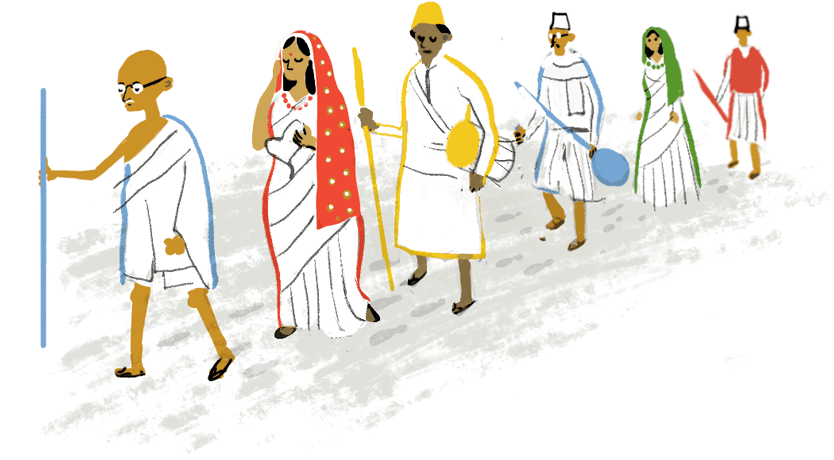
Google Doodle Celebrates India’s Independence Day…

Illustration on Google India shows Gandhi leading the Dandi March of 1930

In honor of the 69th Anniversary of India’s Independence on Aug. 15,Google India’s Doodle features Mahatma Gandhi leading the Dandi March of 1930.

India Independence Day 2015

The scene depicts a significant moment in India’s push for freedom from the rule of the British Raj and the beginning of the Civil Disobedience Movement. Seventy-eight Congress volunteers participated in the 240-mile march in protest of unfair salt laws.

Leon Hong illustrated the Doodle for Google users in India as they celebrate the Indian Independence Act of 1947 on Saturday.


Source…Julia Zorthian   http://www.times.com

Natarajan

” When You Smile to the World, The World Smiles Back…” !!!

We all laugh, and because of so many different things – some of us like subtle humor, others prefer crude jokes, visual humor, mishaps and other types of humor. Laughter is not just a human thing, some primates also laugh (and probably at our expense). Babies laugh an average 300-400 times a day and adults laugh about 15-20 times a day. Laughing has been proven to be beneficial to our health, both physical and mental, but is it also contagious? Watch what happens when this man starts laughing for no reason at all! Try not to laugh as well…

When you smile to the world, the world smiles back’
Laughing Buddha

“Piece of Advice and Tips for a Better Life From a Grandma ….”Choose Happiness , Not Wealth…

1. Accept things with love and understanding

No matter where you are, or what you’re doing, always believe that there’s a light at the end of the tunnel. Never expect, assume, or demand. Do the best you can to control your circumstances, and learn to accept that you can’t always control everything. Once you’ve done all that is in your power, if it’s meant to happen – it will.

2. Life CAN be simple

Even though you often feel like life is too complicated, it can always be simple. All you need to do is focus on one thing at a time. You don’t have to do it all, and you don’t have to do it right now. Be present, be active, do the best that you can. Whatever you put into life – life will hand you back, with interest.

3. Don’t change for other people

Make people accept you the way you are, or don’t accept you at all. Always say what you really think, even if it’s not the popular opinion. When you’re true to yourself, you add beauty to the world – beauty that was missing. You should stay in line, just make sure it’s YOUR line.

4. You’re not who you were – and that’s okay

You’ve been through a lot in life. You’ve studied, been hurt, and changed. Every day we learn something new which changes us in some way or another. Sometimes we realize we’re not who we used to be, but that’s perfectly normal. Everybody changes. In your life, people will point out the changes, and all you need to do is tell them “Of course I’ve changed, and so have you. Everybody changes.”

5. Everything that happens is for the best

Be it significant or otherwise, joyous or sad, anything that happens will end up being in your favor. Everything that happens to us builds us and helps us grow. Life will take you places, show you things, heal you and make you into a better person. Don’t be afraid to try or even to fail, in the end, everything is just a small part of life’s larger plan to turn you into whom you’re supposed to be.

6. Choose happiness, not wealth

Many people live their lives believing that money will make them happy, but the pursuit of wealth is devoid of meaning. Every choice you make, be sure to consider your happiness, not your bank account. In this way, when you’ve reached old age, you’ll know the true value of things, not their monetary value. In the end, you’ll understand that the best things in life are things that money can’t buy – love and friendship.

7. Decide to be positive

One of the most important things you should understand about life is that if you’re not happy, it is not the circumstances that are to blame, but your decision to be unhappy. Every time life places obstacles in your path, give life a big grin, accept the obstacle’s existence and overcome it with joy. Make the decision to be happy, stand by your decisions and do whatever is in your power to keep them. This is the true secret to happiness.

8. Give the people you love your full attention

We can get used to being surrounded by loved ones and start taking them for granted. When you ask someone close to you how they are, don’t accept an “okay”, look into their eyes and ask them about their day, and how they feel. If you feel that you only have friends that remember you when they need something, don’t worry, be happy that you’re a source of light and hope for them.

9. Learn to set a loved one free

At times, we need to set a loved one free to allow them to grow and evolve. Every little sprout must leave the greenhouse and be planted in a larger pot to grow to its full size and bloom. It is not what you do for your loved ones that will help them grow, but rather what you taught them and how they use that knowledge.

10. Sometimes, you need to leave people behind

Sadly, not all our friends help us become better people. In some cases, friends can keep us stunted, not out of malice, but because they want to keep you down at their level. Learn to tell when this happens and stick only to friends that help you grow, lift you up, and inspire you to be who you really are.

11. Some things you only understand when you’re older

In the end, people will judge you according to your actions, that’s why instead of trying to impress and please everyone, follow your heart and do what you want to do, without fear. Remember that it’s better to remember something and say “I can’t believe I did it!” rather than “I wish I did it…”

12. Stop looking for a happy ending

We humans tend to search for some happy ending in whatever happens to us. We want a sense of closure and completion, but sometimes it’s simply not how life is. If you feel like you’ve been searching for that happy ending for too long, you may need to, instead, search for a new beginning. Never be afraid to leave everything and start anew, you still have time, no matter what your age may be. Aspire to make the most out of whatever time you have on this planet.

Source….www.ba-bamail.com

Natarajan

Message for the Day…” Good Moral Character is the Basic Foundation for one’s Life …”

Sathya Sai Baba

The happiness that one derives from virtues is far superior to the happiness that we get from the possession of wealth. Unfortunately the educated youth are striving for wealth, physical strength and friendship. But all these have little value without the wealth of character. For men or women, character is the foundation. If one lacks character, one becomes feeble in all other respects. People of those days strove for noble character. They were prepared to give up their very lives for a righteous cause. Women strived to uphold the honor of their husbands. The strength of an individual lies in one’s character, not in the wealth one earns. One should be prepared to face any hardship to lead a virtuous life. The country is in dire straits due to the absence of men and women of character. Materialistic wealth is not what we need today. We need to earn the wealth of virtues.

” My Dream is to Fly the 747 Oneday…” Says Capt. Indu Nair…

In our Special Independence Day series, Rediff.com looks at India through the lives of her people.

Today: Captain Indu Nair, who joined a private airline after her tenure as a pilot in the Indian Air Force ended five years ago. From the second batch of women pilots in the IAF, she flew during the Kargil conflict.

As a commercial airline pilot, one of her best experiences, she says, is taking off with an all woman crew!

Captain Indu Nair

The complete coverage

It is no longer unusual for passengers to have a lady pilot fly them to their destinations. I have been a pilot for 20 years and it has been a lovely journey. My dream, however, is to fly the Boeing 747!

India has many women pilots now. There are days when both the pilots in the cockpit and the cabin crew — are all women. It is a superb feeling to have an all women crew.

I served the Indian Air Force as a pilot for 15 years and became a commercial pilot when my career ended since I was on a short service commission.

There was a time in school I wanted to be an air hostess, but my sister superior counseled me against it. I then started looking at the civil services but was always fascinated by the uniform and that’s how I joined the IAF.

I was among the earliest batch of women officers. A male bastion till then, I think it took longer for the male officers to adapt to us that us to them.

At the time of the Kargil conflict, two of us women officers were called by our senior officer and told that while the male officers would fly for the Kargil operation, the two of us would be assigned ground duties.

We came out of his office and went back in again to tell him that we are trained pilots like the men and we can do the same. We were told that it would be hard, we would have to sleep in the airplane, use common toilets as the men and be in difficult terrain. We told him we were ready and we were giving flying duties during the Kargil conflict.

We flew in ammunition and supplies; on the way back we carried the bodies of our martyred soldiers.

Ferrying the bodies of young men who had died defending our country was one of the toughest things I have done.

It was tragic. It left me numb.

Captain Indu Nair

Indu Nair was from the second batch of lady pilots to join the Indian Air Force. Photograph: Kind courtesy, Indu Nair.

When I was in the Indian Air Force, I flew the AN-32 — a rugged but forgiving Russian aircraft. You needed physical strength to operate the AN-32.

I now fly the ATR, a delicate machine.

Before a take-off, I take a walk about of the airplane and do the external checks. I often pat my aircraft and in my mind tell her to take us to our destination safely.

Safety is of paramount importance. As captain of the aircraft, I am responsible for the safety of the passengers and the aircraft.

I have seen sunrise and sunset, up in the sky, from the windows of my cockpit. I was telling my copilot just the other day how privileged we are to see nature in all its glory.

We have also seen how fickle nature can be, and how bad weather disrupts flying schedules. In all these years of flying, I have realised that a pilot has to respect the weather and follow the flying manual to a T.

I remember once on a flight, passengers got into an argument with the cabin crew when the flight was diverted because of poor visibility. They kept saying that if they can see the air strip from the window, why couldn’t the pilot!

When we landed at the airport we were diverted to, the first officer and me as the captain, had to explain to the irate passengers that if the air traffic control tells us that we cannot land, we just cannot!

Captain Indu Nair

An AN-32, the Russian-made aircraft she flew in the IAF. Photograph: Kind courtesy, Indu Nair.

My usual schedule is 6 days of flying, followed by two days of rest.

I have to report at the dispatch room at the airport before the flight. We get written regulations; a medical and breath analyser test is done.

In the cockpit, I am in charge as the captain. The first officer and me discuss the flight, make the necessary announcements and steer the aircraft to the destination.

After a flight, we complete the necessary paperwork, go back to the dispatch room and then leave for home.

What I sometimes miss is having a regular 9 to 5 schedule, but such is the nature of my profession that this is not possible.

Captain Indu Nair

IMAGE: Her last sortie as a wing commander in the IAF. Photograph: Kind courtesy Indu Nair.

My children are used to seeing mummy as a pilot and my older child is showing some interest in following in my footsteps. Once I am home, I cook, spend time with the family and get early to bed. On my days off, I catch up on household affairs — I like going and buying vegetables.

My husband laughs that I am better in the cockpit than in the driving seat of a car — but driving on city roads is no longer a pleasant experience.

The thing that I don’t enjoy too much about being away as a pilot is eating hotel food over days. How much airline and hotel food can you eat, after all!

So often, passengers on my regular routes have told me that once they hear I am in the cockpit, they know it would be smooth landing.

Women pilots are not an unusual sight and people, especially, girls look at us with pride.

More and more women every year are taking the commerical pilot’s license. And over the year, women have proved to be efficient pilots. It is there for everyone to see.

Out of 5,100 pilots in India, 600 are women, according to the ministry of civil aviation.

A pilot with Jet Airways for the last five years, Captain Indu Nair will join another domestic airline next week. She lives in Mumbai with her husband, a former Indian Air Force officer, and two daughters.

She spoke to Archana Masih/Rediff.com

Source….www.rediff.com

natarajan

The quiet, nerdy schoolboy who went all the way….Read What SundarPichai’s Grandmother says about him ….

Sundar Pichai was inquisitive and eager to learn, says grandmother Ranganayaki

Kamikaze auto drivers on Chennai’s streets may make you fear for life and limb. But as a school-boy, auto rides to school did not faze the newly-anointed CEO of Google Sundar Pichai, who, a school-mate who shared the rides recalls, had his nose in his books all the way to school.

Quiet, nerdy and studious is how friends of Pichai remember him from his days at Jawahar Vidyalaya, a CBSE school in Ashok Nagar, Chennai. Pichai was so focused on studies and wanted to fare well in academics that most of his associates don’t remember him participating in sports or any other extra-curricular activities.

A classmate recalls, “Sundar was academically bright, though he wasn’t the first in class. He was always ranked third, behind two girls, who took the first two ranks. He wasn’t very participative and kept to himself.”

Cool guy

Another classmate, chary of having her name on record, recalls that he always had a smile on and never got upset over anything.

The school put all the brightest students and achievers in the 9th standard in section A, where Pichai too was placed. Though, of course, there was nothing to indicate that one day he would go on to head a major global corporation.

That he could be fiercely competitive was, however, evident as this classmate recalls: “When the mark-sheets were distributed in class, he would be the first one to rush to take them from the teacher and compare his marks with other toppers in the class.”

Pichai moved out of Jawahar Vidyalaya to join Vana Vani, a school inside the IIT-Madras campus to pursue his Plus Two under the Tamil Nadu State board syllabus.

Born in Madurai, Pichai grew up in Chennai, where his father worked for switchgear-maker English Electric Co Ltd. Pichai did not have very many friends but he was inquisitive and eager to learn, even at a young age, says Ranganayaki, Pichai’s grandmother, who is 92 years old and lives in the same modest house in a quiet lane in Ashok Nagar where Pichai grew up.

Street cricket

Ranganayaki, her memory still strong, recalls that Rajesh, as Pichai is called at home, hated wasting time and was diligent when it came to his studies.

“Both the brothers liked to play cricket in front of the house after school, though it was mostly just the two of them,” she says.

Another classmate, who is still in touch with him from his school days, says Pichai remains the same quiet person he always was.

“It’s difficult for us to imagine that he now heads Google,” she says.

(This article was published on August 11, 2015)
Source…..

    SWATHI MOORTHY and,
    Natarajan

Message for the Day…” Right Conduct is the only way to win the Grace of God…”

Sathya Sai Baba

You must dedicate yourself to right conduct (Dharma) and always be engaged in righteousness (Dharma). Then you will live in peace and the world will enjoy peace. No one can acquire real peace, nor can they win the grace of the Lord through any means other than right conduct. Dharma is the foundation for the welfare of humanity; it is the only unchanging truth across all times. When Dharma fails to transform human life, the world will be afflicted by agony and fear, tormented by stormy revolutions. When the effulgence of Dharma fails to illumine human relationships, people will be shrouded in sorrow. All religions and scriptures expound Dharma and proclaim aloud the Glory of Dharma. The stream of Dharmic activity should never run dry; when its cool waters cease to flow, disaster is certain. God is the embodiment of Dharma; His Grace is won by Dharma

” With Rs 20 lakh, he built a Rs 350-cr business”….Meet Md. Gyasuddin….

Md Gyasuddin

‘I found my motivation in the fast emerging mobile market.’

‘Nokia’s biggest mistake lay in its stubbornness to change.’

‘It’s important to understand the pulse of the people.’

“To succeed in life, you need to be a dreamer and need to follow that dream with passion, hard work and dedication,” said Md Gyasuddin,  managing director of Hitech Mobiles.

He observed this simple rule of life and today he is the owner of Rs 350-crore (Rs 3.5-billion) business.

Starting with a capital of Rs 20 lakh (Rs 2 million), it has been a long journey for him.

“At times, it seemed I was being unreasonable and foolish but never gave up,” he said.

After graduation, Gyasuddin started a small mobile import unit in Kolkata in 2002.

But he had a wider vision — that of creating a mobile brand of his own.

After tutoring himself on the intricate details of the trade, Gyasuddin set up his own company — Hitech Mobiles in 2008.

Over the years, the company grew steadily and is now selling almost 2 million mobile handsets a year.

It is ranked 8th among the Indian handset makers.

Recently, the company set up its assembling unit in at Merrill Logistics Park in Sankrail, Howrah.

In a candid conversation with Indrani Roy/Rediff.com, Gyasuddin talked about how he built his company, what plans he has for it, the new assembling unit among other things.

Hitech Mobiles

What led to the idea of launching a new brand?

From an early age, I was fascinated by mobile phones and always wanted to deal in them.

After graduation, there was tremendous pressure on me to start earning. I came from a lower-middle-class family and my father was a government employee.

There was a crunch of cash all the time. But I was unwilling to take up any ordinary job that came my way and wanted to start a business.

I wanted to import mobile handsets. As a student, I had saved some money and with that took a short trip to Hong Kong to understand the nuances of mobile handsets’ business.

On my return, I started an import unit in Kolkata in 2002. I used to import handsets made by Nokia, Samsung etc and would sell them in the local market.

What was your motivation?

I found my motivation in the fast-emerging mobile market.

Though I was only out of college I knew that the mobile market had huge opportunities and it would soon undergo a thorough transformation.

I thought if I ventured into this market now, I could build a secure future.

The road must have been tough for you. What difficulties did you face in setting up this business?

Most difficult part of my journey was accumulating funds for the business. I took loan from the bank and also from friends and relatives for starting the import unit.

With an initial capital of Rs 20 lakh (Rs 2 million), I started building the mobile import unit.

The next hurdle was manpower. It was extremely difficult to get skilled workers to run the import unit. Unable to gather enough expert hands to run the business, I hired some freshers and took the responsibility of training them myself. My import unit started giving me good returns from 2004.

This is when I started dreaming of launching a mobile brand. My dreams bore fruit in 2008. Starting with a single unit in Kolkata, Hitech now has 20 branch offices all over India — it’s a wonderful feeling!

Hitech accessories

There are so many mobile brands, foreign and Indian, in the market. Why do you think people buy Hitech? What is its unique selling proposition?

We have consciously tried to keep prices of our mobile handsets within affordable limits. The price ranges between Rs 2,000 and Rs 8,000. Recently, we launched a mobile handset that costs Rs 599 only. We are sure it will be a major hit among the first-time buyers.

Also, we take pride in our highly professional after-sales service units, numbering 350, spread across India. We believe in our customers’ brand loyalty and ensure that they never get a chance to complain.

Which countries do you export your products to at present?

We mainly export our products to Nepal, Bangladesh and Bhutan at the moment. But we do plan to reach out to other countries soon.

Who is your target group?

Mobiles that we make are meant for younger generation between 18 and 30 years of age. Our mobiles are meant for those who want maximum features at minimum prices. We cater mainly to those who have been initiated on to the world of smart phones.

Hitech is ranked 8th among Indian mobile handset makers. How do you plan to beat your competitors?

As I said before, no other mobile handset maker but us can offer so many features at such affordable prices. Besides, our research and development team is constantly experimenting with new ideas to make our products unique.

At present, 30-40 per cent of our revenue is accrued from the sales of smartphones and the rest from the sales of conventional handsets. I hope it will take us a few more years to reverse the trend.

During a media interaction you had said that you learnt a lot from what happened to Nokia. Could you please elaborate?

I think Nokia’s biggest mistake lay in its stubbornness to change. Nokia never took its competitors seriously and it stuck to its Symbian operating system. But as India moved on to smart phones with the advent of 3G, people opted for Android, which was the cheaper option.

Samsung and Google grabbed this opportunity and soon Nokia found itself getting irrelevant. We saw in Nokia’s case a great business lesson.

Hence, we have vowed to ourselves to keep surveying the market and keep adapting ourselves to the changing needs of time.

Why did you venture into accessories’ production?

Soon after launching Hitech, we discovered that the modern market was crazy about mobile accessories. A new product was hitting the stores almost on a daily basis. We also noticed that the prices of these accessories were too high.

Hence, we thought of manufacturing accessories that will be user-friendly as well as affordable. Over the last few years, Hitech’s accessories have been a major hit. In fact, our accessories’ sales alone have added as much as Rs 150 crore (Rs 1.5 billion) to the revenues.

Tell us about your new assembling unit in Howrah.

The main motto of Hitech is to produce multi-featured mobiles at reasonable prices. The assembling unit will work towards this end. This 24,000-square foot unit set up at a cost of Rs 15-20 crore (Rs 150-200 million) will employ more than 200 people. The unit will house 11 machines, 4 assembly lines, one quality testing line and one packaging line.

We are collaborating with our Chinese partners, Shenzhen Yiheyuan Technology Company Limited, for mobiles and Shenzhen Hi-Tech Electronic Industrial Co. Ltd for accessories.

In tune with Prime Minister Narendra Modi’s ‘Make in India’ theme, we intend to make high quality handsets that will be smart enough to compete with any of the global brands.

It’s often said that West Bengal has a very poor industrial prospects. Even then, why did you choose this state to set up your assembling unit?

I think it’s unfair to be negative about anything without trying out all the possibilities. Since I am born and brought up in this city, I have always felt I should give something back to Kolkata. Besides, starting a business in Kolkata or in any part of Bengal has its advantages. Here labour comes cheap and as there are not many factories, there is less competition.

Hitech does brisk business in mostly non-metro cities. Have you intentionally avoided expanding your business in the metros? If so why?

Business response from non-metros so far has been enormous. In fact, these are the places where we get maximum number of buyers.

However, we do have plans for expanding in the metros. We are waiting for the goods and services tax to be implemented.

For, it will be a lot easier for us to chalk out an expansion plan when we have a unified tax regime.

What are your plans for expansion?

Talks are on to start business in Sri Lanka and some African countries. Our sales and marketing teams are very dynamic and they are constantly exploring opportunities so that our business can grow.

Having tasted such amazing success, what would be your message to budding entrepreneurs?

There are three pillars of success — hard work, honesty and perseverance.

Moreover, it’s important to understand the pulse of the people. One should always be aware of the market demand. If one sees a spark somewhere, one must stoke it.

An opportunity does not always come knocking. One often needs to convert a feeble chance into a huge opportunity.


Indrani Roy / Rediff.com in Kolkata  Photographs courtesy: Hitech Mobiles

source….www.rediff.com

NatarajanWith Rs 20 lakh, he built a Rs 350-cr business